Nearly 2,000 Cases from January to August This Year
Impact of Transition to Full Surveillance
As syphilis, a sexually transmitted infection, is rapidly spreading in Japan and the United States, the number of infected patients has also sharply increased domestically. While the rise in reported cases appears to be due to strengthened comprehensive surveillance systems by health authorities to track patient occurrence trends, travelers heading overseas during the Chuseok holiday should exercise special caution.
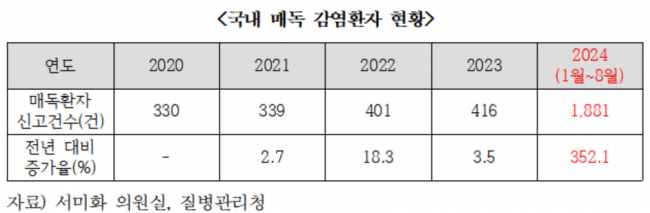
According to Seo Mi-hwa, a member of the National Assembly's Health and Welfare Committee from the Democratic Party of Korea, and the Korea Disease Control and Prevention Agency (KDCA) on the 17th, the number of syphilis-infected patients from January to August this year was recorded at 1,881. By disease stage, there were 838 patients with early latent syphilis, 679 with primary syphilis, 316 with secondary syphilis, and 39 with tertiary syphilis. There were also 9 congenital syphilis cases.

This figure is 4.5 times the total number of syphilis patients last year, which was 416. The number of domestic syphilis patients has been increasing, with 330 in 2020, 339 in 2021, and 401 in 2022.
The KDCA explained that syphilis was under comprehensive surveillance from 2011 to 2019, then switched to sample surveillance from 2020 to 2023, and has returned to comprehensive surveillance this year, so simple statistical comparisons are not possible. Previously, 566 institutions reported only primary, secondary, and congenital syphilis cases, but since syphilis was upgraded to a Class 3 infectious disease in January this year, all medical institutions nationwide have been required to report tertiary syphilis and early latent syphilis cases as well.
A KDCA official stated, "Looking at the 2019 data when syphilis was under comprehensive surveillance in the same manner as this year, the number of patients decreased by about 10% when comparing the same reporting categories over the same period."
Syphilis is caused by infection with the bacterium Treponema pallidum, primarily transmitted through sexual contact, but unlike other sexually transmitted infections, it can also penetrate through blood. About one month after infection, a rash appears at the infection site, and as the bacteria spread throughout the body, rashes develop on the palms and soles. Without proper treatment, the bacteria can remain dormant in the body and cause abnormalities in the heart and nervous system years later, potentially leading to death. If vertically transmitted from a pregnant woman to her fetus, the baby can be born with congenital syphilis.
Syphilis was reinstated as a comprehensive surveillance target this year because it is a long-term transmissible infectious disease with a high likelihood of progressing to severe complications if not treated promptly. The alarming spread of syphilis infections in neighboring Japan was also taken into consideration.
The number of syphilis infections in Japan surpassed 1,000 in 2013 and rapidly increased to the 4,000 range in 2016, the 5,000 range in 2017, and soared to 13,228 in 2022.
The syphilis epidemic is also severe in the United States. In 2022, the number of syphilis infections in the U.S. reached 207,255, the worst level in the past 70 years. In February, Dr. Laura Bachmann of the U.S. Centers for Disease Control and Prevention (CDC) mentioned, "Public health resources have been diverted to emergencies like COVID-19 and mpox, resulting in relatively reduced budget support, threatening the health of sexually transmitted infection victims."
Assemblywoman Seo said, "There are calls for budget support to prevent further transmission of syphilis," adding, "The KDCA currently only supports a portion of travel expenses for epidemiological investigations within the sexually transmitted infection budget related to syphilis."
© The Asia Business Daily(www.asiae.co.kr). All rights reserved.
![Clutching a Stolen Dior Bag, Saying "I Hate Being Poor but Real"... The Grotesque Con of a "Human Knockoff" [Slate]](https://cwcontent.asiae.co.kr/asiaresize/183/2026021902243444107_1771435474.jpg)

















