Claims that essential solutions must be presented instead of superficial stopgap measures
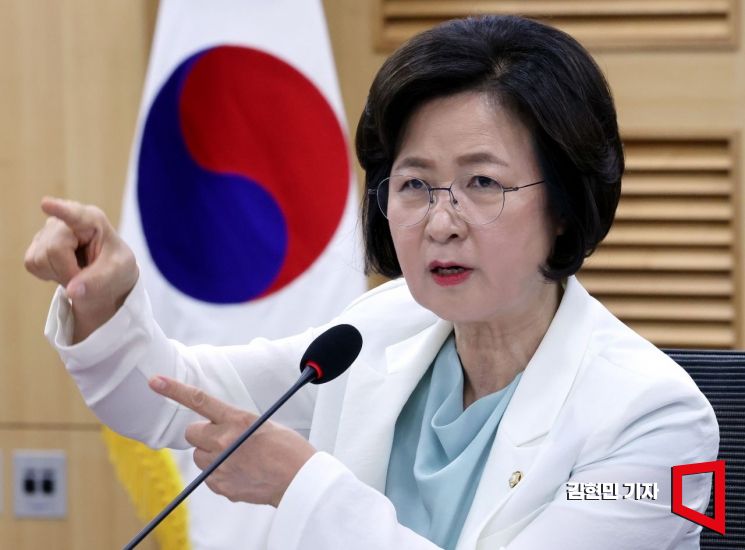 Chu Mi-ae, a member of the Democratic Party of Korea, is speaking at an emergency forum on the promotion of deep-sea oil and gas field exploration and development in the East Sea, held at the National Assembly on the 14th. Photo by Kim Hyun-min kimhyun81@
On the 14th, Chu Mi-ae, a member of the Democratic Party of Korea, revealed that among the four military doctors dispatched to emergency rooms this month, one in four applied to return to their units citing lack of experience and other reasons.
According to data received by Representative Chu from the Ministry of Health and Welfare and the Ministry of National Defense, a total of 250 military doctors have been dispatched since the 4th of this month. Of these, 64, accounting for 25.6%, expressed their intention to return, citing reasons such as having no prior experience working in emergency rooms. In fact, only eight of them were emergency medicine specialists. The majority were from other departments (99), orthopedics (39), and general practitioners without specialist certification (38).
In particular, the initial 15 dispatched personnel were scheduled to work in emergency rooms at Ajou University Hospital, Ewha Mokdong Hospital, Chungbuk National University Hospital, Sejong Chungnam National University Hospital, and Kangwon National University Hospital. However, none of them had emergency medical experience, and Representative Chu reported that 13 out of the 15, except for two, expressed their intention to return.
The Ministry of Health and Welfare and the Ministry of National Defense stated that all military doctors who applied to return will be reassigned to other hospitals. The Ministry of Health and Welfare had initially said it would consult with the Ministry of National Defense on disciplinary measures for dispatched military doctors refusing emergency room duty and requesting to return due to violation of work orders, but later reversed this stance.
Representative Chu said, "The government, which claims that the emergency room rotation fatalities are fake news, is using a trick of simply reassigning military doctors who lack emergency medicine knowledge and have returned by changing their hospitals." She added, "The Yoon Suk-yeol administration must present fundamental solutions instead of superficial stopgap measures to protect the health rights of the people pushed to the brink."
Meanwhile, on the 6th, Representative Chu Mi-ae of the Democratic Party of Korea also disclosed recent five-year data on public health doctors received from the Military Manpower Administration. According to the data, 1,114 public health doctors were enrolled last year. This year, the number dropped by 35.7% (398 doctors) to 716, marking the lowest since 2020. In 2020, 1,318 new public health doctors were recruited, followed by 1,035 in 2021 and 1,050 in 2022.
Accordingly, the total number of public health doctors currently serving decreased by 10.0% (317 doctors) from 3,172 last year to 2,855 as of July this year. Representative Chu's office explained that with nearly 400 fewer public health doctors recruited this year and a similar trend expected next year, the existing scale of about 3,000 public health doctors will decrease to the low 2,000s. Representative Chu pointed out, "Due to the government's irresponsible response, the collapse of regional medical services has already begun, and the temporary dispatch of public health doctors to the metropolitan area is accelerating that collapse."
© The Asia Business Daily(www.asiae.co.kr). All rights reserved.
![Clutching a Stolen Dior Bag, Saying "I Hate Being Poor but Real"... The Grotesque Con of a "Human Knockoff" [Slate]](https://cwcontent.asiae.co.kr/asiaresize/183/2026021902243444107_1771435474.jpg)
















