"Worked Virtually Every Day During Holidays"
Bitter Feelings Even on Rare Home Visits
Specialist Work Increases to Cover Resident Doctor Shortage
"It's been 5 years since I last saw all my relatives during Chuseok. The holiday break used to be so busy that even senior residents without exception had to work." (Resident A, who resigned)
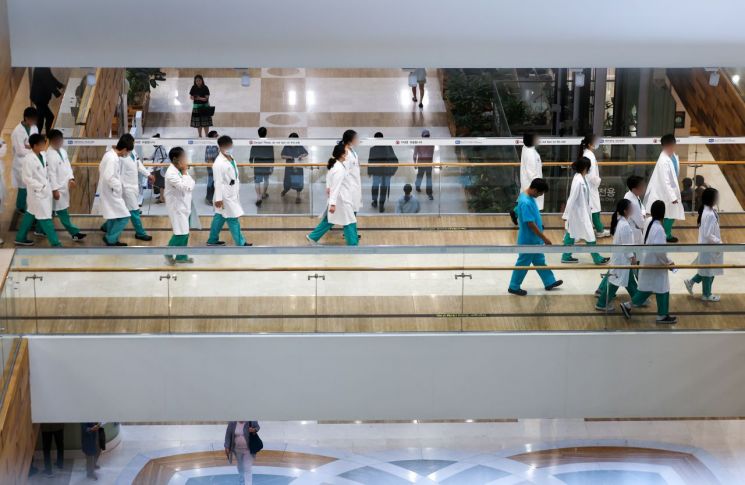
Residents faced their first holiday after resigning and leaving the medical field in protest against the government's medical school expansion policy. During holidays, the number of patients visiting the emergency room usually increases by 2 to 3 times, and residents typically stayed behind to manage patients admitted to the wards. Now that the resigned residents have left the hospital, they said they are finally able to spend a "proper holiday" after several years, but expressed regret over the medical service gaps occurring in many places.
A, who resigned while training in the vital care department (obstetrics, pediatrics, burns, cerebrovascular, etc.) at a tertiary hospital in the metropolitan area, said, "Although there are attending physicians dedicated to inpatient care, they usually do not work during holidays, weekends, or nights. Residents have filled that gap, so we had to come to work almost every day. Visiting relatives during holidays was never possible, and the longer the holiday, the less residents could rest, so we actually hoped for shorter holidays."
Another resigned resident, B, said, "Every holiday, all residents from junior to senior years worked. Although we did not work every day during the holiday, we could never go far because we had to be on standby for patient surges or backup calls from junior residents." B, who recently moved to work at a clinic-level hospital, said, "This holiday, I plan to spend 3 nights and 4 days fully with my family."
Some residents who quit training still remain in emergency medical settings. C, who was an emergency medicine resident at a tertiary hospital in the region, found a job at the emergency room of a general hospital in the same area after resigning. He recalled, "During training, many medical staff had to work during holidays because of the high patient volume, so even senior residents were no exception and came to the hospital."
C added, "Since I got a job at a general hospital emergency room after resigning, I plan to work two out of the three days of this holiday. Because tertiary hospital emergency rooms are not receiving many patients, many patients will likely flock to general hospital emergency rooms, so I will focus on saving the patients right in front of me."
The gap caused by resident resignations has become the burden of medical school professors (specialists). Professor Ko Beom-seok of Seoul Asan Medical Center, who is in charge of public relations for the National Medical School Professors Emergency Response Committee, explained, "In the past, residents mainly managed ward patients during holidays. Professors did not stay on-site unless they were on duty and instead stayed on call for emergencies."
Professor Ko added, "Now that there are patients in the wards, someone has to stay at the hospital. During this holiday period, professors from each department will share the responsibility of managing ward patients."
Professor D of emergency medicine at a general hospital in the metropolitan area said, "Having worked as an emergency physician for over 20 years, I have spent every Lunar New Year and Chuseok at the hospital, so I consider it my fate," but added, "This time, I have to be on duty three times during the five-day holiday, and I just hope nothing serious happens."
© The Asia Business Daily(www.asiae.co.kr). All rights reserved.
![Clutching a Stolen Dior Bag, Saying "I Hate Being Poor but Real"... The Grotesque Con of a "Human Knockoff" [Slate]](https://cwcontent.asiae.co.kr/asiaresize/183/2026021902243444107_1771435474.jpg)
















