40% No-Show Rate for Train Tickets During Holidays Over 6 Years
Urgent Measures Needed... "Cancellation Fees Should Be Raised"
During the fiercely competitive holiday train ticket reservation period, there are urgent calls to prevent 'No Show' and resales. It has been confirmed that 40% of train tickets operated during the holiday seasons over the past six years were no-shows, where reservations were made but passengers did not show up.
On the 14th, Yoo Sang-beom, a member of the People Power Party, cited data received from Korea Railroad Corporation (KORAIL), revealing that a total of approximately 36.48 million tickets for KTX, Saemaeul, and Mugunghwa trains were issued during six Lunar New Year and five Chuseok holiday periods from 2019 to 2024. Among these, about 14.94 million tickets, accounting for 40.96%, were canceled by purchasers and returned to KORAIL.
Earlier, on the 6th, according to data received by Yoon Jong-gun of the Democratic Party from SR, the operator of the Suseo High-Speed Railway (SRT), SR recorded an average sales volume of 557,685 tickets during the same period, with 15% (80,704 tickets) returned.
Returned tickets are resold by KORAIL and SR during certain holiday peak transportation periods. To minimize reservation defaults and provide more opportunities to actual users, KORAIL extended the penalty imposition time for ticket cancellations and returns from 1 hour before departure to 3 hours before in 2018 and also strengthened the fees.
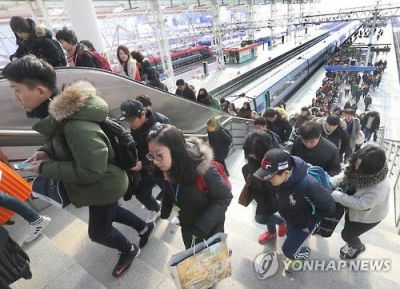 Passengers visiting the train station for homecoming during the Lunar New Year holiday [Photo by Yonhap News]
Nevertheless, a significant number of these tickets remain unoccupied. Of the 4,082,452 tickets sold by KORAIL during this year's Lunar New Year, 46% (1,864,730 tickets) were refunded, and among these, 4% (195,244 tickets) were not resold before the train's departure, effectively resulting in empty seats. SR sold 692,317 tickets during the same period, with 14% (93,949 tickets) returned. Among these, 7.8% (54,139 tickets) were not resold.
Representative Yoo stated, "The repeated no-shows of train tickets during holidays continue to cause inconvenience and harm to citizens," and emphasized, "Fundamental institutional improvements, such as revising KORAIL's standard terms and conditions, are urgently needed." Representative Yoon also urged, "Refunding tickets just before or after train departure is essentially discarding the tickets. During holiday periods, cancellation fees should be increased and measures to raise resale rates should be established."
In addition to canceled tickets and empty seats, unfair ticket trading is also causing headaches for KORAIL and SR. Under the current Railroad Business Act, those who sell tickets to others at prices exceeding their purchase price can be fined up to 10 million KRW. However, since the relevant authorities have not enforced crackdowns, the penalty regulations have become ineffective. According to data from the Ministry of Land, Infrastructure and Transport and Korea Railroad Corporation, there have been zero cases of government crackdowns or fines imposed on KTX scalping over the past 10 years.
In response, SR has conducted crackdowns on unfair ticket trading and registered IPs suspected of using macro programs during the holiday ticket reservation period from the 26th to the 29th in their intrusion prevention system. They are also collaborating with online secondhand trading platforms such as Danggeun, Bunjang, and Junggonara to promote the eradication of unfair ticket trading and strengthen enforcement.
© The Asia Business Daily(www.asiae.co.kr). All rights reserved.
!["The Woman Who Threw Herself into the Water Clutching a Stolen Dior Bag"...A Grotesque Success Story That Shakes the Korean Psyche [Slate]](https://cwcontent.asiae.co.kr/asiaresize/183/2026021902243444107_1771435474.jpg)
















