11 out of 25 Proposed Amendments to the Sanan Act
Includes Introduction of Work Suspension Rights Related to Heatwaves
Inconsistent Heatwave Standards, Unclear Recognition of Force Majeure
As the number of heatwave days increases, there have been successive proposals to amend the Industrial Safety and Health Act to protect on-site workers, with calls to clarify regulations on heatwaves and ensure the effectiveness of government measures. It is necessary to consider appropriate construction periods and construction costs in light of abnormal weather events.
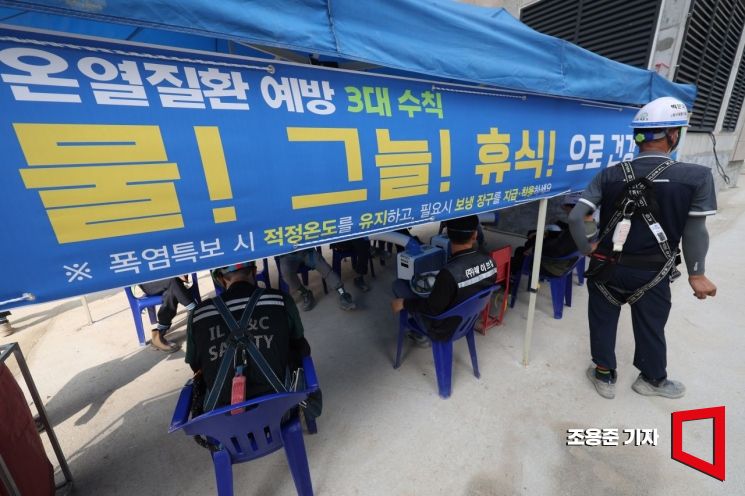 On the morning of the 8th, workers are resting at a heat shelter at the construction site of the Jangwi 4 District Housing Maintenance Project in Seongbuk-gu, Seoul. Photo by Jo Yongjun jun21@
On the 17th, the Construction Industry Research Institute stated in its Construction Trend Briefing, "Since the launch of the 22nd National Assembly, numerous amendments to the Industrial Safety and Health Act have been legislated. To secure the effectiveness of heatwave countermeasures previously announced by central administrative agencies, delegation in the form of administrative rules and the preparation of detailed guidelines are necessary."
This year, 25 amendment bills to the Industrial Safety and Health Act have been proposed since the National Assembly began. Among them, 11 bills include provisions to protect on-site workers during heatwaves and other abnormal weather events, such as △mandatory safety and health measures by employers and △introduction of workers' right to stop work.
The standards for heatwaves, which serve as the basis for exercising the right to stop work, vary. The Korea Meteorological Administration's criterion for heatwave days is a daily maximum temperature of 33 degrees Celsius. The heatwave standard in the heat illness prevention guide announced by the Ministry of Employment and Labor is defined as "a phenomenon where severe heat with a perceived temperature of 31 degrees Celsius or higher continues in a specific area." The heatwave warning criteria in the Enforcement Decree of the Meteorological Act are "when the daily maximum perceived temperature is expected to be 33 degrees Celsius or higher, or 35 degrees Celsius or higher for two or more consecutive days."
The Construction Industry Research Institute pointed out, "Since there is no regulation on the heatwave standard for exercising the right to stop work, a review is necessary. When exercising the right to stop work, extension of the construction period and cost burden are inevitable. If clear standards regarding heatwaves are not presented, disputes over responsibility among contractors, supervisors, and clients may arise."
Heatwave standards also differ among central administrative agencies and individual ministries. The Ministry of the Interior and Safety operates a heatwave crisis alert system divided into four stages (interest to severe) based on △warning zones and △daily maximum perceived temperature. The Ministry of Employment and Labor's heat illness prevention guide has created response guidelines for each of four heatwave risk levels (interest to danger) based on perceived temperature.
The Construction Industry Research Institute criticized that the Industrial Safety and Health Act does not clearly establish heatwaves as a reason for extending construction periods. The Act mentions "typhoons, floods, and other severe weather," but does not include the term heatwave. For penalties not to be imposed for delays and for contract extensions to be granted when construction is delayed due to heatwaves, it is important whether heatwaves are recognized as force majeure. The "General Conditions of Construction Contracts" define force majeure as "typhoons, floods, and other severe weather."
Additionally, the Construction Industry Research Institute pointed out limitations in reflecting the actual number of heatwave days when calculating construction periods. When calculating non-working days during the hot season, the Korea Meteorological Administration's heatwave criterion of maximum temperature (33 degrees Celsius or higher) is used, but since this is based on predicted values derived from past weather data, discrepancies with the actual number of heatwave days at the time of construction are inevitable.
The Construction Industry Research Institute explained, "The Ministry of Employment and Labor's 'Heat Illness Prevention Guide' provides response guidelines such as rest breaks and reduction or suspension of outdoor work based on perceived temperature, so a review of related standards is needed to consider this when calculating working days."
The Construction Industry Research Institute holds the view that heatwave response management should focus on enhancing the effectiveness of existing policies and changing perceptions rather than strengthening regulations. It argues that after effective government measures are established, if corporate responses are inadequate, regulations to sanction or strengthen compliance should be introduced.
The Construction Industry Research Institute stated, "Although there were many victims due to the record-breaking heatwave in 2018, it is somewhat regrettable that efforts by the government and industry to prevent heat illnesses among outdoor workers were insufficient. However, introducing or strengthening new regulations to address this issue could cause further controversy, so caution is necessary."
The Construction Industry Research Institute proposed, "As a consensus has formed mainly among the construction industry and labor groups that appropriate construction periods and construction costs considering heatwaves and other abnormal weather events should precede, prompt government action on this matter is required. Heatwaves and other abnormal weather events should be recognized socially as constants rather than variables in construction projects, and not only should measures to prevent human and material damage be strengthened, but also a shift in social awareness is necessary."
© The Asia Business Daily(www.asiae.co.kr). All rights reserved.
![User Who Sold Erroneously Deposited Bitcoins to Repay Debt and Fund Entertainment... What Did the Supreme Court Decide in 2021? [Legal Issue Check]](https://cwcontent.asiae.co.kr/asiaresize/183/2026020910431234020_1770601391.png)