Price Plunge Amid China’s Economic Downturn
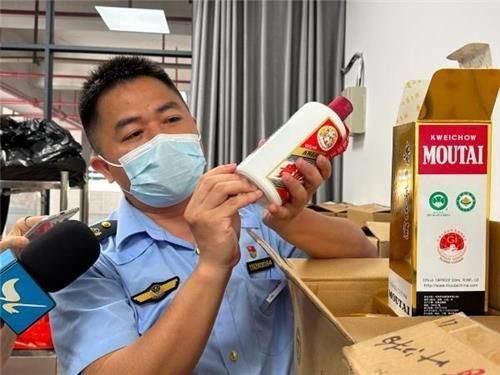
One of China's representative premium liquors and the most popular Chuseok gift is Maotai (茅台) produced by Guizhou Maotai. Guizhou Maotai surprised the world in September 2020 by recording a market capitalization higher than Samsung Electronics. It was also famous as the company with the highest market capitalization in China. However, the company's stock price is currently at its lowest point of the year, suffering humiliation as its market capitalization fell from first to fourth place.
On the 12th (local time), Chinese baijiu price site 'Jinrizhu Jia (今日酒價)' reported that the wholesale price of Maotai's main product, the 53-degree Feitian (飛天) 500ml bottle, was 2,380 yuan (about 445,800 KRW) per bottle as of that day. The current market price is about 40% lower compared to 4,000 yuan (about 750,000 KRW) traded in February 2021. In China, Maotai is not just a simple liquor. It is a product with a market like stocks or gold, where prices fluctuate according to supply and demand. The sharp drop in Maotai prices, which had been continuously soaring, is seen as an event that reflects the crisis in the Chinese economy.

Maotai, regarded as the best liquor by Chinese people, is a representative famous liquor made in the Maotai region of Guizhou Province by steaming sorghum nine times, fermenting the starter eight times, and distilling seven times. It has a good aroma and taste and is loved by many drinkers because it does not cause hangovers even after drinking a lot. The reason it is expensive is that only liquor made in the 'Maotai' village is recognized as genuine 'Maotai-ju.' Even if the same raw materials and methods are used in other regions, it is treated as counterfeit Maotai. The Maotai village is a clean area without dams or factories. It is said that microorganisms floating in the air of this village create the unique aroma and taste of Maotai-ju. At the beginning of this year, Maotai was traded at over 2,800 yuan (about 527,000 KRW) during the Spring Festival (Lunar New Year). In the local Chinese liquor market, there is talk that "this year's Mid-Autumn Festival baijiu market is the coldest in the past 10 years."
As domestic demand in China continues to slow, even the liquor market, which was a representative product ahead of the major holidays of the Mid-Autumn Festival (September 15?17) and National Day holiday (October 1?7), has completely frozen and shows no signs of recovery.
In China, Maotai holds a meaning beyond just liquor. Most products decrease in price over time. However, there are products whose economic value rises over time. These are so-called luxury goods. Maotai was a product that defied time. Along with economic growth, a perception took root among the people that it was similar to real estate, whose price endlessly rises. Treated as an investment asset, Maotai became widely believed to be a guaranteed way to make money once purchased, leading to hoarding behavior and even financial institutions lending money using Maotai as collateral.
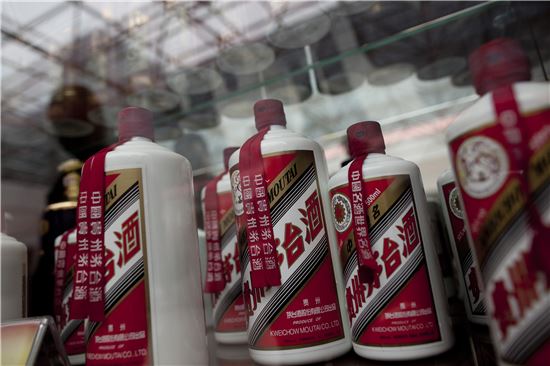 Maotai, known as the national liquor of China (Photo by Bloomberg News).
Usually, the longer it ages, the higher the price. At an auction held in Guizhou Province, China, in 2011, a 1992 vintage Maotai was sold for 1.476 billion KRW. Some analysts say that besides domestic demand contraction, the Chinese government's intensified anti-corruption campaign has also affected the decrease in liquor sales. Maotai and other Chinese premium liquors have been typical holiday gifts and simultaneously served as expensive 'bribes' among government and corporate officials.
In 2017, a symbolic incident occurred when 4,000 bottles of Guizhou Maotai-ju were found at the home of Wang Xiaoguang (王曉光), former vice governor of Guizhou, who was under investigation for corruption charges. At that time, Maotai served at official banquets cost about 220,000 KRW per bottle. The price of 4,000 bottles was at least 880 million KRW. He was arrested while trying to dispose of Maotai-ju down the toilet drain and stepped down from his vice governor position.
Following such incidents, at the end of 2023, China's top disciplinary body, the Central Commission for Discipline Inspection, stated that "corruption is taking new forms, making detection difficult, and there is a risk of resurgence in corruption cases." It announced strengthened supervision focusing on new corruption methods such as bribe-taking via smartphone AirDrop, excessive fees for lectures and consulting, and expensive gifts like liquor, mooncakes, and cigarettes.
Meanwhile, the China Securities Journal recently analyzed that Maotai Group increased direct sales, expanded e-commerce sales channels, and that large state-owned enterprises conducted bulk joint purchases of Maotai in the first half of this year, flooding the market with low-priced Maotai products and causing prices to fall. In particular, Inher Securities forecasted that speculators, fearing further price drops amid the recent Maotai decline, dumped large quantities of previously hoarded stock, causing a sharp price drop, but once this excess supply is resolved, Maotai prices will return to their original levels.
© The Asia Business Daily(www.asiae.co.kr). All rights reserved.
![Clutching a Stolen Dior Bag, Saying "I Hate Being Poor but Real"... The Grotesque Con of a "Human Knockoff" [Slate]](https://cwcontent.asiae.co.kr/asiaresize/183/2026021902243444107_1771435474.jpg)












