Free Currency Exchange as Standard, Additional Benefits and Currency Types Are Key
With the end of the COVID-19 pandemic and the lifting of restrictions on overseas travel, the market for travel-specialized cards (travel cards) is rapidly growing. In particular, the card industry’s expectations for a ‘travel boom’ are increasing as the 34-year hiatus of the October 1st Armed Forces Day being designated as a temporary holiday coincides with the long Chuseok holiday.
According to the ‘2024 Chuseok Holiday Overseas Travel Intention Survey’ conducted by Incheon International Airport Corporation from the 1st to the 7th of last month targeting 1,270 citizens aged 18 or older who have traveled abroad through Incheon Airport within the last five years, 11.2% of all respondents said they plan to travel overseas during the holiday. This is the highest figure since the first survey was conducted in 2020. Incheon Airport Corporation expects an average of 201,000 people per day to use Incheon Airport from the day before until the 18th.
Using travel cards during overseas travel in the Chuseok holiday helps save travel expenses. Travel cards are useful when making payments with the card abroad or withdrawing cash from local ATMs when cash is needed. Most of these products do not charge fees for currency exchange or overseas ATM withdrawals. However, since the card industry has competitively launched travel cards this year, there are differences in additional benefits, supported currencies, and re-exchange fees.
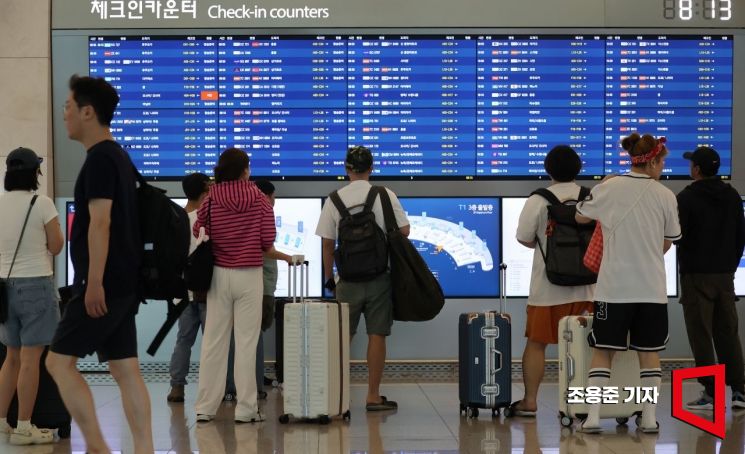 On the 13th, one day before the Chuseok holiday, Incheon International Airport Terminal 1 departure hall is bustling with crowds heading overseas for the holiday period. Photo by Jo Yongjun jun21@
First is Hana Card’s ‘Travelog Check Card,’ which holds about 50% of the overseas check card market share. The Travelog supports a total of 58 currencies, the most among related cards. This includes popular travel countries such as the United States, Europe, and Japan, as well as Colombia, Algeria, and Ethiopia. A 1% fee is charged on re-exchange, but if leftover foreign currency is sent to another Travelog user, it can be transferred free of charge.
Next, KB Kookmin Card’s ‘Travelers Check Card’ supports many currencies for exchange. Travelers supports 56 currencies worldwide. A 1% fee is charged on re-exchange, but a 100% exchange rate preferential benefit is provided until the end of this year.
There are also travel cards that pay interest on leftover foreign currency. Shinhan Card’s ‘SOL Travel Check Card’ and Woori Card’s ‘Wibee Travel Check Card’ pay interest on foreign currency balances in US dollars (2% per annum) and euros (1.5% per annum), and offer a 50% preferential exchange rate on re-exchange. The number of supported currencies is 42 for SOL Travel and 30 for Wibee Travel, respectively.
If the fee charged when converting foreign currency back to Korean won is a burden, you can use Toss Bank’s foreign currency account. Toss Bank introduced a foreign currency account in January, making both exchange fees and re-exchange fees free. It supports 17 currencies.
If you do not want to open a new bank account to use travel cards, you can use the services of Travelwallet, a fintech (finance + technology) company. Travelwallet first launched the foreign currency prepaid card ‘Travelwallet Card’ in February 2021, entering the travel card market about 1 to 3 years ahead of card companies affiliated with the five major financial groups. It supports up to 46 currencies for exchange, and also offers an ‘N-bbang Payment’ feature that makes Dutch pay convenient. This system allows multiple people to split the payment in advance when paying together.
© The Asia Business Daily(www.asiae.co.kr). All rights reserved.

















