August International Finance and Foreign Exchange Market Trends
Stock Investment Funds Turn Net Outflow for the First Time in 10 Months
Bond Investment Funds Reach Largest Scale Since May Last Year
Due to uncertainties surrounding the growth of the global artificial intelligence (AI) industry, foreign investors sold approximately 2.47 trillion won worth of domestic stocks last month.
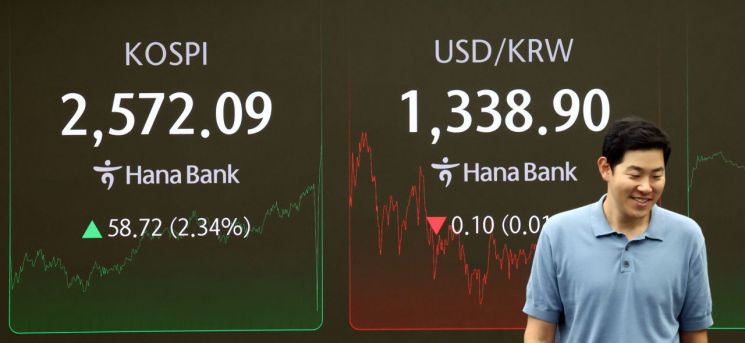
According to the "International Finance and Foreign Exchange Market Trends since August" report released by the Bank of Korea on the 13th, foreign investment funds in domestic stocks recorded a net outflow of 1.85 billion USD in August.
Based on the won-dollar exchange rate at the end of last month (1,336 won), this amounts to about 2.47 trillion won.
This marks the first net outflow of foreign investment funds in domestic stocks in 10 months since October of last year.
A Bank of Korea official explained, "Due to uncertainties about the growth potential of the global AI industry, selling in the electric and electronics sectors expanded, resulting in a net outflow for the first time since October last year."
On the other hand, foreign investment funds in bonds saw a significant increase in net inflow, reaching 5.47 billion USD, compared to 380 million USD last month. This is the largest amount since May of last year. The increased volatility in international financial markets has expanded incentives for short-term arbitrage, leading to a substantial rise in net inflows, mainly in short-term bond investments.
Foreign bond investment funds have maintained a net inflow trend for five consecutive months, with 2.12 billion USD in April, 2.77 billion USD in May, 370 million USD in June, and 380 million USD in July.
The won-dollar exchange rate sharply declined from 1,376.5 won at the end of July to 1,336 won at the end of August, a drop of 40.5 won. As of the 11th of this month, it slightly rose to 1,339 won.
The Bank of Korea stated, "The won-dollar exchange rate fell influenced by the dollar's weakness following the dovish July Federal Open Market Committee (FOMC) meeting results and Federal Reserve Chairman Jerome Powell's speech at Jackson Hole."
The volatility of the won-dollar exchange rate increased compared to the previous month. The daily fluctuation of the won-dollar exchange rate in August was 5.8 won, larger than July's 3.3 won. The volatility rate was 0.43%, up from 0.24% in July.
The credit default swap (CDS) premium for South Korean government bonds (based on the 5-year Foreign Exchange Stabilization Fund bonds) averaged 35 basis points (1bp = 0.01 percentage points) in August, down 1bp from 36bp in the previous month.
CDS are financial derivatives that act as a type of insurance, compensating for losses if the issuing country or company defaults. Generally, if the economic risk of the country increases, the premium also rises.
© The Asia Business Daily(www.asiae.co.kr). All rights reserved.

















