Government, Economic Trends September Issue...Strengthening Views on Price Stability
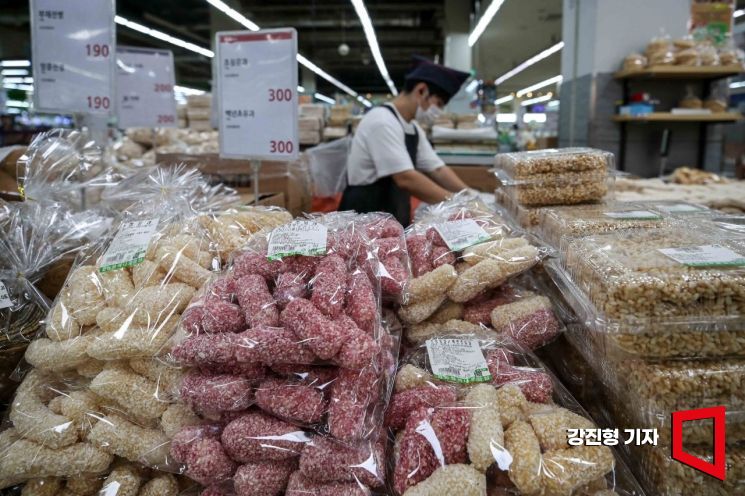 On the 5th, ahead of the major national holiday Chuseok, a merchant is busily making Hangwa at Hanaro Mart Yangjae Branch in Seocho-gu, Seoul. Photo by Jinhyung Kang aymsdream@
The government has maintained its economic assessment that domestic demand recovery is continuing for the fifth consecutive month. Although indicators have emerged showing retail sales have fallen to levels seen four years ago, triggering successive warning signs in domestic demand, the government has not abandoned its optimistic view. The assessment that price stability is continuing has been further strengthened.
On the 13th, the Ministry of Economy and Finance stated in the September issue of the 'Recent Economic Trends (Green Book)' that "Our economy is experiencing an expanding trend of price stability, with a steady recovery centered on exports and manufacturing continuing, and signs of a gradual domestic demand recovery centered on facility investment and the service sector, although there are differences in the pace across sectors."
The assessment of prices has gradually brightened from 'price stability' (July) to 'overall price stability' (August), and 'expanding price stability' (September). Last month, consumer prices rose by only 2.0% compared to a year earlier, and fell by 0.6 percentage points compared to July, marking the lowest increase in three years and five months since March 2021 (1.9%). Although price strength in grocery items such as vegetables and fruits continues, and consumer-perceived price burdens remain ahead of Chuseok, it is evaluated that the prolonged high inflation trend since the COVID-19 pandemic has reached a stable zone.
The assessment of the domestic demand recovery trend is similar to last month. The government began mentioning signs of domestic demand recovery starting in May. While the government had maintained the view that domestic demand was not keeping pace with export recovery, from May it began to express that "signs of domestic demand recovery are visible," and although it added the term "gradual" last month due to weak consumption indicators, it maintained the view of a domestic demand recovery trend.
The government cited facility investment and the service sector as grounds for its optimistic domestic demand assessment. Facility investment in July increased by 10.1% compared to the same month last year. This was thanks to the introduction of eight medium-to-large aircraft, which led to a 50.5% increase in transportation equipment investment. This was interpreted as a positive factor in economic recovery, showing a trickle-down effect where export market improvement leads to expanded facility investment. Kim Gwi-beom, head of the Economic Analysis Division at the Ministry of Economy and Finance, said, "We see the export market improvement as following the usual economic recovery path, leading to improved corporate performance, expanded facility investment, and increased real income."
However, contrary to the government's perception, warning signs continue to appear in retail sales and production indicators closely related to domestic demand. Among the service sectors the government is optimistic about, production in accommodation and food services, closely linked to domestic demand, decreased by 2.8% compared to the previous month. Last month's retail sales index (100.6) was the lowest since July 2020 (98.9), when consumption shrank due to pandemic shutdowns, falling to levels seen four years ago. Although facility investment improved, machinery and equipment investment decreased by 1.6%. Construction performance also declined by 1.7%, with civil engineering (-8.9%) construction results decreasing.
Therefore, experts point out that for the government to gain further confidence in economic recovery, it is necessary to confirm that domestic demand is transitioning to growth, including private consumption such as household spending and construction investment, rather than relying on sustained export strength and temporary expansion of facility investment. The Korea Development Institute (KDI), a government-funded research institute, evaluated on the 9th that "Despite strong exports, domestic demand recovery has not materialized as retail sales and construction investment remain sluggish." It also diagnosed that "Given the accumulated sluggishness in leading indicators of construction investment, construction investment and related employment are likely to continue to be weak for the time being, constraining domestic demand recovery."
© The Asia Business Daily(www.asiae.co.kr). All rights reserved.
![From Bar Hostess to Organ Seller to High Society... The Grotesque Con of a "Human Counterfeit" [Slate]](https://cwcontent.asiae.co.kr/asiaresize/183/2026021902243444107_1771435474.jpg)
















