July Card Loan Balance Hits Record High of 41 Trillion Won
'Quick Cash Window' Insurance Policy Loans Increase by 1.3 Trillion Won
Auto Secured Loans Show Rising Trend Since Early Year
With the prolonged high interest rates, low-income households are increasingly turning to so-called 'recession-type loans.' Recession-type loans refer to loans primarily used by low-credit borrowers who find it difficult to obtain loans from commercial banks, such as card loans, insurance policy loans, and auto-secured loans.
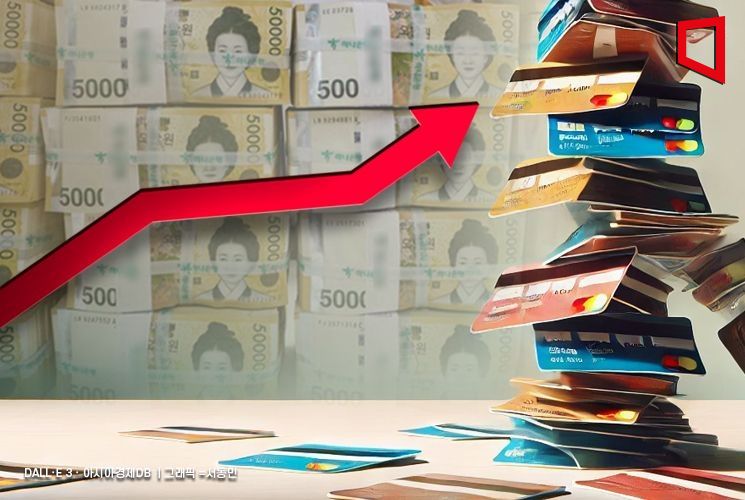
According to the Credit Finance Association on the 17th, the outstanding balance of card loans at nine domestic card companies (Samsung, Shinhan, KB Kookmin, Lotte, Hana, Hyundai, BC, NH Nonghyup, and Woori) amounted to 41.2265 trillion won as of the end of July. The previous month’s balance was 40.6059 trillion won, which was the highest ever recorded, and this figure has been surpassed again. Compared to the card loan balance of 38.1872 trillion won in July last year, it has surged by more than 3 trillion won in one year.
Since card loans are a representative type of recession-type loan, the risk of default is high. There is no separate loan screening process, so anyone with a card can easily use it, but the average loan interest rate reaches 14-15% per annum. As a result, the scale of 'rollover'?where borrowers who fail to repay card loans on time take out new card loans?has approached 2 trillion won. The outstanding balance of refinancing loans, which are a form of rollover, was 1.851 trillion won as of the end of July, an increase of more than 400 billion won compared to 1.4361 trillion won in the same period last year.
The outstanding balance of insurance policy loans, also considered recession-type loans, is also rapidly increasing. According to data from the Financial Supervisory Service, the outstanding balance of insurance policy loans at insurance companies was 70.2 trillion won as of the end of the second quarter this year, up 1.3 trillion won from the same period last year. Insurance policy loans allow borrowers to receive up to 95% of the surrender value within the scope of the surrender refund when canceling the contracted insurance. Unlike banks, which require complicated documentation, these loans can be obtained without separate screening. As of last month, the average interest rate on insurance policy loans was around 4-8%.
Demand for auto-secured loans has also been on the rise. Auto-secured loans are products used when urgent funds are needed to the extent that the borrower is willing to pledge their car as collateral, and they are considered the last resort for low-income borrowers. According to data extracted by Asia Economy from Finda, a loan brokerage fintech (financial technology), the number of auto-secured loan limit inquiries on Finda last month reached 3,202,455. The number of limit inquiries, which was around 1.6 million at the beginning of this year, exceeded 2.5 million in March and surpassed 3 million in June.
A financial industry official explained, “The increase in the outstanding balance of recession-type loans used by borrowers living on tight budgets indicates that the recent economic situation is that difficult,” adding, “It appears that low-credit borrowers who find it difficult to get loans from banks are turning to card companies and insurance companies just before being driven to illegal private loans.”
© The Asia Business Daily(www.asiae.co.kr). All rights reserved.
![Clutching a Stolen Dior Bag, Saying "I Hate Being Poor but Real"... The Grotesque Con of a "Human Knockoff" [Slate]](https://cwcontent.asiae.co.kr/asiaresize/183/2026021902243444107_1771435474.jpg)
















