Current Average Corporate Tax Rate of Top 100 Companies at 2.6%
Raising Corporate Tax to Offset Federal Revenue Deficit
Targeting Companies with Annual Profits Over $1 Billion
"Minimum Tax Increase Plan Dependent on November Election"
 [Image source=AFP Yonhap News]
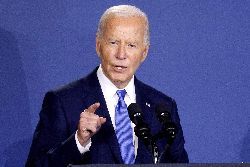
The Joe Biden administration in the United States has announced a draft of new rules imposing a 15% minimum corporate tax on large corporations. The current federal corporate tax rate is 21%, but large corporations have paid much less than this by receiving various tax credits under the guise of investments and other reasons.
If the new tax law is finalized, big tech companies such as Apple and Amazon are expected to be directly impacted. With less than two months remaining until the U.S. presidential election, the direction of the corporate tax rate for large corporations will likely depend on which party, Republican or Democrat, wins the presidency.
The U.S. Treasury Department on the 12th (local time) released a 600-page draft of new minimum corporate tax (CAMT·Corporate Alternative Minimum Tax) rules aimed at raising corporate taxes on the top 100 corporations. The core point is to impose a 15% minimum corporate tax on companies earning more than $1 billion annually.
The current U.S. federal corporate tax rate was set at 21% during the Trump administration in 2017. However, companies receive much lower corporate tax bills thanks to federal tax credit rules that allow deductions for losses incurred from infrastructure improvements, research and development (R&D), and other activities. According to the Treasury Department, the average federal corporate tax rate paid by the top 100 corporations is only 2.6%. In fact, 60% of the top 100 corporations pay less than 1% in corporate taxes.
The Biden administration has been working to raise corporate taxes to offset the federal revenue deficit caused by the hundreds of billions of dollars in clean energy tax credits resulting from the implementation of the Inflation Reduction Act (IRA) in 2022.
The Treasury Department expects that if the proposed increase in the minimum corporate tax rate for large corporations is finalized, it will generate about $250 billion in tax revenue over the next 10 years. The Treasury Department is collecting feedback on the proposed new minimum tax rules until December 12 and plans to implement them next year.
The business community is expressing concern. Neil Bradley, Senior Vice President of the U.S. Chamber of Commerce, said in a statement, "Imposing taxes based on accounting income will distort and complicate the tax code, making it difficult for companies to invest directly in future economic growth, which will result in hindering job creation and innovation."
In this regard, Ruben Avi-Yonah, a tax law professor at the University of Michigan, said, "It appears that the Treasury Department has blocked several key avenues companies use to lower their tax bills," and added, "If the Treasury Department sticks to this, it could face corporate lawsuits."
The Washington Post (WP) reported that the fate of this new plan to increase the minimum corporate tax for large corporations will depend on the outcome of the November presidential election. This is because the Republican and Democratic presidential candidates have completely opposite views on corporate tax policy.
Republican presidential candidate former President Trump has emphasized lowering the corporate tax rate, pledging a rate of 15%, which is lower than the current 21%. Meanwhile, Democratic presidential candidate Vice President Kamala Harris supports raising the corporate tax rate to 28%, higher than the current rate, to provide new tax relief for small businesses and low-income groups.
© The Asia Business Daily(www.asiae.co.kr). All rights reserved.
![Clutching a Stolen Dior Bag, Saying "I Hate Being Poor but Real"... The Grotesque Con of a "Human Knockoff" [Slate]](https://cwcontent.asiae.co.kr/asiaresize/183/2026021902243444107_1771435474.jpg)















