"Mutual Cooperation in Key Strategic Areas" Agreement Signed
Production Costs Down, Efficiency Up, Rapid Delivery to Customers
Hyundai Motor Company and the American General Motors (GM) announced on the 12th that they have established a 'comprehensive cooperation.' Although it is at the level of a non-binding Memorandum of Understanding (MOU) without disclosing specific methods, fields, or strategies, the completed car industry is closely watching how this cooperation will unfold.
Until a few years ago, each company was profitable, but as the shift to electrification accelerated, a flurry of mergers and alliances emerged. Recently, due to the impact of the chasm (temporary demand slowdown), the process of separating the wheat from the chaff has become clearer. We examine what stands out in this cooperation.
Enhancing Purchasing Negotiation Power to Reduce Costs
The most realistic and fastest area for cooperation and results is the plan to jointly procure raw materials. Procuring raw materials at the right time and at reasonable prices is directly linked to a company's competitiveness and profitability. The two companies stated, "We will review integrated sourcing plans for battery raw materials, steel, and other materials."
In manufacturing, buyers often hold the dominant position, and this is even more pronounced in the completed car industry. Hyundai and GM, which sell millions of vehicles annually, have strong buying power, but this has not been the case in the electrification era.
In particular, for batteries, which are key components determining electric vehicle performance, battery cell manufacturers and various raw material suppliers often held the upper hand in price negotiations. This cooperation is interpreted as an attempt to offset that by increasing scale.
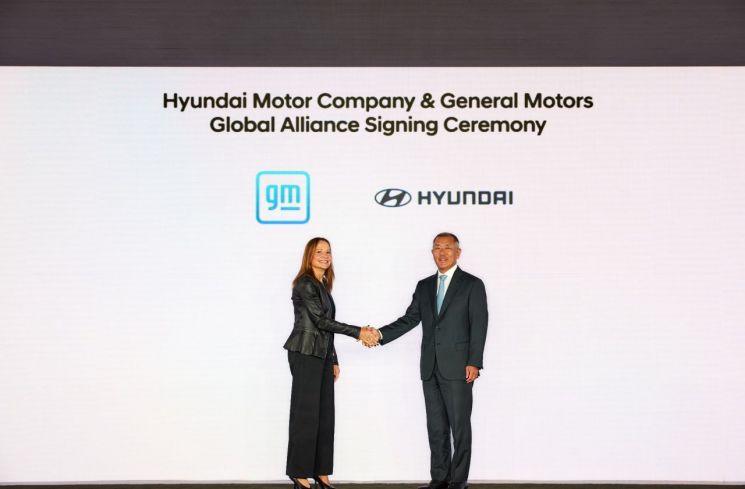 Chairman Chung Euisun of Hyundai Motor Group (right) and Mary Barra, CEO of GM, are posing for a commemorative photo after signing a comprehensive cooperation agreement.
 [Photo by Hyundai Motor Group]
Increased Need for Internal Combustion Engines Amid Electrification Pace Adjustment
It is also notable that they explicitly agreed to jointly develop and produce internal combustion engines. Until now, many cases involved sharing electric or hybrid platforms or jointly developing new electric vehicles in line with the electrification trend. Some automakers have even declared that they will stop producing internal combustion engine vehicles around 2030. Developing or refining engines that use fossil fuels was seen as going against the times.
Hyundai and GM's decision to cooperate on internal combustion engine development and production is interpreted as a recognition that the slowdown in electric vehicle demand may persist for a long time. Electric vehicle prices are falling more slowly than expected, and expanding charging infrastructure is not something that can be solved by willpower alone.
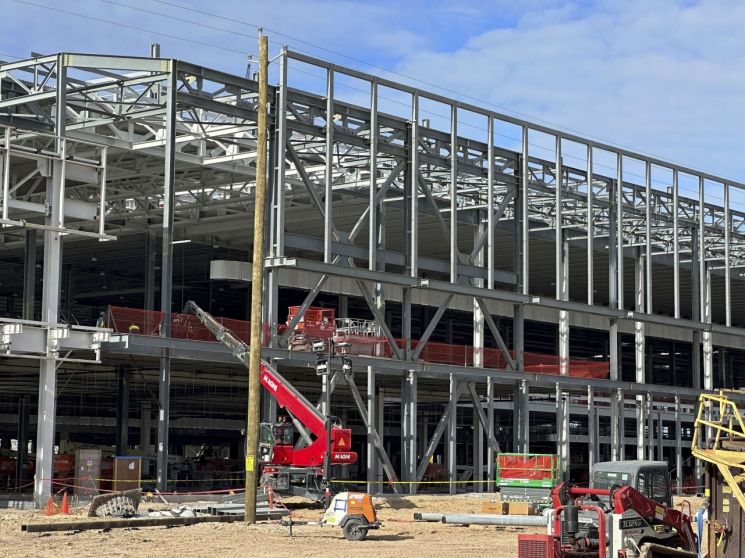 Hyundai Motor Group is building a new factory, HMGMA, in Georgia, USA. Originally planned as an electric vehicle-only plant, the plan was changed to also produce hybrid vehicles.
 [Photo by Yonhap News, AP]
Traditional American and European automakers such as GM, Ford, and Stellantis have postponed new electric vehicle development or reduced production of previously launched electric vehicles. Volkswagen, competing with Toyota for the top spot globally, has undertaken restructuring, including closing factories in its home country. While the direction toward electrification is correct, profitability has plummeted, putting these companies at risk of survival. Over the past two to three years, they have witnessed the rapid electrification transition benefiting mainly Chinese electric vehicle makers.
Hyundai recently decided to launch extended-range electric vehicles (EREV) in the U.S. and China as early as the year after next. They are also refining hybrid systems by increasing engine displacement or applying rear-wheel drive. For GM, this presents an opportunity to improve its relatively less advanced hybrid systems.
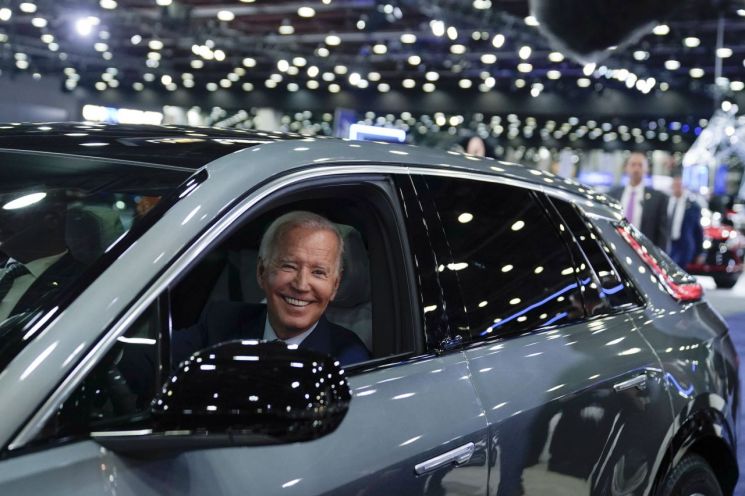 U.S. President Joe Biden participated in the 2022 Detroit Auto Show and took the wheel of the electric vehicle Lyriq, made by GM's luxury car brand Cadillac.
 [Photo by Yonhap News, AP]
Saving Trillion-Won Investments by Utilizing Each Other’s Factories
The agreement to cooperate not only in joint development but also in production is noteworthy. Typically, final vehicle assembly plants need to support production volumes of around 300,000 units to be economically viable, requiring investments worth trillions of won. The involvement of numerous partner companies also adds to the burden.
If joint production is realized, Hyundai can leverage GM’s infrastructure, which has factories evenly distributed across the Americas, including the U.S., Mexico, Brazil, and Argentina. Conversely, GM can use Hyundai’s facilities in Europe and India, regions from which it previously withdrew.
Local production of completed vehicles is advantageous in terms of reducing transportation costs and taxes, thus helping improve profitability. The key is whether they can efficiently handle the preparation and production processes of mass production lines. Mixed production, where various models are manufactured on the same line, allows flexible response to market demand but requires a tightly knit parts supply system. Releasing jointly developed new vehicles under different brands or model names could also backfire depending on market conditions.
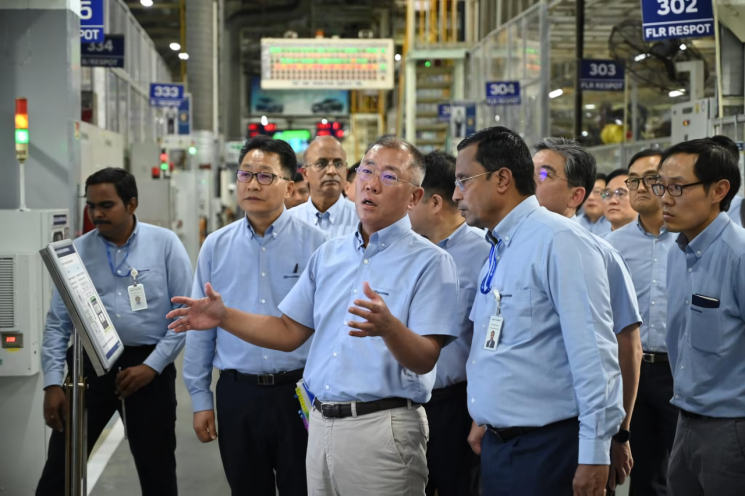 In August last year, Chung Eui-sun, Chairman of Hyundai Motor Group, visited the India factory.
 [Photo by Hyundai Motor Group]
© The Asia Business Daily(www.asiae.co.kr). All rights reserved.
![Clutching a Stolen Dior Bag, Saying "I Hate Being Poor but Real"... The Grotesque Con of a "Human Knockoff" [Slate]](https://cwcontent.asiae.co.kr/asiaresize/183/2026021902243444107_1771435474.jpg)


















