The National Tax Service (NTS) plans to implement appraisal-based taxation for ultra-high-end apartments and detached houses, where market price assessment has been difficult and caused fairness controversies in inheritance and gift tax cases. It will also actively respond to malicious tax evasion such as in the secondhand market and online platforms, following the principle of selection and concentration.
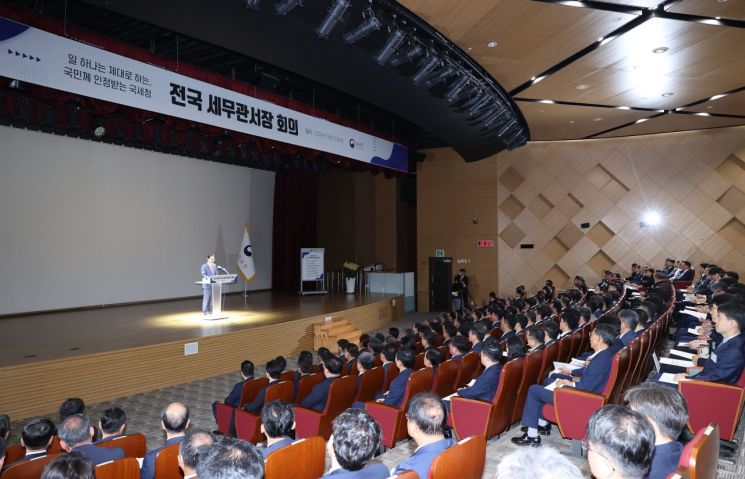
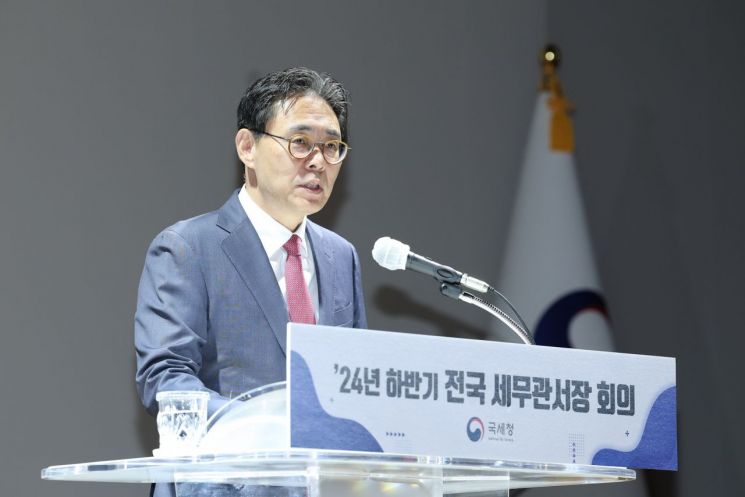
On the 12th, Kang Minsu, Commissioner of the NTS, presided over the first nationwide tax office chiefs meeting since his inauguration at the Sejong Government Complex, discussing these national tax administration operation plans.
Tax audits will be maintained at levels similar to previous years but managed flexibly in terms of annual cases considering economic conditions and manpower. The number of tax audits has remained around 13,000 to 14,000 cases since recording 16,008 cases in 2019 and 13,973 cases last year.
The NTS plans to investigate malicious tax evasion, including acts of private gain such as rebates, until proper accountability is assigned, based on the principle of selection and concentration. Specific examples include illegal use of non-public information for the benefit of family owners, distortion of the secondhand market, illegal multi-level marketing, and false advertising of health products.
Tax evasion on online platforms such as omitted YouTuber advertisements and irregular issuance and trading of virtual assets through overseas exchanges are also key targets for tax authorities' intensive verification.
Tax infrastructure circumvention transactions exploiting unregistered payment gateway (PG) operators and abnormal transactions in planned real estate are also prioritized for management.
However, small taxpayers will be generally excluded from simplified investigations to reduce their burden. The NTS plans to introduce enforcement fines for obstructive acts such as refusal to submit documents by multinational corporations.
Currently, foreign corporations refusing to submit documents can be fined, but the NTS explains that many cases involve paying fines yet continuing to refuse submission. Unlike fines that can be imposed only once, enforcement fines can be repeatedly applied as sanctions.
The offshore tax evasion response system will be strengthened by, for example, mandating submission of domestic stock transfer data between foreign corporations. Intelligent asset concealment detection will also be enhanced through external data linkage analysis such as patents and mortgages, and antique tracking systems. High-value foreign car lease deposits and false mortgage registrations are also major analysis targets.
At the meeting, plans to efficiently redesign existing tax administration tasks to support securing national fiscal revenue were also discussed. For small buildings taxed based on the standard price rather than market price, appraisal will be significantly expanded to improve fairness in inheritance and gift tax taxation.
Ultra-high-end apartments, detached houses, and mixed-use commercial-residential houses, where market price assessment is difficult, will also be added to appraisal targets to encourage sincere reporting.
The NTS currently taxes non-residential real estate with an estimated market price difference of 1 billion KRW or more, or a difference of 10% or more compared to the estimated market price, based on appraisal at market price rather than standard price. According to this policy, the NTS expects the number of appraisals, which was about 185 cases annually, to increase by around 200 cases.
System innovations will be made to restrict access to dependent family data not eligible for deductions during year-end tax settlements, thereby preventing excessive and duplicate deductions at the source.
Simplified filing will be expanded, including the introduction of interactive inheritance tax filing services. A simplified claim system will also be developed that pre-fills the status of gifted property during gift tax filing and allows online filing of comprehensive real estate tax correction claims.
An AI and big data-based tax evasion detection system will be introduced starting with the selection of regular audit targets this year and will be utilized for irregular audit selections in the future. AI national tax consultation will also be expanded to all major tax categories.
Commissioner Kang stated, "We will successfully accomplish our core duties of securing national resources and ensuring fair taxation."
© The Asia Business Daily(www.asiae.co.kr). All rights reserved.
![Clutching a Stolen Dior Bag, Saying "I Hate Being Poor but Real"... The Grotesque Con of a "Human Knockoff" [Slate]](https://cwcontent.asiae.co.kr/asiaresize/183/2026021902243444107_1771435474.jpg)

















