Part-time Workers Standing Without Worry
Japanese Arubaito Company Designs Directly
A chair with a bizarre shape designed in Japan recently became a hot topic on social networking services (SNS). The chair's form is very simple. It consists only of a top board placed on two legs.
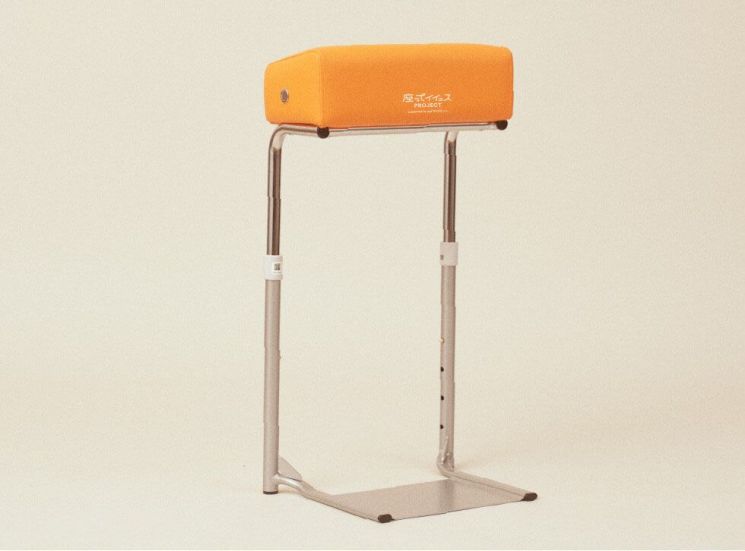
However, upon closer inspection, something looks unnatural. The chair is designed to be higher than a person's sitting height. Because of this, when sitting on the chair, one adopts a slanted posture that is neither sitting nor standing. Why was such a chair created?
A chair that makes you take a strange posture?why was it made?
A chair that makes you take a posture that is neither sitting nor standing may seem contradictory at first glance. It doesn't look like a person sitting on this chair would be very comfortable. However, after being unveiled recently in Japan, this chair reportedly received praise from numerous media outlets and netizens.
The company that designed the chair is 'My Navi Baito,' a Japanese job search platform. It is an app for finding part-time jobs, similar to Korea's 'Alba Cheonguk' or 'Danggeun.' The chair, which the platform directly commissioned, is said to be the result of the so-called 'Stay Seated Project.'
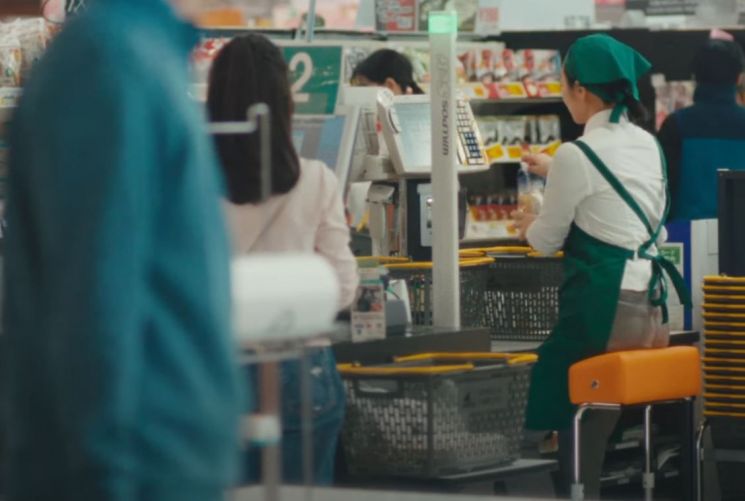 When sitting on a Navibyte chair, you tend to adopt this kind of slanted posture. [Image source=YouTube capture]
For face-to-face service workers in convenience stores, pharmacies, restaurants, and the like, standing while serving customers is a basic principle. Even though consumers have become more lenient toward service workers, this basic principle has not changed. Moreover, workers themselves often stand throughout their working hours to provide friendly service. Navi Baito devised this chair as a form that compromises with these practical limitations while maximizing the convenience of service industry workers.
When sitting on the chair, the slanted posture makes the worker appear to be standing to the person across the counter. Also, workers do not need to stand up every time a customer enters. For elderly part-time workers with knee joint discomfort, this chair is actually much more comfortable.
"Even if a sitting culture is created immediately... people will still stand while working out of consideration"
Through the 'Stay Seated Project' chair, Navi Baito conveyed the intention to "expand the possibilities of labor." The chair's planner gave an interview to a Japanese media outlet last May.
When asked by the interviewer, "What was the purpose of making such a chair?" the planner replied, "It is to understand how the chair affects the physical and psychological state of workers," adding, "If we hear positive voices from the field, companies that have not placed chairs in workplaces will also adopt them."
 The Nevibyte chair is designed with a focus on "preventing employees from feeling pressured by customers."
 [Image source: Nevibyte official website]
To introduce a 'sitting culture' in Japan's face-to-face service industry, the planner gave the chair three functionalities. The first was that "both standing and sitting postures should be comfortable," the second was that "it should be light and easy to store," and the last and most crucial was that "it should not look like the worker is sitting from the customer's perspective."
The planner explained, "Even if a 'sitting culture' is permitted for service workers right now, many will continue to stand while working because of customers' eyes. So, we designed a chair that creates a posture that is neither sitting nor standing."
He added, "I hope that this project will lead to workers in Japan being able to work comfortably in the future," emphasizing, "The goal of the project is to create a perspective that 'this much change is acceptable.' The more voices we gather, the easier it becomes for companies to take action."
© The Asia Business Daily(www.asiae.co.kr). All rights reserved.



















