Ruling and opposition parties hold joint meeting at National Assembly
People Power Party holds meeting with relevant ministers
Democratic Party holds forum criticizing government proposal
As the government submitted the pension reform bill to the National Assembly, the ruling and opposition parties have entered into a fierce tug-of-war over the reform measures. The People Power Party emphasized the need to form a special parliamentary committee with an equal number of members from both parties, unaffected by the ruling party's minority status, to discuss pension reform. However, the opposition party raised concerns about income security and intensified their offensive against the government’s proposal.
On the 12th, the People Power Party’s Special Committee on Pension Reform held a policy meeting at the National Assembly with Minister of Health and Welfare Cho Kyu-hong, Minister of Employment and Labor Kim Moon-soo, Financial Services Commission Chairman Kim Byung-hwan, and First Vice Minister of Strategy and Finance Kim Yoon-sang to discuss pension ‘structural reform’ measures. After the meeting, Park Soo-young, a People Power Party lawmaker and chair of the special committee, stated, “The conclusion reached today is that pension reform is not something that can be handled solely by the National Pension Service under the Ministry of Health and Welfare, but rather a multi-layered pension system involving the Ministry of Employment and Labor, Financial Services Commission, and Ministry of Strategy and Finance. We agreed that this issue should not be dealt with by only the Ministry of Health and Welfare or the Health and Welfare Committee in the National Assembly, but that the National Assembly should establish a special committee on pension reform and that an integrated effort involving the entire government, including relevant ministers, is necessary to properly focus on pension issues.”
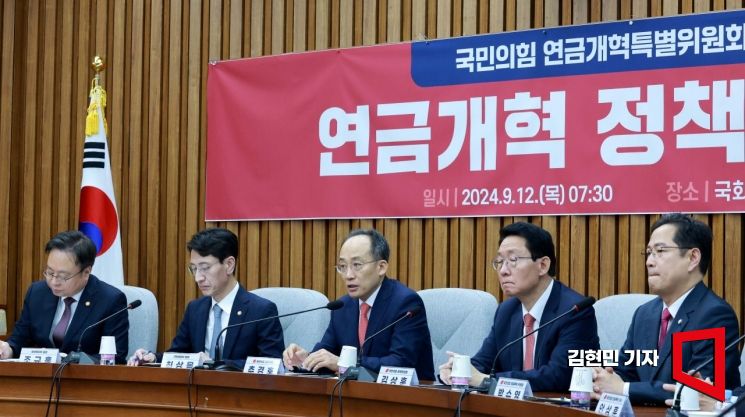 Chu Kyung-ho, floor leader of the People Power Party, is speaking at the pension reform policy forum hosted by the People Power Party's Pension Reform Special Committee at the National Assembly on the 12th. Photo by Hyunmin Kim kimhyun81@
Ahn Sang-hoon, a People Power Party lawmaker and secretary of the special committee, said, “For the financial sustainability of the National Pension Service, the emphasis should be on raising insurance premiums, and the increase in the income replacement rate should be achieved by converting severance pay into pensions to make it substantial.” Regarding the slight increase in the income replacement rate, which refers to the benefit amount, despite the rise in the pension insurance premium rate, which refers to the contribution amount, he explained that this would be supplemented multilayeredly through the pensionization of severance pay. On the management of retirement pensions, he also evaluated that “the National Pension Service has a higher rate of return than other pensions and the fund size can grow.” Ahn said, “The first phase of parametric reform will be carried out by the end of this year,” adding, “We should not discuss only the National Pension Service but also include retirement pensions, so even if it is divided into first, second, and third phases, discussions should be held one by one within the overall direction set by the special committee.”
Democratic Party welfare committee members also held an ‘Urgent Diagnosis Discussion on the Yoon Seok-yeol Government’s Pension Reform Plan’ at the National Assembly on the same day. The opposition party generally emphasized that this reform plan means ‘pay more and receive less.’ Kang Sun-woo, a Democratic Party lawmaker and secretary of the welfare committee, pointed out, “It seems that the government’s proposal is the result of considering how to minimize the role of the state.”
Professor Joo Eun-seon of the Department of Social Welfare at Kyonggi University, who presented at the discussion, explained, “Since 2007, the income replacement rate of the National Pension Service has been lowered by 0.5% annually, reaching 42% this year, and the government’s plan is actually to stop this reduction,” adding, “Considering this, it is more reasonable to see the plan as maintaining the income replacement rate rather than increasing it.” In particular, she mentioned the automatic adjustment mechanism that adjusts the income replacement rate according to inflation and other factors, warning, “Significant benefit cuts must be endured,” and “If this mechanism operates, it could be destructive, especially for elderly people, particularly the very old.” Regarding the proposal to differentiate insurance premiums by generation, Professor Joo criticized, “It does not conform to the basic principle of social security that insurance premiums should be borne according to income level.” The Ministry of Health and Welfare proposed gradually raising the insurance premium rate by year of birth and year of enrollment, but Professor Joo pointed out that this is not a tax imposed based on income.
© The Asia Business Daily(www.asiae.co.kr). All rights reserved.
![Clutching a Stolen Dior Bag, Saying "I Hate Being Poor but Real"... The Grotesque Con of a "Human Knockoff" [Slate]](https://cwcontent.asiae.co.kr/asiaresize/183/2026021902243444107_1771435474.jpg)











