Bank of Korea Releases Monetary and Credit Policy Report
Excessive Household Debt Hinders Economic Development
Must Reduce Through Monetary Policy and Government Measures
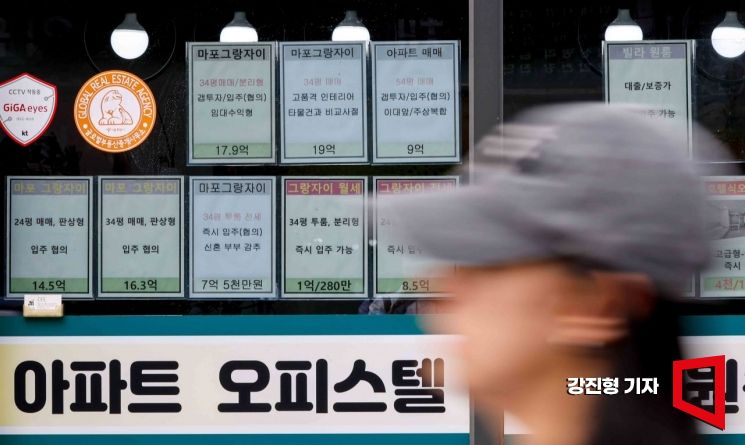 Apartment sale and jeonse prices are posted on real estate in Mapo-gu, Seoul. Photo by Jinhyung Kang aymsdream@
There is a forecast that the household debt ratio in South Korea, currently among the highest in the world, will rise further due to recent increases in housing prices.
According to the Monetary and Credit Policy Report released by the Bank of Korea on the 12th, South Korea's household debt ratio relative to gross domestic product (GDP) was recorded at 92.1% in the first quarter. This is the fourth highest level among the 31 OECD member countries.
Although the household debt ratio relative to GDP has gradually decreased since peaking at 99.3% in the third quarter of 2021, it remains at a top global level and poses risks that could hinder economic growth, according to the Bank of Korea. The Bank considers an appropriate household debt ratio to be around 80%.
The report noted that the household debt ratio could rise again as household loans continue to increase amid rising housing prices in the Seoul metropolitan area over the past few months.
According to the Bank of Korea's calculations, if household loans in the financial sector increase by 6 trillion won per month, the household debt ratio relative to GDP will rise to 92.2% in the second quarter, 92.3% in the third quarter, and 92.6% in the fourth quarter.
Given that household loans in the domestic financial sector increased by as much as 9.8 trillion won last month, the possibility of a rise in the household debt ratio in the third quarter is very high.
The report analyzed that the recent rise in housing prices was influenced by a combination of factors including concerns over supply-demand imbalances due to a shortage of newly built apartments in Seoul and avoidance of non-apartment housing, a decline in loan interest rates due to expectations of interest rate cuts, deregulation, and expansion of policy financing.
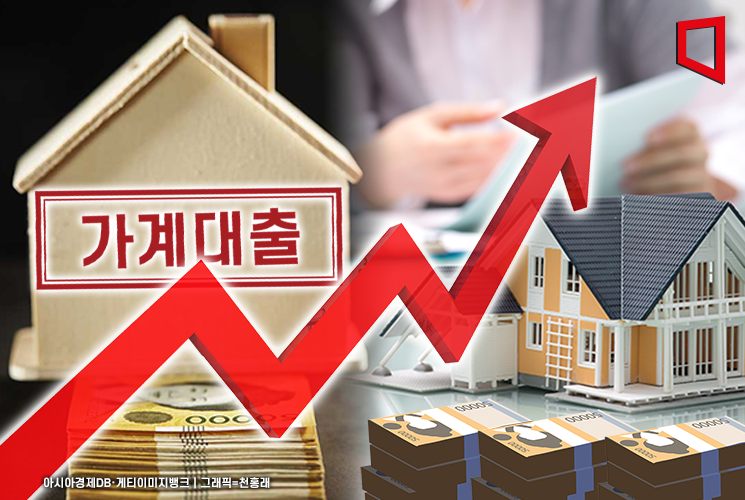
In South Korea's case, the economic stimulus effect from rising housing prices is limited, while financial and economic volatility may increase during future housing price adjustments, and the high household debt ratio could act as a structural factor restricting consumption.
Although rising housing prices theoretically stimulate the economy through increased construction investment and wealth effects, in South Korea, the linkage between housing prices and building investment is low, and the wealth effect is limited due to the high household debt ratio, the report added.
A Bank of Korea official emphasized, "Since the housing market and household debt are influenced by various factors such as housing supply, macroprudential regulations, and interest rates, it is necessary to respond with an appropriate policy mix to prevent the recent expansion from becoming prolonged."
He continued, "From a monetary policy perspective, it is necessary to decide the timing and pace of future interest rate cuts while considering the impact of housing prices and household debt trends in the Seoul metropolitan area on financial stability. Regarding macroprudential regulations, it is important to review the effects of expanding housing supply and strengthening macroprudential measures and consider additional strengthening measures if necessary."
© The Asia Business Daily(www.asiae.co.kr). All rights reserved.


















