Professor Hong Changwan's Team Identifies Nrf2 Regulatory Mechanism
Opens Possibility for CAR-T Cell Immunotherapy
Targeting Solid Tumors Beyond Blood Cancer Limitations
A study has shown that the CAR-T cell therapy, known as an immunotherapy for blood cancers, can also be effectively applied to solid tumors, which account for 90% of all cancers.
A research team led by Professor Hong Changwan from the Department of Convergence Medical Science at Pusan National University College of Medicine announced on the 12th that they have identified the role of the Nrf2 transcription factor, which responds to reactive oxygen species (ROS), in the anti-cancer immune response of CAR-T cells. They also confirmed the potential of CAR-T cell therapy technology that can be applied not only to existing blood cancers but also to solid tumors.
A transcription factor is a protein that regulates gene expression within cells.

The research team discovered that the Nrf2 transcription factor, which activates antioxidant functions in response to reactive oxygen species, actually interferes with the cancer cell-killing function of CAR-T cells. While existing CAR-T cell therapy has achieved significant results in blood cancers, its effectiveness in solid tumors has been limited due to the immunosuppressive environment. By inhibiting the Nrf2 transcription factor, the research team found that the activity of anti-cancer immune cells such as CD8+ T cells and CAR-T cells was maintained, resulting in a significant improvement in anti-cancer efficacy even in solid tumors.
CAR-T cells are T cells specifically engineered to attack cancer cells. "CAR" stands for Chimeric Antigen Receptor, which is artificially introduced into T cells. This receptor enables the T cells to accurately recognize and attack cancer cells.
CAR-T cell therapy involves extracting T cells from a patient's blood, introducing the CAR gene through genetic engineering, and then reinfusing them into the patient. These modified CAR-T cells can seek out and attack cancer cells, making this a promising new immunotherapy for cancers that do not respond well to traditional treatments.
Immunotherapy using CAR-T cells has opened a new horizon in cancer treatment, especially achieving groundbreaking results in blood cancers. However, this therapy has been effective only for blood cancers, which account for 10% of all cancer types. Although many researchers have been working to enhance the efficacy of CAR-T cells against solid tumors, which make up the remaining 90%, progress has been hampered by the unique immunosuppressive environment of solid tumors.
One of the key factors that interferes with the anti-cancer action of CAR-T cells in the tumor microenvironment is reactive oxygen species. These are oxygen molecules produced during cellular metabolism, which play an important role in cell signaling and immune responses at appropriate levels, but when produced excessively, they are known to promote the proliferation and metastasis of cancer cells and inhibit the activity of immune cells. Oxidative stress caused by reactive oxygen species can suppress the activity of CD8+ T cells, which are representative anti-cancer immune cells, thereby reducing the effectiveness of cancer treatment.
In solid tumors, the excessive production of reactive oxygen species inhibits or alters the function of immune cells, allowing cancer cells to evade attacks from the immune system. This is why it has been challenging to enhance the effectiveness of CAR-T cells in solid tumors.
In this study, Professor Hong Changwan's team revealed that the Nrf2 transcription factor, which activates antioxidant functions in response to reactive oxygen species, actually suppresses the activity of CAR-T cells, thereby weakening their tumor-killing function.
Conversely, when Nrf2 was inhibited, the activity of CD8+ T cells was maintained in the tumor microenvironment of solid tumors, and the activity of CAR-T cells was also preserved. Maintaining activity by suppressing Nrf2 expression led to a significant enhancement of the anti-cancer efficacy of CAR-T cells in solid tumors.
Professor Hong Changwan stated, "This study is an important achievement that can greatly contribute to expanding the application of CAR-T cell therapy from blood cancers to solid tumors," and added, "We hope that, in the future, CAR-T cell therapies targeting Nrf2 will be developed to provide new hope for more cancer patients."
This research was supported by the National Research Foundation of Korea's Mid-career Researcher Program and NeoImmuneTech's NT4010 Industry-Academia Cooperation R&D Project. Professor Hong Changwan of Pusan National University College of Medicine served as the corresponding author, with Dr. Cho Yuna as the first author, Dr. Shim Jua and Ph.D. candidate Lee Somin, and Professor Kim Chan Hyuk of Seoul National University as key co-researchers.
This study, which elucidated the mechanism by which the antioxidant factor Nrf2 suppresses anti-cancer responses, was published online on August 22 in "Molecular Therapy," a sister journal of "Cell," which is globally recognized in the field of therapeutics.
The title of the paper is "Targeting ROS-sensing Nrf2 potentiates anti-tumor immunity of intratumoral CD8+ T and CAR-T cells."
This new technology is being transferred to the biotechnology company NeoImmuneTech and is expected to be used in the development of clinical therapeutic agents in the future.
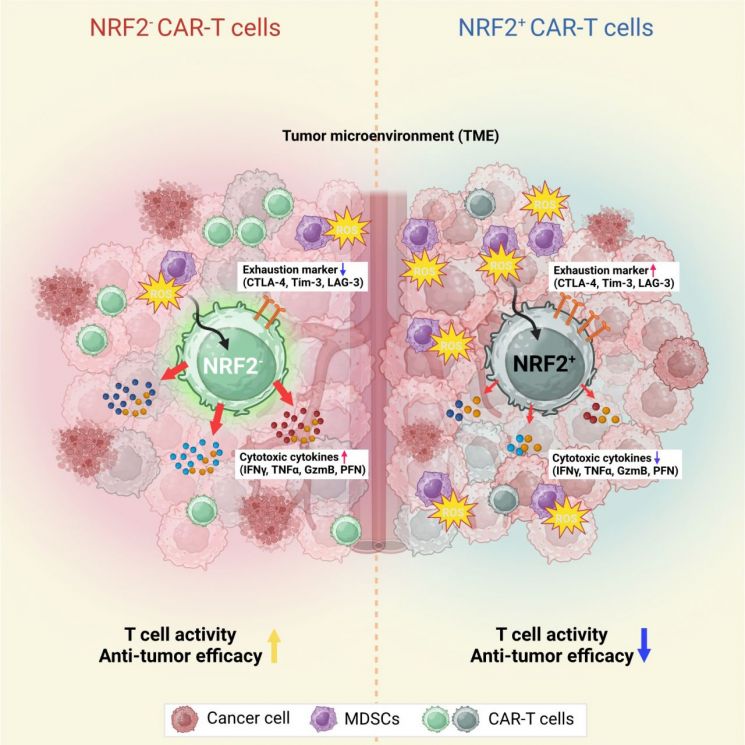 Solid tumor-targeting CAR-T cell therapy developed by the research team at Pusan National University.
© The Asia Business Daily(www.asiae.co.kr). All rights reserved.
![Clutching a Stolen Dior Bag, Saying "I Hate Being Poor but Real"... The Grotesque Con of a "Human Knockoff" [Slate]](https://cwcontent.asiae.co.kr/asiaresize/183/2026021902243444107_1771435474.jpg)












