Bank of Korea Monetary and Credit Policy Report
Resident Overseas Investment Greatly Exceeds First Half Level
Foreigners' Domestic Investment Reduced Compared to First Half
"Caution Needed for Worsening Foreign Exchange Supply-Demand Imbalance"
Recently, as the scale of overseas net investment by Seohak Ants has expanded to levels significantly exceeding the first half of the year, an analysis has emerged cautioning the need to prevent the worsening of foreign exchange supply and demand imbalances.
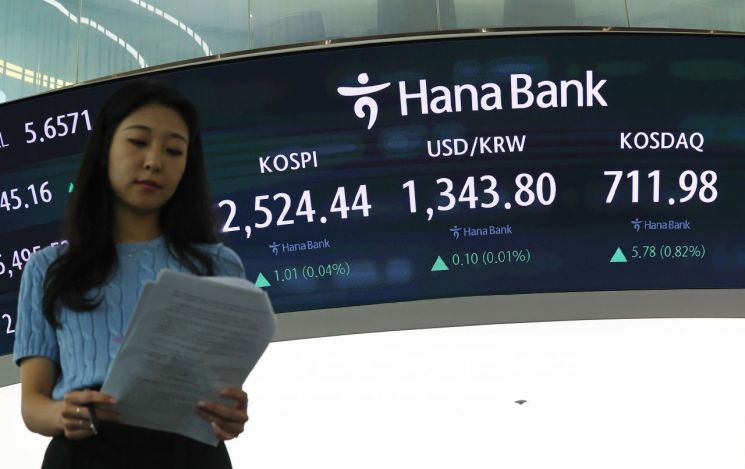
According to the 'Monetary and Credit Policy Report' released by the Bank of Korea on the 12th, the net investment scale of residents in overseas securities in July was $10.11 billion, greatly surpassing the first half of this year (monthly average of $6.95 billion). Among these, stocks continued net investment flows despite price adjustments in major U.S. Big Tech companies, while bonds expanded significantly. With growing expectations of an interest rate cut by the U.S. Federal Reserve (Fed), investors, mainly individual investors, appear to have flowed into bonds aiming to benefit from future market interest rate declines.
On the other hand, foreign investors' domestic securities investment slowed, centered on bonds. The net investment scale of foreign investors in domestic securities in July was $2.24 billion, significantly reduced compared to the first half of the year (monthly average of $3.22 billion). In particular, bonds saw their net investment scale in July shrink to about one-third of the first half, showing a more pronounced slowdown than stocks. Securities firms and investment companies with short-term investment tendencies appear to have led net withdrawals aiming to realize gains from falling market interest rates (rising bond prices).
The report evaluated that the trend of residents' overseas securities investment dominance is expected to continue and cautioned to prevent the worsening of foreign exchange supply and demand imbalances. Residents' overseas securities investment is expected to continue its upward trend due to expanded overseas investments by entities such as the National Pension Fund and individual investors, but foreign investors' domestic securities investment may see increased volatility in stock investments depending on the global artificial intelligence (AI) industry and economic outlook.
A Bank of Korea official stated, "In the past, during periods of increased external risks, foreign investors' domestic stock funds flowed overseas, whereas residents' overseas stock funds had relatively low repatriation levels and even increased net investment during the COVID-19 crisis," adding, "The dominance of residents' overseas securities investment could act as a factor that exacerbates foreign exchange supply and demand imbalances depending on the development of external risk factors."
© The Asia Business Daily(www.asiae.co.kr). All rights reserved.
![Clutching a Stolen Dior Bag, Saying "I Hate Being Poor but Real"... The Grotesque Con of a "Human Knockoff" [Slate]](https://cwcontent.asiae.co.kr/asiaresize/183/2026021902243444107_1771435474.jpg)
















