Dispatching secretaries to receive medical field suggestions
University and small hospital medical staff express fatigue
Regarding Korea's postponement of personnel increase, "a sincere appeal"
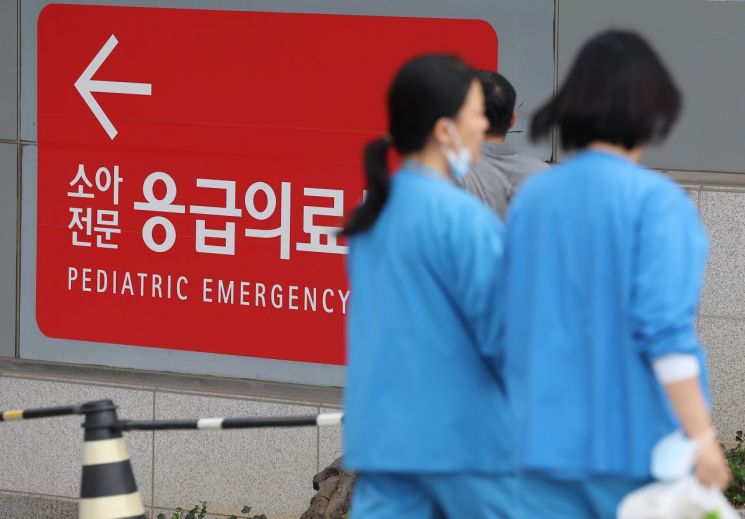 Ahead of the Chuseok holiday, as emergency room operations are disrupted at hospitals nationwide, medical staff are seen moving in front of the emergency room of a large hospital in Seoul on the morning of the 10th.
 [Image source=Yonhap News]
The Presidential Office announced that after dispatching secretaries and administrative officers to 17 university hospitals and small to medium-sized hospitals nationwide to hear voices from the field, the situation was "not easy." They said there were many requests to dispatch military doctors and public health doctors due to manpower shortages, and that the submitted suggestions would be reviewed with relevant ministries. They also reiterated that the 'personal information digging' of emergency room doctors is a matter to be strictly punished.
A Presidential Office official said on the afternoon of the 11th at the Yongsan Presidential Office during a press briefing on the results of the Presidential Secretariat's visit to emergency medical sites. Previously, from the 5th until the day before, secretaries and administrative officers from eight senior offices were dispatched to 34 university hospitals and small to medium-sized hospitals in 17 cities and provinces to check the situation.
The official explained, "The field visits were conducted because there were many opinions that difficulties in emergency medical sites are accelerating, aiming to encourage medical staff who are devoted to saving lives and health on site and to listen to their difficulties and suggestions."
The Presidential Office said the on-site confirmation results were "difficult. Not easy." The official said, "Training hospitals, that is, university hospitals, are providing care centered on severe patients due to the reduction of emergency capacity caused by the departure of residents, but the medical staff's fatigue is high, and they complained of additional resignations and manpower shortages. Small to medium-sized hospitals, such as non-training hospitals, complained that as university hospitals focus on severe cases and disperse patients, the number of patients has increased significantly, raising fatigue levels as well."
They added, "Issues such as low medical fees, patients' preference and concentration on large hospitals and metropolitan hospitals, patients' reluctance to accept responsibility due to concerns about civil and criminal liability, and difficulties in smooth patient transfer caused by differences in diagnosis and classification between fire departments and hospitals have been accumulating even before collective actions," and "there was an opinion that this should be addressed at this opportunity."
The Presidential Office explained that many suggestions were made on-site regarding civil and criminal immunity for medical personnel, expansion and investment in essential regional medical care, normalization of essential medical fees, and resolving recruitment difficulties in local small to medium-sized hospitals. They also said there were suggestions such as support for hiring medical support nurses, morale-boosting measures for professors filling the resident gaps, additional regional fees for intensive care units, and expanded investment in regional base hospitals.
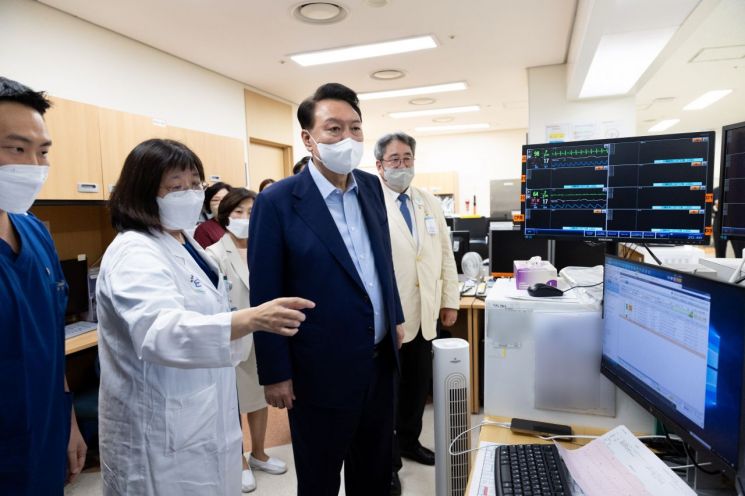 President Yoon Suk-yeol visited a regional emergency medical center in Gyeonggi Province on the 4th to receive an explanation about the emergency medical field. [Image source=Yonhap News]
A Presidential Office official said, "Recently, due to scouting competition between hospitals, there have been many cases requesting the dispatch of military doctors and public health doctors while complaining about the chain departure of doctors and financial deterioration," adding, "there was also a request to defer repayment of next year's health insurance advance payments to support hospitals' current financial difficulties."
According to the Presidential Office, medical staff usually move hospitals a lot in September, but recently, doctors from hospitals in the Chungcheong and Gangwon regions have been heavily scouted to metropolitan hospitals, increasing the burden on regional hospitals.
The official said, "Among the suggestions received during the field visits, many overlap with the Chuseok emergency medical special measures or medical reform tasks, so we will provide more detailed information through publicity and guidance," and "newly raised or supplementary issues will be reviewed together with relevant ministries."
Regarding the recent 'personal information digging' and 'witch hunts' against dispatched personnel online, they said, "It is a clear criminal act and must be strictly punished," adding, "I understand there are self-purification movements within the medical community, and I hope such movements become more active."
Meanwhile, regarding People Power Party leader Han Dong-hoon's comment that the government's plan to increase medical school admissions could be postponed until 2025, a Presidential Office official said, "I think it is a sincere appeal by Representative Han to have the medical community participate in the consultative body."
© The Asia Business Daily(www.asiae.co.kr). All rights reserved.
![Clutching a Stolen Dior Bag, Saying "I Hate Being Poor but Real"... The Grotesque Con of a "Human Knockoff" [Slate]](https://cwcontent.asiae.co.kr/asiaresize/183/2026021902243444107_1771435474.jpg)

















