Measures to Eradicate Illegal Private Loans and Improve the Loan Business System
"Strengthening Selection and Supervision of Illegal Companies"
Up to 5 Years Imprisonment for Illegal Loan Business Acts
Loan Brokerage Site Registration Authority Raised to Financial Services Commission
Local Government Loan Business Registration Requirements... Expected Reduction of 3,300 Cases
Unregistered Loan Operators Renamed as 'Illegal Private Loan Operators'
Financial authorities have taken measures to strictly crack down on illegal private loans. The main point is to go beyond the government's previous policy of legitimizing lending companies, to selectively target illegal operators and strengthen proper supervision. Representative measures include increasing penalties for unregistered lenders and invalidating principal and interest on antisocial loan contracts. The registration requirements for lending businesses at local governments will also be tightened, which is expected to lead to the exit of more than half of the current lending companies. Kim Byung-hwan, Chairman of the Financial Services Commission, stated that it is important for the government and related agencies to unite and respond with full force, and that they plan to promote legislation so that the amendment to the Lending Business Act can be discussed in the National Assembly in the second half of this year.
On the 11th, the Financial Services Commission announced the ‘Measures to Eradicate Illegal Private Loans and Improve the Lending Business System’ together with the Office for Government Policy Coordination, Ministry of Justice, Ministry of Science and ICT, National Police Agency, and Financial Supervisory Service after a government-party consultation.
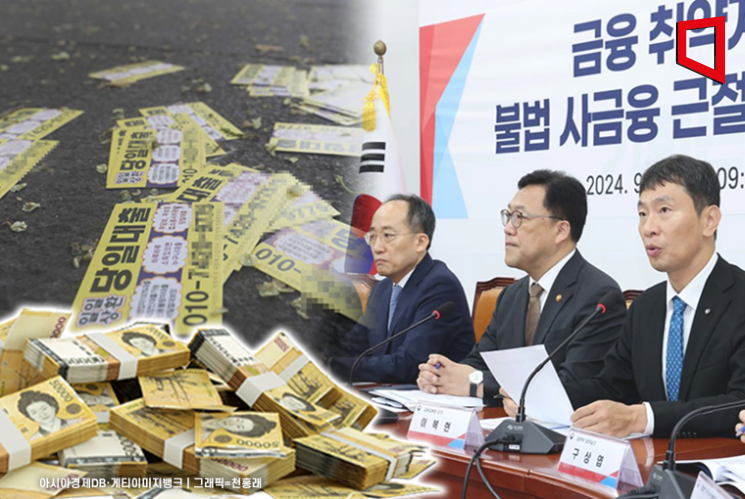 On the 11th, the Financial Services Commission, after consultations with the ruling party and government, announced the 'Measures to Eradicate Illegal Private Loans and Improve the Loan Business System' together with the Office for Government Policy Coordination, Ministry of Justice, Ministry of Science and ICT, National Police Agency, and Financial Supervisory Service.
Up to 5 Years Imprisonment for Unregistered Operations... Restriction on Illegal Contract Validity and Strengthened Supervision of Online Loan Brokerage
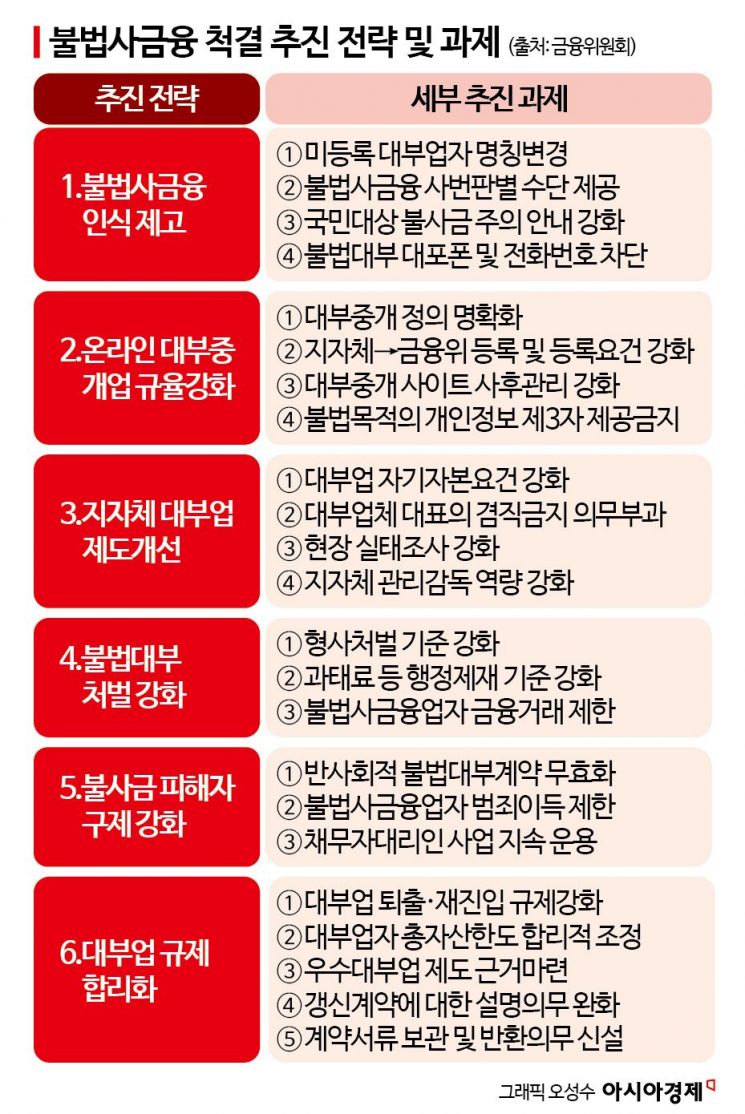
First, penalties and sanctions for illegal lending activities will be strengthened. If illegal private lenders violate the maximum interest rate, operate without registration, or impersonate government or financial institutions, the punishment standards will be strengthened to imprisonment of up to 5 years and a fine of 200 million KRW. When false business names are used or contract documentation obligations are violated, the current fine of 6 million KRW will be raised to a maximum of 30 million KRW. If a lender violates the Debt Collection Act, grounds will be established to issue institutional warnings, cautionary measures, and sanction employees. Additionally, limits on transfers, remittances, and withdrawals will be imposed on illegal private lenders, and grounds will be established to prohibit opening multiple accounts. If convicted, electronic financial transactions will be restricted for 3 to 5 years.
Efforts will also be made to establish grounds to restrict the validity of illegal loan contracts and confiscate criminal proceeds. For antisocial illegal loan contracts that are significantly disadvantageous to consumers, such as those related to sexual exploitation debt collection, human trafficking, bodily injury, assault, or threats, both principal and interest can be declared null and void. To limit criminal proceeds, if an illegal private lender charges interest exceeding the commercial statutory interest rate of 6% at the time of loan contract, the contract will be considered null and void.
Supervision of online loan brokerage sites, which are a main channel for illegal private loans, will also be strengthened. The registration authority for loan brokerage sites will be elevated from local governments to the Financial Services Commission. They will be required to meet personnel and physical requirements similar to loan comparison platforms (such as capital requirements and establishment of IT and security facilities) and to have information protection systems in place. The use of personal information obtained by lenders and loan brokers for purposes other than intended will be prohibited.
Strengthening Local Government Lending Business Registration Requirements... “Expected Reduction from 7,700 to 3,300 Companies”
To prevent damage to loan users caused by the proliferation of small-scale lenders and illegal operations, local government lending business registration requirements will be strengthened. The current local government capital requirements of 10 million KRW for individual operators and 50 million KRW for corporations will be raised to 100 million KRW and 300 million KRW, respectively. Currently, there are 7,600 lending companies registered with local governments, and if these standards are applied, only 3,300 companies (2,000 individual and 1,300 corporate) will be able to operate. To prevent a single lender from operating multiple local government lending companies with assets under 10 billion KRW to avoid Financial Services Commission registration, the concurrent holding of executive positions by representatives in other lending companies will be restricted. To ensure thorough supervision by local governments, the current annual on-site inspections and staff training will be strengthened.
Raising Awareness and Rationalizing Regulations Including Renaming Unregistered Lenders to Illegal Private Lenders
To prevent victims from unknowingly contracting with illegal private lenders, the name of unregistered lenders will be changed. The term ‘unregistered lender’ under the Lending Business Act will be changed to ‘illegal private lender’ for operators conducting illegal lending without registration. Loan brokerage sites will be encouraged to post a registration lending business inquiry site. Grounds will be established to report illegal loan advertisement phone numbers, and the Telecommunications Business Act will be amended to prohibit and punish the use or opening of burner phones for unregistered lending or illegal debt collection purposes.
Regulatory adjustments will also be made to immediately expel unqualified lenders and provide incentives to qualified lenders. For lenders who do not meet registration requirements, the mayor or governor and the Financial Services Commission will be granted authority to delete registrations ex officio, leading to immediate expulsion of unqualified operators. The re-registration ban period after voluntary closure will be extended from 1 year to 3 years to strengthen blocking of re-entry by unqualified lenders. Incentive systems to encourage supply of financial services to low-income groups will also be expanded. Legal grounds will be established to designate ‘excellent lenders,’ and local government lenders will also be required to comply with total asset limit regulations (10 times), while the asset limit for excellent lenders will be increased from 10 times to 12 times.
The government plans to swiftly promote legislation on the amendment to the Lending Business Act, including these system improvement measures. The government legislative bill is expected to be submitted as early as December this year. In addition to legal amendments, measures that can be implemented immediately (such as strengthening local government on-site inspections) will be executed promptly.
Kim Byung-hwan, Chairman of the Financial Services Commission, said, “We placed the highest priority on establishing the institutional foundation and system so that the government and related agencies can unite with strong determination and urgently respond to prevent damage from illegal private loans that destroy the daily lives of low-income and vulnerable groups.” He added, “We will continue to closely cooperate with related ministries and agencies to ensure that related system improvement measures are promptly and smoothly implemented as soon as possible.”
© The Asia Business Daily(www.asiae.co.kr). All rights reserved.



















