119 Emergency Responders Win Lawsuit to Cancel Warning Disciplinary Action
Court: "Opportunity to Present Opinions Was Not Sufficiently Guaranteed"
Fire Department: "Emotions Uncontrolled, Complaints Occurred"
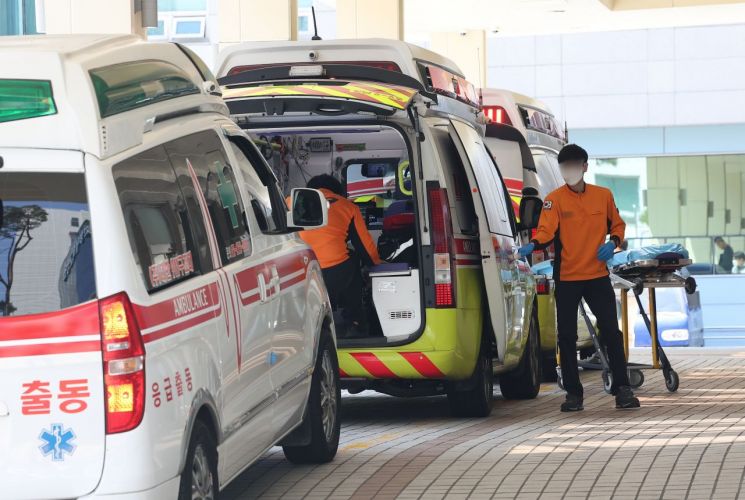 A paramedic is transporting a patient in front of the emergency room of a large hospital in Seoul. Photo by Yonhap News
According to Yonhap News, a 119 paramedic who received a warning for being rude to a caller filed a cancellation lawsuit and won.
On the 11th, the Administrative Division 1-2 of the Incheon District Court (Chief Judge Kim Won-mok) announced, "In the cancellation lawsuit filed by paramedic A against the Mayor of Incheon regarding the warning, the plaintiff won." The court accepted A's claim of "violation of the Administrative Procedures Act" and ordered Incheon City to cancel the warning. The court explained, "Warning disciplinary actions against fire service officials are subject to the Administrative Procedures Act," and "According to the Administrative Procedures Act, when an administrative agency imposes a disposition that restricts the rights and interests of a party, it must provide an opportunity to submit opinions." It added, "Although the defendant claimed that the rights to refuse to testify and to receive assistance from a lawyer were verbally explained to A in the investigation room, it is difficult to see that the opportunity to present opinions to guarantee the right to defense was sufficiently ensured," and "For this reason, the warning is canceled, and whether the disposition itself was appropriate will not be further judged."
Earlier, on the morning of August 7 last year, citizen B contacted the Incheon Fire Headquarters situation room from a hotel in Incheon, saying, "I lived abroad and came to Korea for cancer treatment, but I have a high fever now," and asked, "What should I do?" When the situation room staff said, "We will send an ambulance to the hotel for hospital transfer," B requested, "I have not been able to wash for three days due to the flu, so please give me some time to shower." The staff guided, "The ambulance will arrive at the hotel in 30 minutes," and the ambulance from the local safety center arrived at the hotel in 22 minutes while B was showering.
Six minutes after the ambulance arrived, B came down to the first-floor lobby and was reprimanded by paramedic A, who was on site, saying, "You should not make the ambulance wait like this." B, who was transferred to the hospital, filed a complaint the next day, stating, "The paramedic was rude." In response, the Incheon Fire Headquarters conducted an internal investigation, and A received a warning on the 28th of the same month.
The Incheon Fire Headquarters explained, "According to the National Public Officials Service Regulations, A must always handle duties kindly, promptly, and accurately, but failed to control personal emotions," and "Since an unnecessary complaint was filed, strict responsibility must be imposed." However, they added, "Considering A's accumulated merits and the degree of misconduct, a warning was issued," and "Perform your duties diligently with special attention to prevent similar cases in the future." Disciplinary actions for fire officials are divided into six categories: dismissal, removal, demotion, suspension, salary reduction, and reprimand. Among these, a warning is not considered a disciplinary action but may result in disadvantages such as transfer personnel changes, work performance evaluations, and performance bonuses for one year.
When the warning against A became known, the National Public Officials Union Fire Headquarters held a press conference in front of Incheon City Hall in November last year, stating, "A warning was issued to a paramedic who suffered from malicious complaints." A also appealed the warning to the Personnel Innovation Committee but was dismissed and filed an administrative lawsuit in February. Although 119 paramedics are national public officials, since the Incheon Fire Headquarters is an institution under Incheon City, the lawsuit was filed against the Mayor of Incheon, the authority responsible for the disposition. A argued, "The warning was issued without prior notice, so there was no opportunity to submit opinions," and "This violated the Administrative Procedures Act as it hindered the exercise of the right to defense." He added, "At the time, I explained to the complainant that the dispatch for other emergency patients might be delayed," and "It cannot be considered a violation of the National Public Officials Service Regulations just because I raised my voice somewhat during the process."
The Incheon Fire Headquarters decided not to appeal the ruling, considering that A had already been transferred to another region in February. A representative stated, "The investigation found that the complainant was not a malicious complainant, and the 30-minute delayed dispatch was first proposed by the situation room staff to the complainant," and "Although the procedure was flawed, there was no problem with the warning itself."
© The Asia Business Daily(www.asiae.co.kr). All rights reserved.

















