Rural Development Administration Announces Status of Domestically Developed Varieties
"Diversification Needed for Stable Fruit Prices and Production"
Apple 'Arisu' Cultivation Area 970ha
Domestic Pear Variety Distribution Rate 14.9%
Efforts Needed to Expand Production and Distribution of New Varieties
"Promotion of Specialized Production Complexes and Systematic Distribution"
The number of domestically developed fruit varieties appearing on Chuseok ancestral ritual tables is increasing. In the case of apples, the distribution of developed varieties with enhanced taste, such as 'Hongro' and 'Arisu,' has increased, resulting in a domestic variety distribution rate of 22.4% last year. This represents a 5.4 percentage point increase compared to 2014 (17.0%).
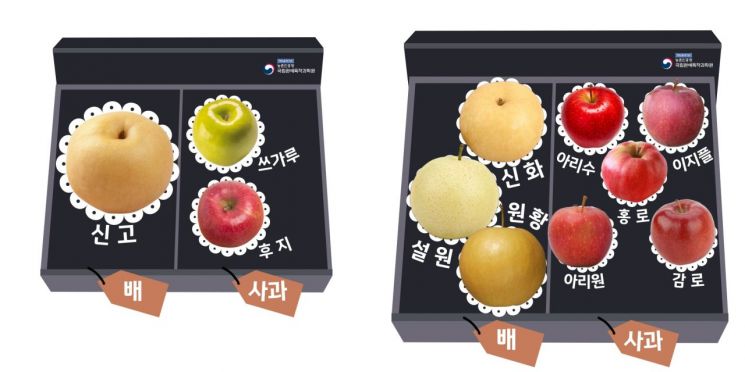 Example images of fruit boxes from the 1990s (left) and 2024. The number of domestically developed apple and pear varieties has increased significantly. /
 [Image provided by Rural Development Administration]
The Rural Development Administration (RDA) announced on the 11th that apple and pear varieties developed through a fruit variety diversification strategy are replacing existing varieties and playing an active role in the Chuseok market. Comparing the varieties distributed in the Chuseok market 30 years ago and now, the RDA evaluated that domestically developed fruit varieties are steadily entering the market and gaining recognition.
Kim Myung-soo, Director of the National Institute of Horticultural and Herbal Science at the RDA, said at a briefing held that day, "This year, the demand for stable production and prices, especially for apples, was greater than ever. To reduce price fluctuations and maintain stable production, it is important to distribute a variety of cultivars."
He added, "Among the past five years, 2022 was the only year without cold damage during the flowering period, and especially last year, cold damage and anthracnose occurred simultaneously, greatly reducing fruit production. Variety diversification is essential in terms of expanding consumer choice." He also noted, "Considering the inevitable direct competition with imported fruits, expanding the scope and enhancing competitiveness will also be beneficial."
'Arisu,' Delicious and Resistant to Anthracnose... Domestic Pear Variety Distribution Rate at 14.9%
Thirty years ago, imported apple varieties such as 'Fuji' and 'Tsugaru' were distributed in the Chuseok market. Since neither variety was at peak ripeness during Chuseok, consumers faced limitations in experiencing the best taste. In response, the RDA developed the first domestically bred apple variety 'Hongro' in 1988, followed by 'Arisu' in 2010. Since 2020, varieties such as 'Easyple,' 'Ariwon,' and 'Gamro' have also been developed and began sales last year.
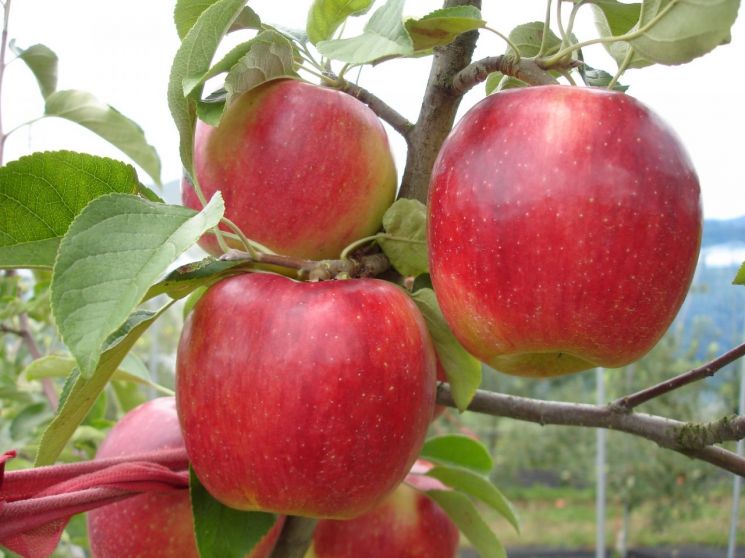
In particular, Arisu, which ripens in early September, is noted for its good taste, well-colored skin, and resistance to anthracnose, replacing the anthracnose-susceptible Hongro and gaining attention as a climate change-adaptive variety. Within about 10 years of distribution, its cultivation area has expanded to 970 hectares?more than three times the size of Yeouido (290ha)?and is catching up to Hongro (5,474ha).
 Kim Myung-soo, Director of the National Institute of Horticultural and Herbal Science at the Rural Development Administration, is introducing a new fruit variety at a briefing held at the Government Sejong Complex on the 11th.
 [Image source=Yonhap News]
Lee Dong-hyuk, Director of the Apple Research Institute at the National Institute of Horticultural and Herbal Science, explained, "The total apple cultivation area in South Korea is 33,489 hectares, with Hongro accounting for 16%. The overall market share of domestically developed varieties was 22.4% as of last year." The distribution rate of domestically developed varieties, which was 17.0% in 2014, entered the 20% range in 2019 (20.2%) and has been rising annually since.
In the case of pears, 30 years ago, imported varieties such as 'Jangshiprang' and 'Shingo' dominated the market. Although Shingo still holds a high market share, the domestically developed pear 'Wonhwang' is also active. The cultivation area of Wonhwang was 421 hectares as of last year. Additionally, the domestic pear 'Sinhwa' has expanded its cultivation area to 183 hectares, mainly in the outskirts of the Seoul metropolitan area. The distribution rate of these domestically developed varieties was 14.9% last year.
Thirty years ago, only a few grape varieties such as 'Campbell Early' and 'Kyoho' were distributed in the Chuseok market, but in the future, consumers will encounter several varieties with unique aromas, textures, and colors. 'Hongju Seedless,' which has a sweet and sour taste with a subtle muscat aroma, is increasing in cultivation mainly in major grape-producing areas such as Sangju and Gimcheon. 'Shooting Star,' characterized by a cotton candy scent and unique grape berry color, is also raising expectations among farmers.
"Discussing Distribution Systematization to Expand Domestically Developed Varieties"
The RDA views the competitiveness of domestically developed varieties as high. However, since it takes considerable time to increase production and distribution networks after developing a variety, efforts will be made to expand these as well. This includes establishing specialized production complexes in major producing regions' city and county agricultural technology centers and strengthening cooperation with distribution companies.
Lee Dong-hyuk, Director of the Apple Research Institute at the National Institute of Horticultural and Herbal Science, explained, "It takes more than 15 years to develop a single variety, and even longer for that variety to establish itself in the market. To shorten this time as much as possible, we are internally promoting projects to establish specialized production complexes for regionally specialized varieties."
Director Kim said, "For new varieties, when they enter the auction market in small quantities, price formation does not work well, which can be economically disadvantageous for producers. We will discuss systematization to enable new varieties to be traded through separate distribution channels in consultation with the Ministry of Agriculture, Food and Rural Affairs."
© The Asia Business Daily(www.asiae.co.kr). All rights reserved.



















