The Korea Institute of Energy Research (hereinafter KIER) announced on the 11th that a joint research team from the Renewable Systems Research Laboratory and the Energy ICT Research Group has developed core technology to realize 'Urban Electrification' through artificial intelligence.
Urban electrification aims to transition urban energy sources from fossil fuels to renewable energy by introducing building-integrated photovoltaic technologies and the like.
In the United States, Europe, and other regions, this concept is actively promoted as a key strategy for achieving carbon neutrality and creating sustainable urban environments.
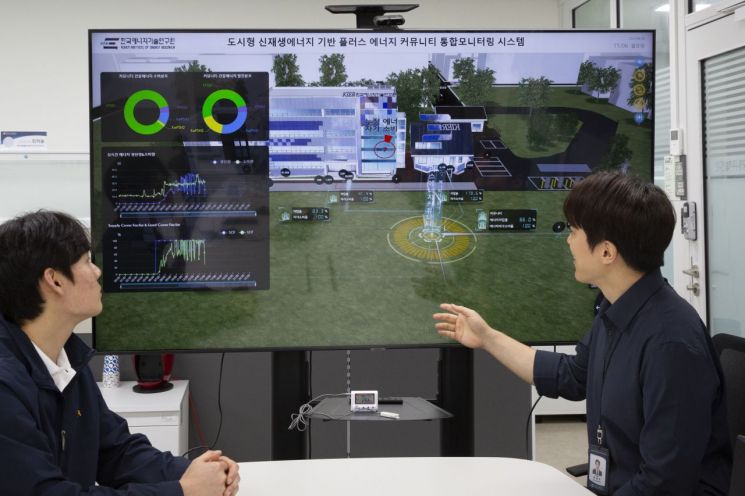 Research team members are monitoring the energy management system. Provided by Korea Institute of Energy Research
However, traditional urban models can easily adjust energy supply from fossil fuels according to electricity demand, whereas cities undergoing electrification have a high dependence on renewable energy, which causes variability in energy supply depending on weather conditions. This leads to mismatches in electricity demand among buildings, making stable operation of the power grid difficult.
For example, extreme 'Low-Probability High-Impact Events' caused by climate change, such as sudden cold snaps or severe heatwaves, can sharply increase energy demand while simultaneously limiting energy production, threatening the stability of urban power grids with large-scale blackouts.
Low-Probability High-Impact Events are rare enough to be described as 'extreme,' but they are difficult to predict and, once realized, the scale of economic and social damage is hard to estimate, making them a subject of caution.
To address these issues, the joint research team developed an energy management algorithm incorporating artificial intelligence analysis results and implemented it as a system.
First, artificial intelligence was used to analyze patterns of energy consumption and renewable energy production for each building. Then, the team identified the impact of complex variables such as weather, human behavior patterns, the scale of renewable energy facilities, and operational conditions on the power grid.
During this process, the joint research team confirmed that Low-Probability High-Impact Events, which occur only 1.7 days per year (about 0.5%), can have a decisive impact on the overall stability and operating costs of the power grid.
The analyzed data was also incorporated into the algorithm and system. The developed algorithm optimizes energy sharing between buildings and effectively manages peak demand and peak generation.
In particular, it not only maintains daily energy balance but also enables stable operation of the power grid under extreme conditions by responding to Low-Probability High-Impact Events.
The joint research team also confirmed that when the self-developed system was applied to a community unit simulating an urban electrification environment, a self-sufficiency rate (the degree to which buildings can meet power demand through their own generation) of 38% and a self-consumption rate (the proportion of surplus electricity produced by buildings that is directly used) of 58% could be achieved.
These figures represent a significant improvement compared to buildings without the system, which had a self-sufficiency rate of 20% and a self-consumption rate of 30%, and the improvement effect can reduce electricity bills by 18% compared to before.
Most importantly, the annual energy consumption applied in the demonstration was 107 MWh, which is seven times higher than simulation-based studies by advanced overseas institutions, indicating a relatively high potential for actual application of the related system in urban environments, the joint research team emphasized.
Dr. Han Kwang-woo of the Energy ICT Research Group said, “This research result is meaningful in that it enhances the efficiency of urban electrification and secures power grid stability through artificial intelligence,” adding, “The joint research team will apply the developed system to various urban environments in the future to improve energy efficiency and power grid stability, thereby contributing to the realization of carbon neutrality.”
Meanwhile, this research was conducted as a basic project of the Korea Institute of Energy Research. The research results were published online in the internationally renowned journal in the building sector, 'Sustainable Cities and Society.'
© The Asia Business Daily(www.asiae.co.kr). All rights reserved.
![Clutching a Stolen Dior Bag, Saying "I Hate Being Poor but Real"... The Grotesque Con of a "Human Knockoff" [Slate]](https://cwcontent.asiae.co.kr/asiaresize/183/2026021902243444107_1771435474.jpg)
















