Concerns Over Price Drop Due to Demand Decline
Suggests Restriction on Multi-Patterning DUV Import
As the United States hinted at the possibility of additional sanctions restricting the supply of high-bandwidth memory (HBM) for artificial intelligence (AI) semiconductors to China, South Korean semiconductor companies are closely monitoring the situation with tension. Although the immediate impact on earnings is expected to be limited, there could be difficulties in seizing future market opportunities. If sales to China are blocked, it could lead to an overall decline in demand for the HBM market and a drop in prices, negatively affecting company profitability.
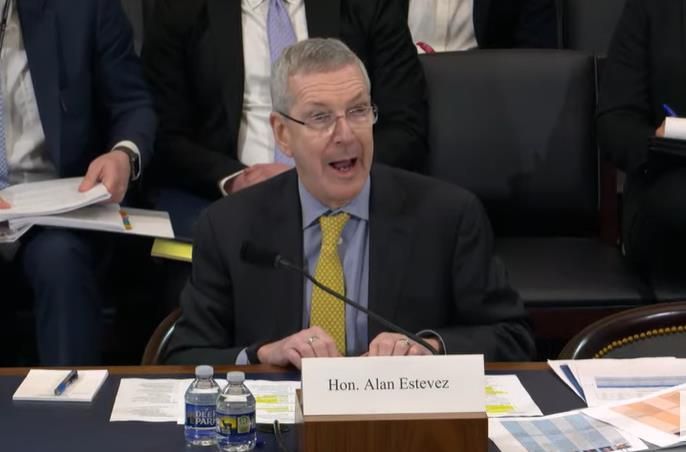 Allen Estevez, Deputy Assistant Secretary for Industry and Security at the U.S. Department of Commerce.
 Photo by Yonhap News
According to industry sources on the 11th, major semiconductor companies are currently verifying whether the remarks made by Alan Estevez, U.S. Deputy Under Secretary of Commerce for Industry and Security, that "HBM should be supplied to the U.S. and its allies, not China," imply the immediate implementation of additional sanctions against China. There are also speculations that additional sanctions could extend beyond HBM to include gate-all-around (GAA) process technologies, causing further industry tension. The GAA process is a key technology for Samsung Electronics’ Device Solutions (DS) division’s foundry (semiconductor contract manufacturing) business and TSMC. An industry insider said, "At this time, nothing can be confirmed," and refrained from further comment.
Currently, it is reported that Samsung Electronics and SK Hynix’s HBM exports to China are not substantial. Both companies have stated that detailed data cannot be disclosed. However, their sales in China are increasing. This has led to analyses suggesting that China has begun stockpiling Korean products such as HBM before U.S. sanctions become more severe. According to the semi-annual reports disclosed by Samsung Electronics and SK Hynix last month, Samsung Electronics’ sales in China for the first half of the year reached 32.3452 trillion won, nearly doubling compared to 17.808 trillion won in the same period last year. Although this figure includes other products such as smartphones and home appliances, it is reported that most of the sales growth in the Chinese market came from semiconductors. SK Hynix also recorded sales of 8.6061 trillion won in China during the first half, more than double the 3.8821 trillion won in the same period last year.
If demand for HBM in China increases, HBM prices will rise, helping to improve the profitability of suppliers such as Samsung Electronics and SK Hynix. Conversely, if U.S. sanctions cause the growth momentum of the Chinese HBM market to decline sharply, it could negatively impact suppliers. Concerns are also raised due to the expanding scope of U.S. semiconductor sanctions against China and the high likelihood that the "strong versus strong" stance toward China will continue regardless of which candidate wins the U.S. presidential election in November.
Estevez’s indication of additional import restrictions on immersion deep ultraviolet (DUV) lithography equipment, used for multi-patterning, cannot be overlooked. Immersion DUV equipment uses argon fluoride (ArF) light sources and is primarily utilized in multi-patterning processes. Multi-patterning is a technique that divides circuits into multiple exposures sequentially, allowing for finer circuit patterns but with the drawback of lower yield (ratio of good products).
According to industry and academia, restrictions on the import of immersion DUV equipment could have a more adverse effect on the DRAM business than on NAND flash. NAND flash uses higher node processes with larger patterning units, whereas DRAM requires multi-patterning technology for fine processes in the early 10-nanometer (1 nm = one billionth of a meter) range. DUV equipment remains highly useful for processes above 7 nm. However, since Samsung Electronics and SK Hynix secured "Verified End User (VEU)" status related to their business in China last October, there is speculation that even if the U.S. imposes additional multi-patterning sanctions on China, these companies might be exempt from the sanctions.
The fact that the immersion DUV sanctions target Chinese foundry companies such as SMIC (中芯國際, Zhongxin Guoji) also heightens industry concerns. SMIC, which manufactures chips for Huawei on a contract basis, succeeded in processes below 7 nm thanks to this equipment. It is widely known that processes below 7 nm cannot be realized without extreme ultraviolet (EUV) equipment produced by the Dutch company ASML, but China broke this convention using DUV equipment. Since the U.S. blocked the import of ASML EUV equipment, China has been sacrificing yield and profitability to perform sub-7 nm processes using immersion DUV equipment. The U.S. move to block even the import of immersion DUV equipment openly reveals its intention to prevent Chinese foundries from catching up with the U.S. and its allies. Korean companies have no choice but to be aware of this policy stance when conducting business in China.
An industry insider said, "Samsung and SK secured VEU status for their semiconductor factories in China last October, so there is no problem upgrading equipment within the scope of VEU," adding, "Most big tech companies that consume HBM are outside of China."
© The Asia Business Daily(www.asiae.co.kr). All rights reserved.

















