35% of the total, 40,000 creditors with claims under 100,000 won
115,000 creditors reported, agreed to the rehabilitation plan
Each stakeholder must be persuaded individually until the meeting to reach an agreement
Among the creditors of TMON and WEMAKEPRICE (TMEP), whose rehabilitation procedures were initiated on the 10th, it has been confirmed that 40,000 are consumers who lost less than 100,000 KRW. This means that about 35% of the total 115,000 creditors are small-amount transaction creditors with claims under 100,000 KRW. TMEP failed to enforce a proposal for prior repayment to small creditors, resulting in the difficult situation of having to carry these creditors even after the commencement of the rehabilitation process. They now face the challenge of persuading all 115,000 creditors individually, from creditor registration to agreement on the rehabilitation plan and stakeholders' meetings.
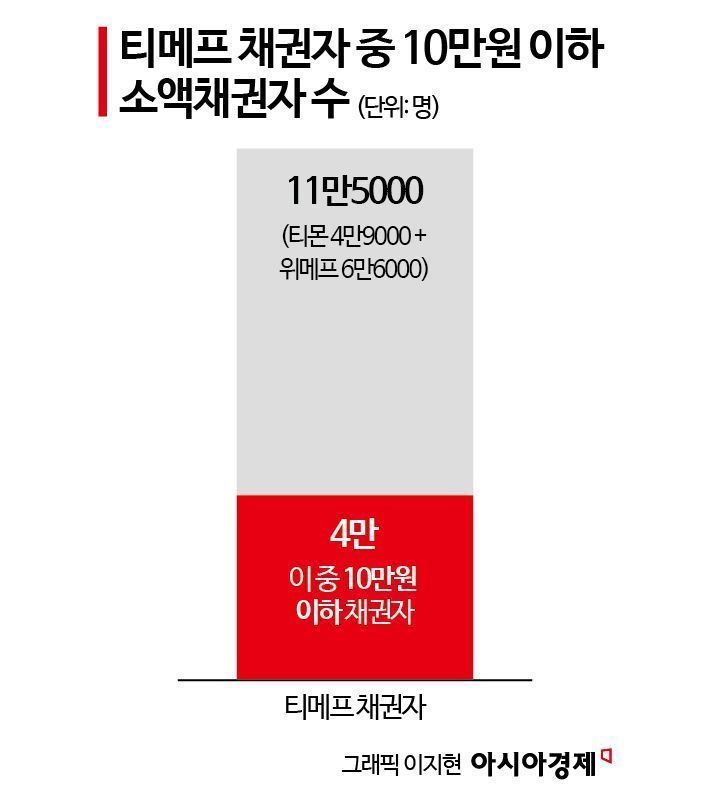
According to a comprehensive report by Asia Economy on the 11th, among the total 115,000 creditors of TMEP (49,000 for TMON and 65,000 for WEMAKEPRICE), about 40,000 hold claims under 100,000 KRW. Although a proposal for prioritized repayment to small creditors was made during the voluntary restructuring support (ARS) process before the rehabilitation commencement, it was rejected due to unclear funding and the principle of equality among creditors. Typically, reducing the number of creditors is an important first step for swift decision-making on the rehabilitation plan, but consensus faltered at this stage.
This has also put the rehabilitation court in a difficult position. Normally, the court would verify the registration certificates of the 115,000 creditors from TMEP and encourage creditor registration by sending notices to their addresses. However, the postage cost per case is 5,200 KRW, resulting in a total delivery fee exceeding 1.5 billion KRW. This amount must be prepaid by TMEP, but if TMEP cannot bear the cost, the creditor registration process will be blocked from the start. Ultimately, the court decided to replace the creditor registration with a ‘public notice procedure’ based on Article 10 of the Debtor Rehabilitation and Bankruptcy Act.
The problem with public notice is that creditors are not contacted directly beforehand, so creditors must actively check the amount of money they have not received through the TMEP website and directly negotiate if the amount differs. TMEP plans to submit the creditor list to the court by the 10th of next month, and before that, creditors will be able to view their claim amounts on the company’s website. The rehabilitation court emphasized, “It is necessary to verify whether the existence and amount of claims are accurately recorded.”
Due to the nature of the industry, disputes over the reported claim amounts are not expected. However, the large number of creditors?well over 100,000?could pose an obstacle in passing the rehabilitation plan, which requires the consent of more than two-thirds of the creditors. A source familiar with TMEP’s situation said, “In construction companies, claim amounts often vary significantly, requiring confirmed judgments after creditor investigations, but transactions between TMEP and creditors are recorded electronically due to the nature of online commerce, so there is little room for disputes over claim amounts,” adding, “However, many difficulties may arise during the creditor agreement process.”
Meanwhile, TMEP plans to sell the company to external investors and repay debts with the proceeds before obtaining approval for the rehabilitation plan. Whether a buyer will appear is also an issue, but the repayment rate will be a key concern for creditors.
The court set the deadline for submitting TMEP’s rehabilitation plan as December 27. Earlier, TMEP filed for corporate rehabilitation on July 29 after a delay in settlements occurred. The court approved the ARS program for self-rehabilitation, but it ended last month on the 30th after failing to devise a self-rescue plan.
© The Asia Business Daily(www.asiae.co.kr). All rights reserved.
![User Who Sold Erroneously Deposited Bitcoins to Repay Debt and Fund Entertainment... What Did the Supreme Court Decide in 2021? [Legal Issue Check]](https://cwcontent.asiae.co.kr/asiaresize/183/2026020910431234020_1770601391.png)
















