0.9 Increase Compared to Same Period Last Year
Total Emergency Patients Decrease
Regional Center Mortality Rate Increases Most
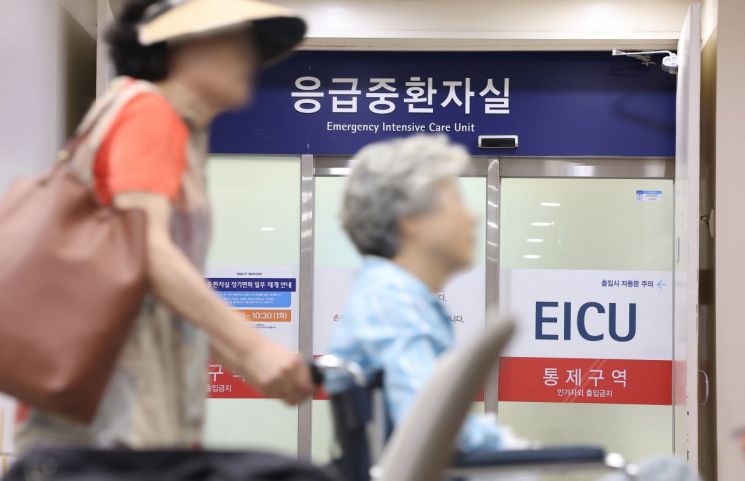
As the medical gap caused by the resignation of residents has prolonged, the total number of emergency patients has decreased while the mortality rate of emergency patients has increased.
According to data submitted by the National Medical Center to Rep. Kim Yoon of the Democratic Party on the 10th, from February to July this year, when residents at training hospitals resigned in protest against the increase in medical school admissions, the number of deaths per 1,000 emergency patients was 6.6, an increase of 0.9 compared to the same period last year.
The total number of emergency patients decreased by 16.9% compared to the same period last year (4,115,967 → 3,420,877).
Looking at the mortality by type of emergency medical institution, deaths at regional centers increased the most, from 6.4 last year to 8.5 this year, an increase of 2.1. Deaths at local centers increased from 5.4 to 6.6, an increase of 1.2, and deaths at local institutions increased from 5.6 to 5.9, an increase of 0.3.
The number of patients who were alive upon arrival but later died also increased the most at regional centers. At regional centers, the number increased from 20.7 to 22.8, a rise of 2.1, while at local centers it increased from 10.1 to 10.8, a rise of 0.7.
Looking only at the mortality rate of severe patients (KTAS 1?2), the number of deaths per 1,000 severe patients at local centers increased from 77.0 to 78.6, an increase of 1.6. KTAS is a classification system that indicates the urgency level of patients with numbers from 1 to 5.
The number of emergency patients transferred to other hospitals due to inability to provide treatment also increased. The number of transferred patients per 1,000 emergency patients was 15.6 last year and 16.5 this year, an increase of 0.9. For severe patients alone, the number increased from 56.9 to 57.8, an increase of 0.9.
By institution, the number of transferred patients at regional centers increased from 14.5 to 19.7, an increase of 5.2, and transfers at local centers increased from 15.5 to 16.1, an increase of 0.6. Transfers at local institutions decreased from 16.7 to 15.4, a decrease of 1.3.
Rep. Kim Yoon stated, "As severe emergency patients who could not be accommodated at regional centers visited local centers, the burden on local centers increased, and it appears that deaths among severe patients at local centers have also increased. To minimize emergency room disruptions, support for medical personnel and backup treatment conditions must be provided."
© The Asia Business Daily(www.asiae.co.kr). All rights reserved.
![Clutching a Stolen Dior Bag, Saying "I Hate Being Poor but Real"... The Grotesque Con of a "Human Knockoff" [Slate]](https://cwcontent.asiae.co.kr/asiaresize/183/2026021902243444107_1771435474.jpg)
















