8 Organizations Including Hankyung Association Propose to National Assembly and Government
"Possibility of 'Short-term' Management Rights Attack Forces Being Exploited"
"Damaging Corporate Value... Unable to Prevent Korea Discount"
Eight economic organizations, including the Korea Economic Association, have requested the National Assembly and the government to block the enactment of regulatory bills proposed by the 22nd National Assembly. They urged reconsideration of the bills, arguing that measures such as expanding directors' fiduciary duties to shareholders, mandating cumulative voting, and introducing independent directors are more likely to lower the threshold for short-term investors to infringe on management rights rather than promote the Korean securities market and corporate value enhancement.
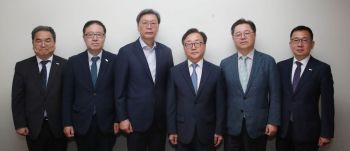 The full-time vice presidents of six major economic organizations held a breakfast meeting on the 6th to discuss the legislative status of the 22nd National Assembly, including regulatory bills on corporate governance.
 From the left: Park Yang-gyun, Director of the Korea Association of Mid-sized Enterprises; Jung Yoon-mo, Full-time Vice President of the Korea Federation of SMEs; Kim Chang-beom, Full-time Vice President of the Korea Economic Association; Lee Dong-geun, Full-time Vice President of the Korea Employers Federation; Park Il-jun, Full-time Vice President of the Korea Chamber of Commerce and Industry; Cho Sang-hyun, Director of the International Trade and Commerce Research Institute at the Korea International Trade Association.
[Photo by Hankyung Association]
The Korea Economic Association announced that on the 11th, eight organizations jointly submitted a proposal to the National Assembly and the government regarding regulatory bills under review by the National Assembly's Legislation and Judiciary Committee and the Political Affairs Committee that could adversely affect corporate management.
According to the Korea Economic Association, since the opening of the 22nd National Assembly on May 30, 18 amendments to the Commercial Act have been submitted to the Legislation and Judiciary Committee as of last month. Among these, 14 contain provisions to strengthen corporate governance regulations. Recently, a 'Listed Company Governance Act Amendment' was also proposed in the Political Affairs Committee.
The bills do not only include the recently controversial expansion of directors' fiduciary duties to shareholders. They also mandate the compulsory implementation of cumulative voting when appointing directors in listed companies with assets exceeding 2 trillion won. The bills include provisions to elect all audit committee members separately and to enforce the introduction of independent directors, thereby mandating the composition of the board of directors. There is also a provision to mandate electronic shareholders' meetings.
Some in the business community refer to these bills as the 'Corporate Governance Shackles Act.' The eight organizations forecast that if the bills pass the National Assembly, corporate value will be damaged, deepening the Korea discount (undervaluation of the Korean stock market), and the effect on protecting individual investors will be minimal. Rather, they believe the bills will create a favorable environment for management rights attacks by activist forces or global hedge funds seeking short-term profits, worsening the Korea discount instead of enhancing value.
The eight organizations argued that the bills are primarily designed to curtail the management authority of the largest shareholders. They expressed concerns that boards of directors could be formed to suit the preferences of the second and third largest shareholders rather than the largest shareholder. The mandatory cumulative voting system for director elections and the separate election of all audit committee members could pose problems. The cumulative voting system grants voting rights equal to the number of directors to be appointed per share when electing two or more directors.
They particularly pointed out that separately electing all audit committee members could favor speculative forces. Currently, one audit committee member at the shareholders' meeting is elected separately from other inside and outside directors. According to the proposed bills, all audit committee members must be elected separately. The eight organizations stated, "In 2003, the foreign activist fund Sovereign attacked SK, earning about 1 trillion won in short-term gains before withdrawing from Korea," adding, "If the bills materialize, speculative capital's attacks on management rights will intensify, and repeated national wealth outflows may occur."
They also criticized provisions that prevent companies from autonomously composing their boards of directors. If the proposed bills rename outside directors as 'independent directors,' the term 'outside director' used in the Financial Company Governance Act, Capital Market Act, and Fair Trade Act would all need to be changed to 'independent director.' The term 'independent director' is explained only as a director not influenced by the largest shareholder, which could cause confusion. They also pointed out issues with removing the upper limit on the total number of board members in the articles of incorporation and raising the minimum ratio of outside directors on the board from the current one-quarter to one-third.
Furthermore, they expressed concerns that bills increasing directors' fiduciary duties might shrink corporate management rights rather than strengthen minority shareholders' powers. Provisions expanding advisory shareholder proposals on environmental, social, and governance (ESG) issues and requiring listed companies with assets over 2 trillion won to hold electronic shareholders' meetings in parallel raise doubts about whether they will provide substantial benefits to minority shareholders.
The eight organizations stated, "Expanding directors' fiduciary duties could lead to a proliferation of lawsuits, disrupting companies' entry into new industries, mergers and acquisitions (M&A), and investment execution, and constraining fundraising," adding, "Activist funds could exploit ESG shareholder proposals at shareholders' meetings to pressure companies."
Ultimately, the economic organizations pointed out that these measures could undermine entrepreneurial spirit and weaken the Korean economy's structure. They noted that corporate management was previously constrained due to amendments to the Commercial Act in 2020, such as the separate election of audit committee members, the multiple derivative suit system, and the strengthening of the 3% voting rights limit for major shareholders, and warned that similar issues could recur in the 22nd National Assembly.
The eight organizations appealed, "Legislation to further strengthen regulations must be stopped."
© The Asia Business Daily(www.asiae.co.kr). All rights reserved.
![Clutching a Stolen Dior Bag, Saying "I Hate Being Poor but Real"... The Grotesque Con of a "Human Knockoff" [Slate]](https://cwcontent.asiae.co.kr/asiaresize/183/2026021902243444107_1771435474.jpg)
















