Announcement of demolition just 2 years after full section opening
Merchants say "Damage to commercial area is inevitable"
Seoul City states "A long-term plan for revitalization is possible"
On the afternoon of the 10th, Shin (52), a self-employed business owner met at Sewoon Sangga in Jung-gu, Seoul, sighed, saying, "Since Seoul City has already announced the dismantling, no matter how much we oppose it, it probably won't make a difference," and added, "It's absurd that they plan to spend tax money again to remove it."
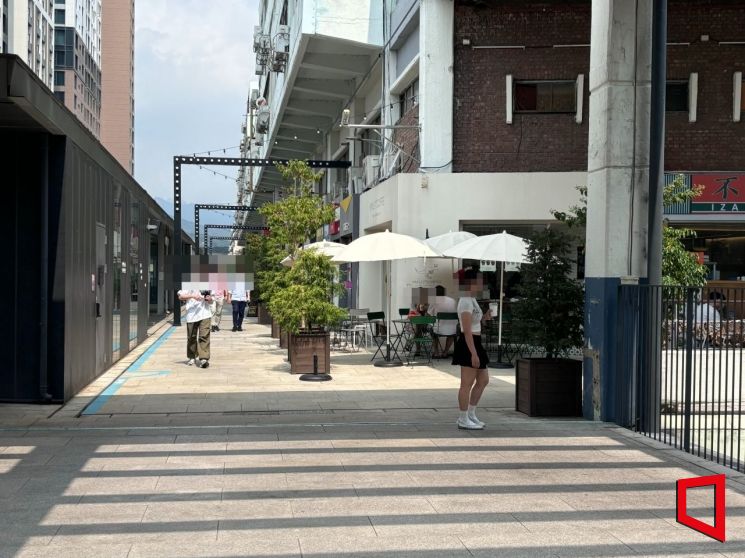 Citizens are walking on the elevated pedestrian walkway at Sewoon Sangga in Jung-gu, Seoul.
 [Photo by Yeom Dayeon]
The Sewoon Sangga aerial walkway is a 1 km-long bridge connecting the third floors of seven buildings: Jongmyo~Sewoon Sangga~Cheonggye & Daerim Sangga~Sampung Sangga & Hotel PJ~Inhyeon & Jinyang Sangga. It was promoted as part of an urban regeneration project starting in 2016 during former Seoul Mayor Park Won-soon's administration. Approximately 110.9 billion KRW of city budget was invested, and the entire section was completed and opened in 2022.
Among these, the 250m section between Sampung Sangga and Hotel PJ, which is connected only by the aerial walkway and not linked to any stores, is planned to be dismantled first and converted into a park. The dismantling of this section is expected to begin in March next year and take about three months. The remaining sections will be dismantled later according to the Sewoon Sangga complex parkification plan.
Seoul City cited the low-than-expected number of users and the fact that the walkway did not help revitalize the commercial district as reasons for dismantling the aerial walkway. According to the city, when the project was promoted, it was predicted that about 100,000 people would pass through the walkway annually, but the actual number of pedestrians last year was only about 10,000, which is 11% of the forecast.
In particular, the actual traffic volume on the aerial walkway section between Sampung and Hotel PJ, which is to be dismantled first, averaged 1,757 crossings per day, only 6.7% of the predicted figure. In contrast, the ground-level traffic volume averaged 12,206 crossings per day, about seven times that of the aerial walkway. However, it was confirmed that in some places, the sidewalk width at ground level was reduced to less than 1 meter due to piers and other facilities.
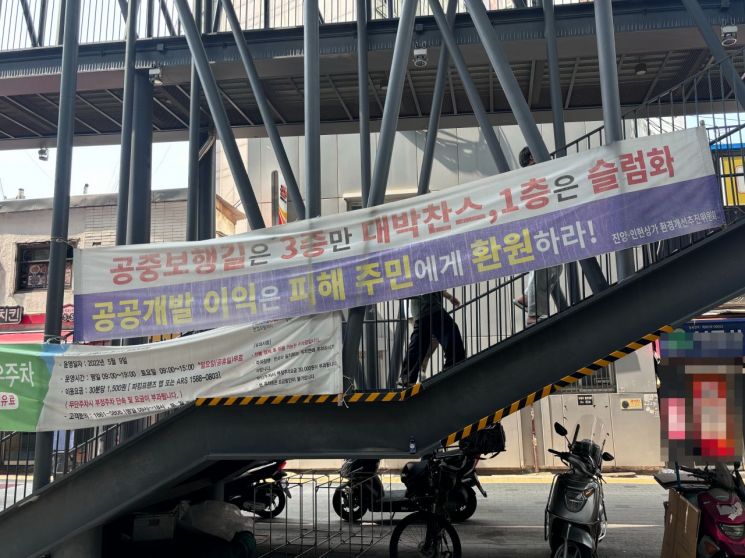
However, merchants did not hide their concerns about the dismantling of the aerial walkway. Lee (49), who runs a restaurant in Daerim Sangga, said, "It's a popular restaurant where people line up to eat, but I don't know what will happen in the future," and added, "Now they don't even turn on the lights on the walkway at night, and when I inquired with Seoul City, they said it's because of the electricity bill."
Kim (67), who runs a paint shop, also said, "Since there is a bridge, some people run on it, and overall the response seems good, but it seems to be used unnecessarily for political fights." Jo (44), who operates a cafe on the third floor of Sampung Sangga, expressed concern, saying, "I don't understand why they want to remove it instead of preserving the special commercial district connected by the bridge," and added, "It had been open for a year and was settling in, but if the walkway disappears, the number of customers will inevitably decrease."
Seoul City explained that the decision to dismantle was made after considering various factors, including residents' opposition from the early stages of the aerial walkway installation and continuous criticisms from the Board of Audit and Inspection. From the time of installation, concerns were raised that the ground-level sidewalks were narrowed, blocking sunlight and causing commercial districts to decline due to dispersed pedestrian traffic. After installation, it was also evaluated that the walkway was vulnerable to fire safety and did not contribute to regional regeneration through increased pedestrian traffic. Accordingly, Seoul City plans to hold a public hearing on the 23rd to discuss the dismantling of the aerial walkway and the urban regeneration activation plan for the Sewoon Sangga area.
A Seoul City official said, "We want to listen to citizens' opinions and improve the section between Sampung and Hotel PJ, where the ground-level pedestrian environment is poor and local residents suffer significant damage," and added, "This is not an attempt to erase the traces of the former mayor's urban regeneration project."
© The Asia Business Daily(www.asiae.co.kr). All rights reserved.
![Clutching a Stolen Dior Bag, Saying "I Hate Being Poor but Real"... The Grotesque Con of a "Human Knockoff" [Slate]](https://cwcontent.asiae.co.kr/asiaresize/183/2026021902243444107_1771435474.jpg)

















