Tmon and Wemakeprice (TMEP) have entered corporate rehabilitation two months after a large-scale settlement non-payment incident. Although they plan to normalize the companies and repay the unsettled amounts through external investment, there are also expectations that they may ultimately proceed to bankruptcy.
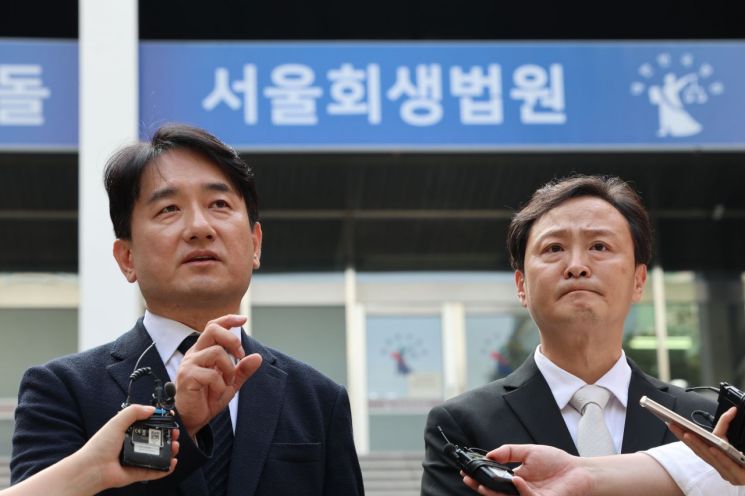 On the afternoon of the 10th, when the decision to commence rehabilitation procedures for TMON and WEMAKEPRICE was made, Ryu Hwa-hyun, CEO of WEMAKEPRICE (left), and Ryu Kwang-jin, CEO of TMON, are answering questions from the press at the Seoul Rehabilitation Court in Seocho-gu, Seoul.
 [Image source=Yonhap News]
Corporate Rehabilitation Initiated Two Months After Settlement Non-Payment Incident
The Seoul Rehabilitation Court, Rehabilitation Division 2 (Chief Judge An Byung-wook) decided on the commencement of rehabilitation procedures for Tmon and Wemakeprice on the 10th. Going forward, external managers appointed by the court will take charge of managing the two companies.
Typically, when a company applies for rehabilitation procedures, the existing management is appointed as the manager, so it is expected that Ryu Kwang-jin, CEO of Tmon, and Ryu Hwa-hyun, CEO of Wemakeprice, will continue to manage the companies. The two companies must prepare rehabilitation plans after compiling creditor lists, reporting and investigating claims, and other related processes.
However, in the case of TMEP, even though the rehabilitation procedures have commenced, it is expected to take time before a final decision is made on whether to rehabilitate or declare bankruptcy. Usually, when rehabilitation procedures begin, creditors are given about two months to report their claims. But since TMEP has tens of thousands of creditors, it may take a long time to ascertain the scale of the claims. If TMEP’s rehabilitation process proceeds successfully and a rehabilitation plan is prepared, a decision to approve the rehabilitation plan is expected within one to one and a half years.
Additionally, an investigator appointed by the court will evaluate TMEP’s going concern value and liquidation value. If it is judged during the rehabilitation process that the liquidation value of the company is higher, the rehabilitation procedure may be terminated or the rehabilitation plan rejected, leading to bankruptcy.
This incident was triggered on July 8 by Wemakeprice’s failure to pay settlement amounts to sellers. On July 19, Tmon indefinitely postponed settlement payments to travel agencies, causing the situation to escalate rapidly. TMEP applied for corporate rehabilitation procedures at the Seoul Rehabilitation Court on July 29, less than a month after the incident occurred. Subsequently, they attempted voluntary restructuring (ARS), but due to irreconcilable differences between creditors and TMEP as the debtor, the matter ultimately moved to the court’s judgment.
Corporate Normalization and Repayment Through M&A
TMEP is expected to include in its rehabilitation plan a strategy to overcome the current situation through external investment and mergers and acquisitions (M&A). They have consistently asserted this even before the court approved the rehabilitation plan.
After concluding the second confidential rehabilitation procedure meeting last month, CEO Ryu Hwa-hyun stated, “We have received letters of intent for investment from two domestic private equity firms,” adding, “Once creditor and debtor relationships are organized and investment commitment letters are obtained, the funds can be used to normalize and repay Tmon.”
Whether investment will actually follow remains uncertain, and even if investment is secured, the possibility of normalization is low. Most sellers and consumers have already left the platform. Moreover, TMEP is currently unable to properly pay employee wages due to financial difficulties, accelerating staff departures. Having lost trust, it is difficult to attract new sellers and consumers, and the lack of personnel makes it impossible to guarantee normal service operations.
If the rehabilitation plan is not properly implemented, the rehabilitation procedure may be terminated, leading to bankruptcy. In this case, unsettled claims will become worthless, resulting in damages amounting to trillions of won. According to the Ministry of Economy and Finance, the Financial Supervisory Service’s investigation concluded that the unsettled amounts Tmon and Wemakeprice failed to pay to sellers totaled 1.279 trillion won. The number of affected companies is 48,124.
Meanwhile, the ultimate person responsible for this incident, Koo Young-bae, CEO of Qoo10, previously proposed the establishment of KCCW (K-Commerce Center for World), which would merge TMEP as a rescue measure. The plan is to grow KCCW until 2027 and then either list it through an IPO or sell it. Creditors opposed this, arguing that it is an unrealistic plan aimed at evading responsibility. TMEP also plans to focus more on self-rescue measures independently of CEO Koo’s establishment of KCCW.
© The Asia Business Daily(www.asiae.co.kr). All rights reserved.
!["The Woman Who Threw Herself into the Water Clutching a Stolen Dior Bag"...A Grotesque Success Story That Shakes the Korean Psyche [Slate]](https://cwcontent.asiae.co.kr/asiaresize/183/2026021902243444107_1771435474.jpg)

















