Expansion of Facilities and Equipment at National University Medical Schools
Legal Amendments Proposed to Foster Regional University Hospitals
55.2 Billion KRW Allocated with Differential Support for Medical Education Innovation
Ministry of Education: "First Ever Financial Support for Medical Schools"
As the medical strike caused by the 'increase in medical school quotas' continues for a prolonged period, the government has proposed a conciliatory measure, pledging to invest about 5 trillion won to improve the educational environment of medical schools. This is the first time the government has concentrated financial investment in medical schools. The plan includes expanding facilities at national university medical schools and strengthening investments to develop national university hospitals into essential regional medical hubs.
On the 10th, the Ministry of Education held a briefing at the Government Seoul Office along with related ministries to announce the 'Investment Plan for Improving Medical Education Conditions.'
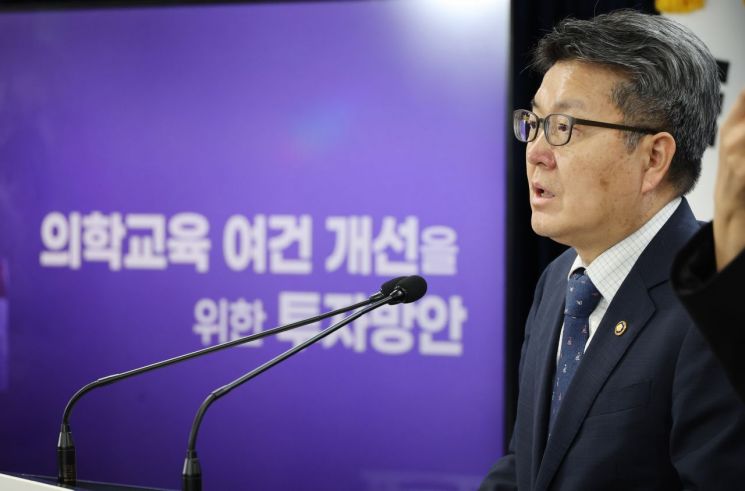
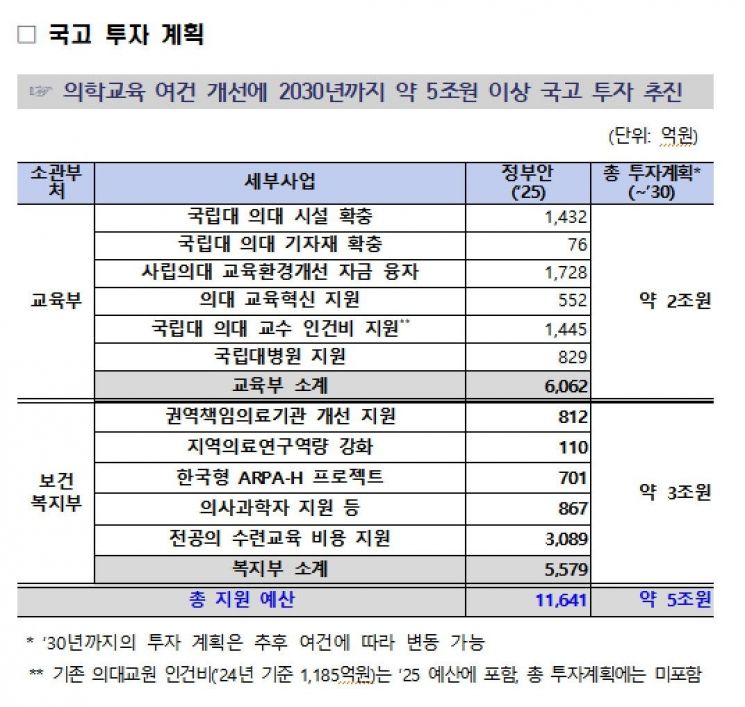
The government plans to invest more than 5 trillion won in national funds by 2030 to improve medical education conditions. The Ministry of Education intends to invest about 2 trillion won in areas including ▲expansion of facilities at national university medical schools (143.2 billion won) ▲expansion of equipment at national university medical schools (7.6 billion won) ▲loans for improving educational environments at private medical schools (172.8 billion won) ▲support for medical education innovation (55.2 billion won) ▲support for faculty salaries at national university medical schools (144.5 billion won) ▲support for national university hospitals (82.9 billion won).
The Ministry of Health and Welfare will invest about 3 trillion won in ▲support for improvement of regional responsibility medical institutions (81.2 billion won) ▲strengthening regional medical research capabilities (11 billion won) ▲Korean-style ARPA-H project (70.1 billion won) ▲support for physician-scientists (86.7 billion won) ▲support for resident training costs (308.9 billion won), among others.
First, the government will promote the expansion and improvement of faculty, facilities, and educational equipment at medical schools. There is also a plan to gradually support experimental and practical training equipment.
Additionally, the government will increase the number of professors at national university medical schools by 1,000 over three years starting next year. The scale is approximately 330 in 2024, 400 in 2026, and 270 in 2027. Private medical schools will also be encouraged to establish and implement their own faculty expansion plans.
Financial investment will be strengthened to develop national university hospitals and other university hospitals into regional and essential medical hubs. Along with this, a legal amendment will be pursued to transfer the management authority of national university hospitals from the Ministry of Education to the Ministry of Health and Welfare. To ease total salary and total quota regulations for national university hospitals, exceptions for designation as other public institutions will also be pursued.
By 2028, clinical education training centers will be established in all national university hospitals where students and residents can receive systematic, simulation-based education and training in environments similar to actual hospitals. Educational spaces within national university hospitals will be expanded, and student training conditions will be improved through modernization of hospital infrastructure.
Using the Regional Innovation-centered University Support System (RISE), the government plans to establish a virtuous cycle system to nurture doctors who settle in local communities. Additionally, the selection ratio for regional talent admissions at 26 non-metropolitan medical schools will be gradually increased, and specialized models for regional talent admissions will be developed. Furthermore, community-linked curricula will be strengthened, including expanded practical training within local communities.
In particular, the government will support medical education innovation with a budget of 55.15 billion won. The government plans to specify the plan through a separate consultative body with medical schools in the future. Support will be provided differentially after reviewing plans submitted by each school.
Investment in regional training hospitals will be strengthened, and the allocation of residents to regions will be expanded. Starting next year, the proportion of residents assigned to non-metropolitan areas is also being considered to increase from the current 45% to 50%. Additionally, a pilot project for multi-institution cooperative training based on the cooperative network between tertiary general hospitals and affiliated hospitals will be introduced from next year.
Moreover, starting next year, a 'contract-type essential physician system' for specialists will be introduced. It will target 96 specialists across 4 regions and 8 clinical departments, providing a monthly regional work allowance of 4 million won. Economic and non-economic support measures to encourage medical students from regional medical schools to settle in the region even after obtaining specialist qualifications will also be intensively reviewed as follow-up tasks by the Presidential Commission on Medical Reform.
However, the medical community is currently firmly opposing, demanding the 'cancellation of medical school quota increases in 2025 and 2026.' In response, there is a possibility within political circles to discuss zero increases in medical school quotas in 2026. Regarding this, Choi Eun-hee, Director of the Talent Policy Office at the Ministry of Education, stated, "If there is any change in the scale of quota increases in the future, we will consult with various ministries and universities and make comprehensive judgments considering those conditions at that time."
Director Choi also emphasized, "This is practically the first time financial support is being provided to medical schools," adding, "We have worked hard to secure the budget to turn this difficult opportunity into a chance to improve education."
© The Asia Business Daily(www.asiae.co.kr). All rights reserved.



















