Cooperation with MSC and Europe Instead of Hapag-Lloyd
Freer Despite US FMC Regulations
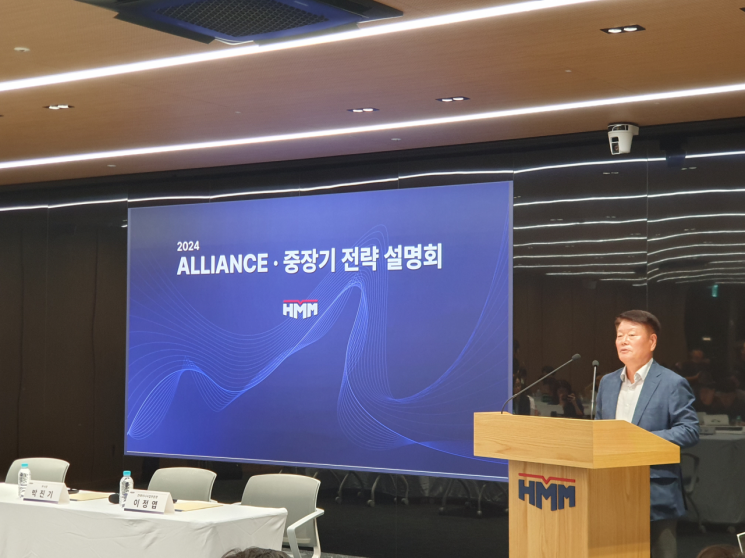 Kim Kyung-bae, CEO of HMM, is holding a press conference at the HMM headquarters in Yeouido, Seoul on the 10th.
HMM has put an end to the long-standing controversy over the reorganization of the shipping alliance. Even after Germany's Hapag-Lloyd exited the existing alliance, HMM maintains its alliance system with Japan's ONE and Taiwan's Yang Ming, while strengthening the gap left by Hapag-Lloyd through cooperation with MSC, the world's number one shipping company.
On the morning of the 10th, Kim Kyung-bae, CEO of HMM, held a press conference at the headquarters in Yeouido, Seoul, emphasizing this point. Kim said, "The new cooperation system will have the highest level of competitiveness compared to other shipping alliances," and explained, "The gap left by Hapag-Lloyd, which mainly handled the European region within the alliance, has been filled by cooperating with Switzerland's MSC, allowing us to secure more ports and routes and enhance competitiveness."
Earlier, HMM announced the formation of a new cooperative body called the "Premier Alliance" with ONE and Yang Ming, partners of the existing shipping alliance "THE Alliance." The cooperation period is five years starting from February next year. Additionally, HMM agreed to exchange slots with MSC on the Northern Europe and Mediterranean routes for four years starting from February next year.
This arrangement is expected to secure the east-west routes connecting Europe and Asia more stably. Although concerns arose about a decline in competitiveness on European routes after Hapag-Lloyd left the existing "THE Alliance," HMM maintains that there is no problem at all. Lee Jung-yeop, Executive Vice President and Head of HMM's Container Business Division, stated, "Hapag-Lloyd's contribution was about 20%, mostly on Mediterranean routes, and it hardly contributed to the slot capacity connecting Asia and the U.S. West Coast," adding, "With cooperation with MSC, the slot capacity on the Northern Europe routes of the Premier Alliance reaches 3 million TEUs, surpassing other shipping alliances such as Ocean with 2.5 million TEUs and Gemini with 1.9 million TEUs."
According to HMM, the number of service routes increased from 26 under the existing THE Alliance system to 30 with the Premier Alliance. Specifically, Northern Europe routes increased from 4 to 6, Mediterranean routes from 4 to 5, and Middle East routes from 2 to 3.
In particular, through slot exchange cooperation with MSC, the number of European routes expanded from 8 (4 Northern Europe and 4 Mediterranean) to 11 (6 Northern Europe and 5 Mediterranean).
HMM expects that a significant volume of cargo previously transferred at Busan Port by the 2M alliance, consisting of Maersk and MSC, will be maintained. Additionally, HMM plans to attract direct flight services originating from Korea to strengthen the competitiveness of domestic ports. Specifically, the Premier Alliance plans to provide direct flight services from Busan, Japan, and Vietnam to Northern Europe, which are not offered by other shipping alliances such as Ocean and Gemini. On the Mediterranean routes, HMM aims to maximize the number of port calls at key ports in Busan, China, Southeast Asia, and the Mediterranean, and plans to implement new direct flight services to Turkey and other locations.
This system is also expected to avoid antitrust regulations from the U.S. Federal Maritime Commission (FMC). Executive Vice President Lee said, "The routes under FMC jurisdiction are those from Asia to the U.S. East Coast and from the U.S. East Coast to Europe," adding, "The cooperation with MSC is strong enough to be legally binding, but since it is a one-to-one slot exchange rather than a shipping alliance, it is expected to be free from antitrust regulations."
Meanwhile, HMM remained tight-lipped about the suspended sale of the company. CEO Kim said, "We have not had any special talks with the major shareholder, and it is not our place to comment," and explained, "We plan to repay the perpetual bonds scheduled for this year and next year early as planned." HMM is scheduled to repay early perpetual bonds worth 660 billion KRW in October this year and 720 billion KRW in April next year. Once the perpetual bonds are repaid, the stakes held by KDB Industrial Bank and Korea Ocean Business Corporation are expected to increase further. Currently, their combined HMM stake is 57.9% as of the first quarter, and if the perpetual bonds are converted into shares, the volume will increase, leading to speculation that the sale may become more difficult.
© The Asia Business Daily(www.asiae.co.kr). All rights reserved.

















