Preventing Gaps in the Dissolution Process of 'Seosawon'
Strengthening Care for Severe and High-Difficulty Cases... Measures to Improve Treatment Including Additional Allowances for Care Workers
The 'Social Service Support Center' set to replace the closing Seoul Social Service Institute will open next month. Its role has been adjusted to strengthen services through providing incentives to the private sector rather than directly offering care services. Seoul City will operate a specialized call center to bridge the 'information gap' that prevents people from accessing care services due to lack of information, and will also improve the treatment of care workers.

On the 9th, Seoul City announced the 'Seoul Care Service Publicness Enhancement Plan' to enable the community to promptly provide care when citizens need it. The goal is to create a safe care ecosystem by investing 878.6 billion KRW over five years. Seonghun Jeong, Director of Seoul Welfare Office, said in a morning briefing, "This plan is about the first phase," adding, "We focused on long-term care for the elderly, support for disabled activities, and emergency care."
This plan was established to prevent care gaps following the abolition of the Seoul Social Service Institute ordinance in May. Seoul City stated that the Institute had failed to provide care requiring public roles, such as care for high-need users and during vulnerable hours, and had operated more for the convenience of workers than users, contrary to its original purpose. Therefore, the public sector will shift from direct service provision to roles in education, training, and quality improvement, while providing incentives to the private sector to eliminate blind spots in care.
Social Service Support Center, Focused on Supporting and Nurturing the Private Sector
The city plans to establish and operate the dedicated support organization 'Social Service Support Center' within the Seoul Welfare Foundation starting next month to play a new public care role. Unlike the Seoul Social Service Institute, which mainly provided direct services, the Center will focus on supporting and nurturing private service providers. It will ensure the publicness of private services and perform quality management, consultation, and educational support to prevent service quality imbalance among providers. Director Jeong said, "Although the Institute started with the goal of addressing care blind spots that the private sector could not cover with publicness, it practically failed to do so until recently, five years later," adding, "We will now focus more on supporting and managing private services rather than the roles previously performed by the Institute."
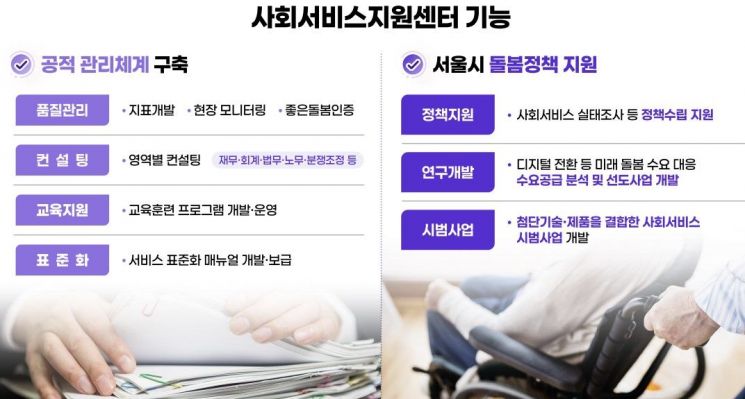
Since the nature of the Social Service Support Center differs from the Institute's previous role, new personnel will be selected through an open recruitment process. Director Jeong explained, "We provided retirement consolation payments to the Institute's workers and held briefing sessions through the Ministry of Employment and Labor to connect them to good care institutions," adding, "There will be no employment succession issues. The Institute will be completely dissolved, and the Support Center will be established as a new function within the investment-funded institution, with new personnel selected through a recruitment process."
To improve citizen access to care services, a specialized counseling call center, 'Safe Care 120,' will be pilot-operated starting next month. After calling the 120 Dasan Call Center and pressing a specific number, callers will be connected to a counselor who will guide them to the most appropriate information and institutions based on their care needs. A KakaoTalk counseling center will also be operated for hearing- and speech-impaired individuals or those reluctant to use the phone.
Additionally, the city plans to establish and pilot-operate integrated care support centers next year to enable elderly and disabled individuals to receive all necessary services in one place where they live. These centers will serve as integrated consultation desks within the community, tailored to user characteristics such as age, health status, primary caregiver, and living environment, providing guidance on all available services and linking users to service providers. Four centers, including 'public type' directly operated by autonomous districts and 'private type' utilizing welfare centers and other specialized organizations, will be pilot-operated from next year, with plans to expand based on performance evaluations.
Additional Support for High-Need and Severely Disabled Elderly Care
Seoul City aims to minimize care blind spots that frequently occur among low-income, high-need, and severely disabled elderly and disabled individuals. Elderly requiring high-level care, such as bedridden, severe dementia, or large body size, will be linked to 'Seoul-type Good Care Certified Institutions' to prevent avoidance. Currently, 460 elderly are managed at seven locations, with a goal to expand to at least one location per autonomous district (25 locations). For elderly difficult to manage by one caregiver, the city will support additional personnel wages for up to four hours per day to enable two-person care teams.
From next year, four 'Specialized Activity Support Institutions' dedicated to bedridden, paralyzed, and high-need severely disabled individuals living alone will be designated and operated. The goal is to reduce the usual 15-30 day connection time for high-need severely disabled activity supporters to a maximum of one week. Designated institutions will receive annual support of 20 million KRW for dedicated personnel wages and operating expenses. Activity supporters caring for high-need severely disabled individuals will also receive an additional monthly 'High-Need Care Allowance' of 300,000 KRW.
For school-age disabled children aged 8-19 requiring short-term mobility support of up to 90 hours per month for commuting and after-school programs, a monthly support of 100,000 KRW will be provided. The annual usage limit for Care SOS Service will be increased by 200,000 KRW to 1.8 million KRW, and the upper limit for each of the five services will be abolished.
Improving Care Workers' Treatment... Aiming for 'Sustainability'
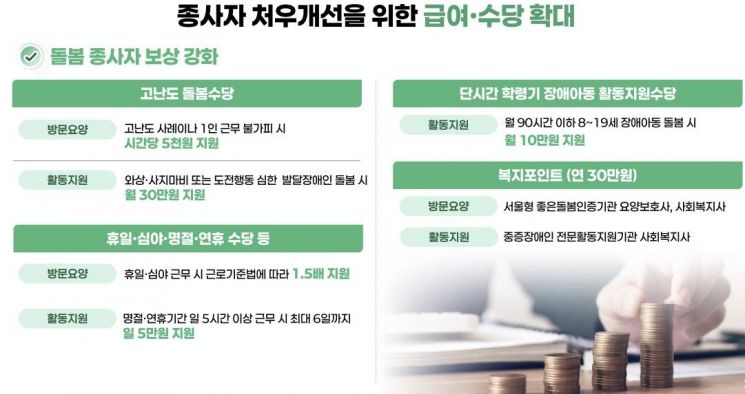
Measures to improve care workers' treatment include strengthening economic compensation and improving working conditions. First, when a visiting caregiver must care alone for a high-need or severely disabled client who requires two-person care, an additional 5,000 KRW per hour will be paid. Workers affiliated with Seoul-type Good Care Certified visiting care institutions and social workers at specialized activity support institutions for the severely disabled will receive welfare points worth 300,000 KRW annually.
Allowances to resolve care issues during holiday periods will also be provided. Disabled service users will receive a 50% surcharge compared to weekdays. Activity supporters will receive a special holiday allowance of 50,000 KRW per day, up to six days annually.
Robots and other equipment to reduce work intensity and prevent musculoskeletal disorders will be supported. Fifty wearable and excretion care robots will be pilot-introduced at Good Care Certified Institutions, and eight at specialized activity support institutions. Smart cognitive programs for dementia patients will also be supported. Furthermore, Seoul City will provide professional counseling, including legal advice, for care workers facing emotionally or physically dangerous situations, and plans to produce and distribute a 'Rights Recovery Manual.'
© The Asia Business Daily(www.asiae.co.kr). All rights reserved.
![Clutching a Stolen Dior Bag, Saying "I Hate Being Poor but Real"... The Grotesque Con of a "Human Knockoff" [Slate]](https://cwcontent.asiae.co.kr/asiaresize/183/2026021902243444107_1771435474.jpg)


















