Selected 131 Locations with 71 Improved by July
All Effective in Queue Length and Traffic Speed
Additional 60 Locations to Be Improved with Related Agencies by September
The Seoul Metropolitan Government, in collaboration with the Seoul Metropolitan Police Agency, has changed the signal system at major habitual congestion sections to improve vehicle flow. About 130 locations, including the Bukahyeon-ro intersection, were targeted, and an effect of improved travel speed was analyzed.
According to the Seoul Metropolitan Government on the 9th, more than 70% of traffic-related complaints received by the Seoul Metropolitan Police Agency and local police stations in the first quarter were about resolving traffic congestion. In particular, traffic inconvenience during commuting hours was found to be high.
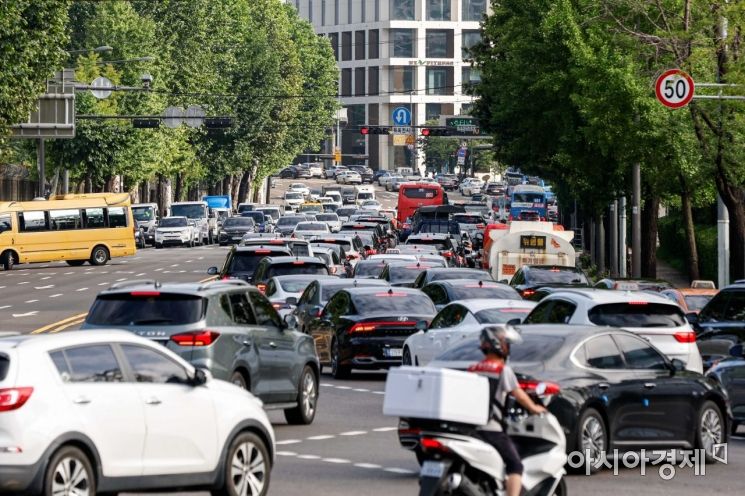
Accordingly, the Seoul Metropolitan Government and the Seoul Metropolitan Police Agency held a task force (TF) meeting in April to improve habitual traffic congestion points, selecting 131 target sections and working to resolve habitual congestion through signal system improvements. The TF team initially selected 94 habitual congestion sections from traffic-related complaints received in the first quarter and additionally selected 37 sections through data analysis.
Primarily, the signal systems of 71 locations were improved by July, and compared to before the improvements, the average queue length decreased by 9.3%, and travel speed increased by 8.7%.
For example, at the Gimpo Airport Entrance intersection, the left-turn signal time from the north to the east direction and the pedestrian signal time partially overlapped, causing habitual queue spillbacks. After changing the pedestrian signal sequence, the travel speed increased from an average of 18.5 km/h to 27.4 km/h. The queue length shortened from 195 m to 110 m. At the Gurebang Bridge intersection on Bukahyeon-ro, the pedestrian signal at the ePyeonhansesang Sinchon 401-dong intersection turned on during the vehicle signal, causing vehicles to suddenly stop or speed up frequently. However, by changing the signal system and adjusting signal times, the passage width for vehicles in both directions was expanded, resolving traffic congestion and reducing the risk of traffic accidents.
The Seoul Metropolitan Government plans to complete the second phase of signal improvements for the remaining 60 locations by September in cooperation with related agencies. Furthermore, it will expand the spatial scope to include road axes and surrounding areas to improve vehicle flow across the entire road axis. Yoon Jong-jang, Director of the Seoul Metropolitan Government’s Transportation Office, said, "There are limits to meeting increasing traffic demand through physical road environment improvements alone," adding, "We will actively promote traffic operation policies such as signal system improvements to alleviate citizens’ traffic inconveniences."
© The Asia Business Daily(www.asiae.co.kr). All rights reserved.

















