Kishida's Final 2-Day Visit to Korea Before Retirement
Consensus on 'Korea-Japan Relations Development' Despite Change in Prime Minister
No Mention of Past Issues Like Sado Mine or Forced Labor
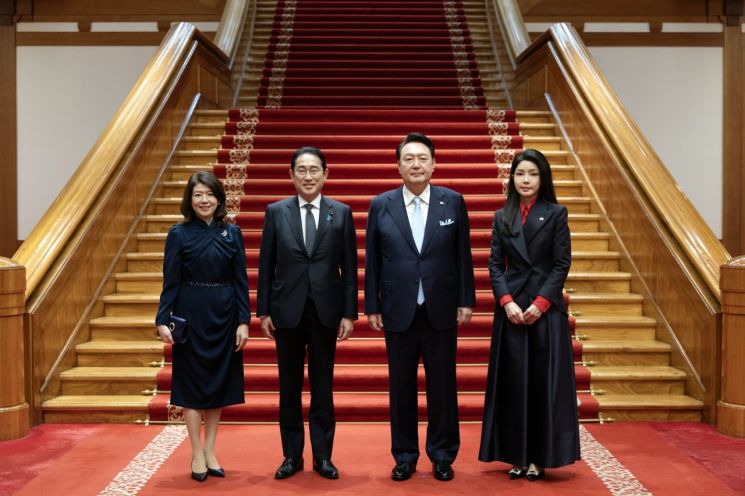 President Yoon Suk-yeol and First Lady Kim Keon-hee, Japanese Prime Minister Fumio Kishida and Mrs. Yuko are taking a commemorative photo at the dinner held at the main building of the Blue House on the 6th. Photo by Yonhap News
Japanese Prime Minister Fumio Kishida, concluding his 1-night, 2-day visit to South Korea, urged President Yoon Suk-yeol to "continue efforts for the development of Korea-Japan relations." Through this summit, the two leaders confirmed a consensus on the future-oriented development of bilateral relations and achieved concrete outcomes such as signing the 'Memorandum of Cooperation on the Protection of Overseas Nationals' and exploring 'measures to simplify immigration procedures.' However, historical issues that attracted attention, such as the 'Sado Mine,' were not even brought to the negotiation table, leading to criticism that the meeting was only a half-hearted encounter.
Proactive Kishida: "Whoever the next prime minister is, Korea-Japan relations remain important"
After completing his visit to South Korea on the 6th and 7th, Prime Minister Kishida posted on his social media platform X (formerly Twitter), expressing, "I sincerely thank President Yoon and First Lady Kim Geon-hee," and wrote, "Please continue to work hard so that Korea-Japan relations will further develop." He also recalled, "This was my third visit to Korea, and President Yoon has visited Japan twice. Especially, the memory of having sukiyaki (Japanese-style meat hot pot) together with his wife in Ginza was a pleasant one."
During his visit, Kishida actively engaged by posting four messages related to Korea-Japan relations on X. Having decided not to seek re-election and with his term ending later this month, Kishida is known to have strongly desired this visit to finalize the improvement of Korea-Japan relations, one of his greatest achievements during his tenure.
In fact, President Yoon and Prime Minister Kishida have demonstrated a 'bromance' by holding 12 summits since their inaugurations. In this summit, they not only reaffirmed their policy of continuous improvement in Korea-Japan relations but also prepared concrete practical cooperation measures. Notably, they signed a memorandum of cooperation on the protection of overseas nationals to mutually assist in evacuating and withdrawing their citizens in the event of a crisis in a third country, and agreed to explore measures to simplify immigration procedures, such as introducing a 'pre-entry inspection system' allowing Japanese entry screening at domestic airports.
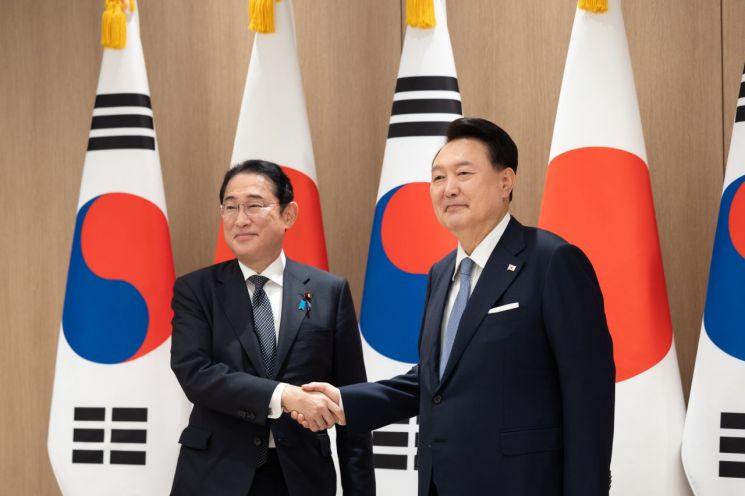 President Yoon Suk-yeol shakes hands with Japanese Prime Minister Fumio Kishida at the expanded Korea-Japan summit held at the Yongsan Presidential Office in Seoul on the 6th. [Image source=Yonhap News]
During the small-scale talks, expanded meetings, and dinner held during the visit, President Yoon and Prime Minister Kishida emphasized the need for harmony to advance Korea-Japan relations in a warm atmosphere. Kishida said, "Since President Yoon made a significant decision to improve Korea-Japan relations in March last year, cooperation between the two countries has greatly expanded," and President Yoon stated, "The achievements we have built together with Prime Minister Kishida are the most meaningful since I took office."
In particular, the two leaders confirmed their intention to continue cooperation even after the change of the Japanese prime minister. Kim Tae-hyo, First Deputy Director of the National Security Office, conveyed that Kishida said, "Whoever becomes Japan's next prime minister, the importance of Korea-Japan relations will not change." President Yoon also requested, "Please play a role so that the successor prime minister can continue the flow of Korea-Japan relations development," to which Kishida reportedly replied, "I will gladly do so."
Unmentioned Sado Mine and Forced Labor... Opposition: "No Apology Until the End"
However, the summit did not mention diplomatic controversies related to Japan's Sado Mine UNESCO registration process. A presidential office official said, "The registration of the Sado Mine was already settled through intense negotiations and agreements in July, so it was not mentioned between the leaders." The Sado Mine was a site where Koreans were forcibly mobilized during the Japanese colonial period. The Japanese government succeeded in registering it as a World Cultural Heritage site this year. Although the South Korean government agreed, controversy arose over humiliating diplomacy because Japan did not specify 'forced' mobilization of Korean workers in related exhibits.
Prime Minister Kishida expressed at the summit regarding historical issues, "I personally feel deeply saddened that many people had very difficult and sorrowful experiences under harsh conditions at that time." He also stated, "Including the 1998 Korea-Japan Joint Declaration, I clearly conveyed that the historical awareness inherits the stance of successive Japanese cabinets as a whole."
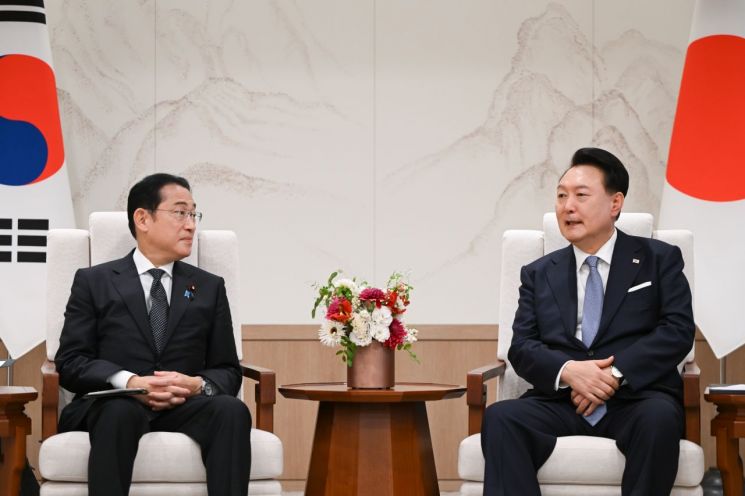 President Yoon Suk-yeol is talking with Japanese Prime Minister Fumio Kishida at the Korea-Japan small group meeting held on the 6th at the Yongsan Presidential Office in Seoul. [Image source=Yonhap News]
However, Kishida's remarks did not represent a progressive stance beyond his previous position. Earlier, in May last year, Kishida had stated that he inherits the historical awareness of successive Japanese cabinets, including the 1998 Korea-Japan Joint Declaration, and at a joint press conference after the summit with President Yoon, he mentioned, "I am saddened by the fact that many people suffered very painful and sorrowful experiences under harsh conditions during the forced labor period."
Regarding the 'third-party compensation plan,' a solution to the forced labor issue announced by President Yoon in March last year, Korea and Japan failed to achieve concrete results. This plan involves the Japan-Korea Forced Labor Victims Support Foundation paying compensation and delayed interest to victims who have received confirmed compensation rulings in lawsuits, using funds voluntarily contributed by private sectors from both countries instead of Japanese companies. However, Kishida did not show clear support during this meeting either.
As a result, criticism poured in from the political sphere, especially from opposition parties. Despite repeated meetings where the two leaders called for the development of Korea-Japan relations, there was no progress on the crucial historical issues.
Han Min-soo, spokesperson for the Democratic Party, said at a National Assembly briefing the day before, "No matter how much the Yoon Suk-yeol administration tries to dress it up, handout diplomacy cannot be disguised as an achievement," and criticized, "Prime Minister Kishida, who visited Korea before his retirement, did not utter a sincere apology regarding historical issues until the very end." He added, "Do not package the small souvenirs obtained from Japan as achievements," and pointed out, "The hope of the Yoon administration that if South Korea fills half of the water cup, Japan will fill the other half ended as a vain hope."
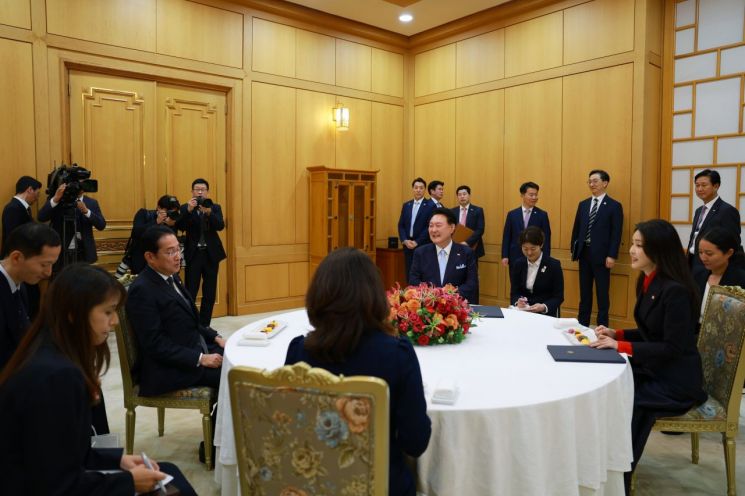 President Yoon Suk-yeol and First Lady Kim Keon-hee are having a conversation with Japanese Prime Minister Fumio Kishida and his wife Yuko, who visited the Blue House main building on the 6th.
 [Image source=Yonhap News]
© The Asia Business Daily(www.asiae.co.kr). All rights reserved.



















