'Gimpo Airport Innovation District' Designation Notice... 2.9 Trillion KRW Investment
30,000 Jobs and 4 Trillion KRW Economic Impact... UAM Takeoff and Landing Site
Development Profits Invested in Living SOC... Promoting Coexistence of Preservation and Development
By 2030, an urban air mobility (UAM) takeoff and landing site and a complex transfer facility will be completed around Seoul Gimpo Airport, ushering in a full-fledged era of aerial transportation. Gimpo Airport will be reborn as an airport-centered industrial and economic hub like Tokyo's Haneda Airport and Singapore's Changi Airport, with enhanced airport functions such as passenger and logistics movement and an expanded future advanced industry cluster.
On the 8th, Seoul City announced that the area around Gimpo Airport in Gonghang-dong, Gangseo-gu (354,000㎡) is scheduled to be officially designated as the 'Gimpo Airport Innovation District' on the 9th, and detailed development plans will be promoted thereafter. Since the legal basis for project funding has been established, the city plans to proceed swiftly together with the project implementer, Korea Airports Corporation.
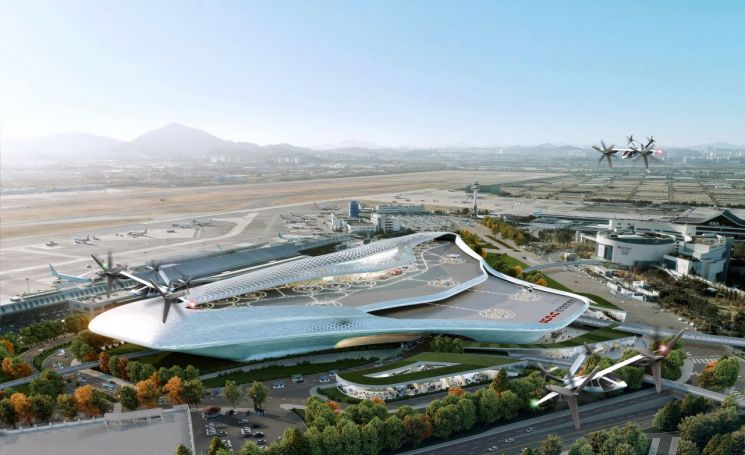 Perspective view of Gimpo Airport UAM (Urban Air Mobility) takeoff and landing site and complex transfer facility. [Provided by Seoul Metropolitan Government]
The area around Gimpo Airport was conditionally selected in December 2021 by the Ministry of Land, Infrastructure and Transport as an urban regeneration innovation district (national pilot district) for aviation-related business and educational facilities and mobility innovation industry facilities, and passed the public institution project feasibility study (preliminary feasibility study) last June. In June, after receiving a legal interpretation response from the Ministry of Government Legislation stating that the innovation district can be designated without lifting the development restriction zone, the final designation and announcement were made through the Ministry of Land, Infrastructure and Transport’s Urban Regeneration Special Committee review, opening the way for the project.
After the innovation district development is completed in 2033, Gimpo Airport will be reborn as an innovative new industry hub linked with new complex transfer facilities such as UAM takeoff and landing sites and S-BRT (spine bus rapid transit), as well as existing urban airport infrastructure. It is expected to create about 30,000 jobs and an economic ripple effect of approximately 4 trillion KRW.
Specifically, a total project cost of 2.964 trillion KRW will be invested in the Gimpo Airport Innovation District, including ▲100 billion KRW from national and city funds ▲490 billion KRW from public sources such as Korea Airports Corporation ▲2.905 trillion KRW from the private sector, transforming it into a future transportation and mobility advanced industry base including UAM, S-BRT, and urban rail. The 'Gimpo Airport Urban Regeneration Innovation District,' developed as a complex facility ranging from four basement floors to eight above-ground floors, will cover a total area of 350,000㎡ with three blocks. Block 1 will house UAM takeoff and landing sites and complex transfer facilities, Block 2 will focus on aviation business facilities, and Block 3 will be centered on advanced industry facilities.
Development profits generated from the creation of an advanced industry cluster linked to the airport will be reinvested in the local area. The plan is to foster coexistence with areas that have been marginalized due to airport noise damage and building regulations, as well as public, sports, and childcare facilities. Additionally, benefits will be provided for residents near Gimpo Airport, including discounts on rent for nearby shops and officetels, reduced fees for public parking lots, and priority hiring opportunities for local residents by innovative district tenant companies such as mobility advanced industry firms.
Kim Seung-won, head of Seoul City’s Balanced Development Headquarters, said, "We will strive to return development benefits that residents near Gimpo Airport, who have experienced development restrictions and disconnection from surrounding areas due to airport facilities, can feel. Above all, we will vigorously promote the project so that the area around Gimpo Airport can be reborn as a future transportation hub and an economically vibrant city centered on advanced industries."
© The Asia Business Daily(www.asiae.co.kr). All rights reserved.
![User Who Sold Erroneously Deposited Bitcoins to Repay Debt and Fund Entertainment... What Did the Supreme Court Decide in 2021? [Legal Issue Check]](https://cwcontent.asiae.co.kr/asiaresize/183/2026020910431234020_1770601391.png)















