[Current Status of Biofuels in the US] ②
Interview with Professor Stephan Mueller of University of Illinois
Emphasizing the Need to Simultaneously Utilize All Available Technologies
"To achieve carbon neutrality, I believe it is necessary to approach it by utilizing all technologies in combination. It cannot be achieved by just one or two technologies. Improving engines or using electric vehicles alone is not enough."
Stefan Mueller, a professor at Illinois State University in Chicago, said this during a meeting with Korean reporters on the 3rd. Professor Mueller, affiliated with the university's Energy and Fuel Center, specializes in bioenergy and life cycle analysis (LCA) of energy sources. He said, "In other fields, it is easier to find alternative means or energy sources, but this is not the case in the transportation sector," adding, "There will inevitably be more pressure to realize carbon neutrality."
 Professor Stephan Mueller of Illinois State University in Chicago explained bioethanol to the Korean press on the 3rd.
 [Photo by U.S. Grains Council]
Like in Korea, the spread of electric vehicles in the United States has been slow, and this trend is expected to continue for some time. Despite various policies to expand adoption, such as tax benefits, there are many issues that are not easy to solve in the short term, such as the lack of charging infrastructure. Professor Mueller said, "At least until the next generation, hybrid engines are the answer," and added, "Then, in the current generation, carbon emissions should be reduced by using clean gasoline with hybrids."
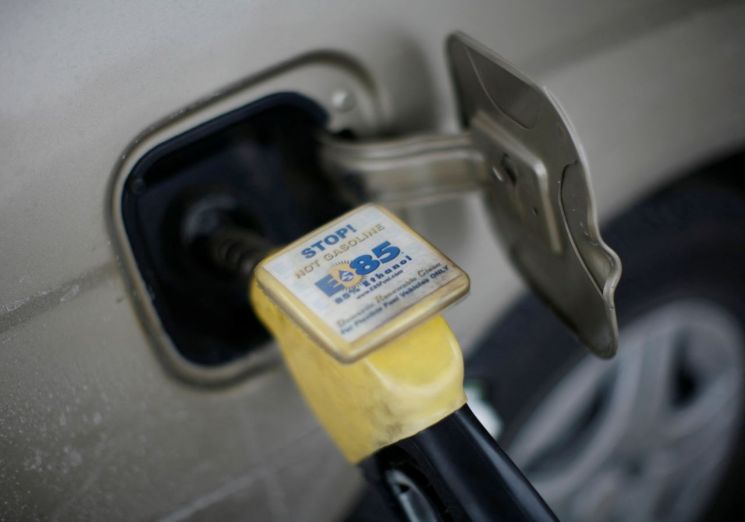
He pointed out that mixing bioethanol, obtained by processing corn and other crops, with gasoline not only increases the octane rating but also has the advantage of not using harmful substances to the human body. He explained, "In the U.S., MTBE was mixed in the past but was found to be a carcinogen and is no longer used," adding, "Ethanol-blended fuel has a high octane rating without additional additives, making it advantageous in terms of cost and the environment."
He also emphasized that the increasing adoption of Sustainable Aviation Fuel (SAF), including in Korea, should be noted. Korea plans to mandate the use of eco-friendly fuel blended with conventional aviation fuel starting in 2027. Some countries, including France, have already implemented this.
He explained, "It is difficult to operate airplanes with electricity, so using clean fuel is an important issue," and added, "Various technologies are being researched and commercialized simultaneously, including the use of ethanol in addition to biodiesel."
© The Asia Business Daily(www.asiae.co.kr). All rights reserved.

![User Who Sold Erroneously Deposited Bitcoins to Repay Debt and Fund Entertainment... What Did the Supreme Court Decide in 2021? [Legal Issue Check]](https://cwcontent.asiae.co.kr/asiaresize/183/2026020910431234020_1770601391.png)