Pope Francis, who embarked on a tour of four countries in Asia and Oceania, arrived in Papua New Guinea following his visit to Indonesia.
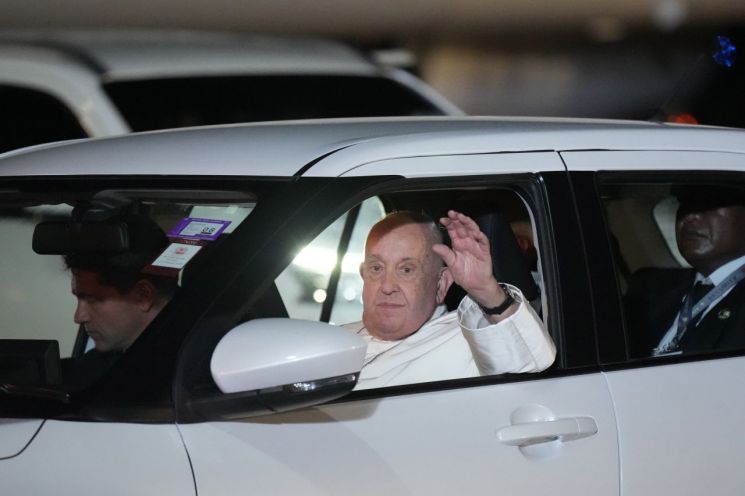
On the 6th (local time), the Pope departed from Jakarta, Indonesia in the morning and arrived in Port Moresby, the capital of Papua New Guinea, the second country on his tour, in the afternoon of the same day. At the airport, he met with Catholic officials including Papua New Guinea Prime Minister James Marape who came to greet him, and after a brief welcoming ceremony, he moved to the Apostolic Nunciature in Papua New Guinea.
On the 8th, the Pope plans to visit the remote jungle area of the Vanimo Diocese in Papua New Guinea. Vanimo is located at the northernmost border area between Papua New Guinea and Indonesia and is considered the most remote and isolated region. About 120,000 people live there, but residents have not had access to tap water or electricity and lived in isolation for a long time, with missionaries arriving only in 1961. The Pope plans to meet priests and nuns from his home country Argentina in the Vanimo Diocese. He also plans to inspect a high school established by the church and a center for abused women.
In addition, the Pope will meet with Catholic officials, street children, youth, civic groups, and political leaders during his four-day stay in Papua New Guinea, and plans to move to East Timor on the 9th.
Father Thomas Lavauli, an Argentine who has been active in Vanimo for 14 years, said, "Because of the pagan traditions, it is not easy to practice Catholic faith 100%, but I think the Christian identity in Papua New Guinea is very strong."
In Papua New Guinea, about 96% of the approximately 12 million population are Christians. Among them, Catholics make up about 30%. However, as traditional beliefs have long been combined, local Christian culture unique to Papua New Guinea is being formed, with practices such as shamanism and witch hunts still remaining.
© The Asia Business Daily(www.asiae.co.kr). All rights reserved.
![Clutching a Stolen Dior Bag, Saying "I Hate Being Poor but Real"... The Grotesque Con of a "Human Knockoff" [Slate]](https://cwcontent.asiae.co.kr/asiaresize/183/2026021902243444107_1771435474.jpg)
















