Real Estate R114, Weekly Apartment Market Trends in the Seoul Metropolitan Area
Seoul Sales and Jeonse Prices Each Rise by 0.03%
Increased Movement Compared to Previous Week
Stress DSR Level 2 Differential Interest Rates Applied in Metropolitan Area
Need to Monitor Direction of Demand Contraction
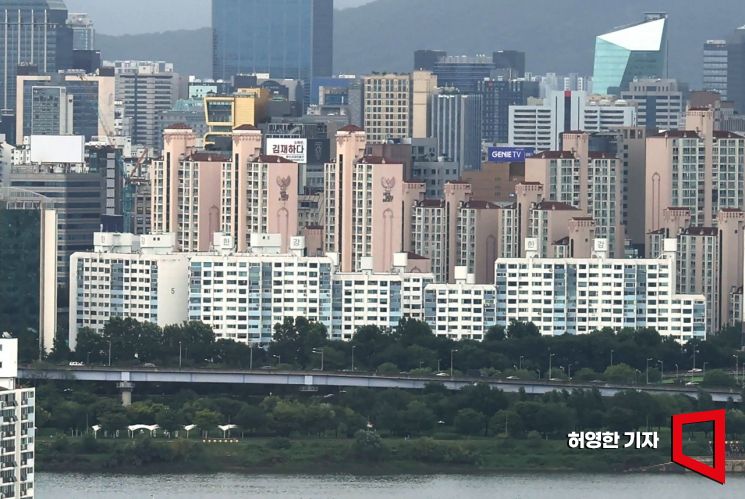
The rate of increase in apartment sale and jeonse prices in Seoul and the metropolitan area slightly expanded (by 0.01%~0.02 percentage points) in the first week of September. According to Real Estate R114 on the 7th, jeonse prices have been rising for over a year in Seoul and the metropolitan area, and sale prices have been increasing for 13 consecutive weeks in Seoul and the metropolitan area.
However, since comprehensive loan regulations including Stress DSR Level 2 were introduced from this month, it is necessary to observe a bit longer to see if there will be an impact of demand contraction leading to a slowdown in the rate of change. For the sale price trend to slow down, it is essential that the jeonse market, which continues to stimulate actual demand, stabilizes first. However, with the autumn moving season in full swing, the situation is not easy.
Seoul apartment sale prices rose by 0.03%, increasing the rise by 0.01 percentage points compared to the previous week. General apartments increased by 0.03%, and reconstruction apartments rose by 0.04%. New towns and Gyeonggi/Incheon each rose by 0.01%.
Among the 25 districts in Seoul, none showed a decline, and prices rose in 16 districts, which is more than half. The increases were led by Mapo (0.13%), Gangdong (0.09%), Seongdong (0.06%), Eunpyeong (0.04%), Dongjak (0.04%), and Gangnam (0.04%).
In new towns, Dongtan (0.03%) and Bundang (0.01%) rose, while in Gyeonggi/Incheon, Incheon (0.06%), Guri (0.03%), Suwon (0.02%), Seongnam (0.02%), Hwaseong (0.01%), and Gwangmyeong (0.01%) saw increases.
The metropolitan area jeonse market entered the autumn moving season in earnest, slightly increasing the rate of rise compared to the previous week in Seoul, new towns, and Gyeonggi/Incheon. This week, Seoul rose by 0.03%, new towns by 0.01%, and Gyeonggi/Incheon by 0.02%.
In Seoul, Gangdong (0.13%), Jungnang (0.12%), and Dongdaemun (0.12%) showed a notable weekly increase of over 0.10%. Following were Gwanak (0.08%), Seongdong (0.07%), Gangnam (0.05%), Yongsan (0.04%), Mapo (0.04%), Nowon (0.04%), and Guro (0.04%).
Most new towns remained flat (0.00%), with Dongtan (0.08%) and Pyeongchon (0.01%) rising. In individual areas of Gyeonggi/Incheon, Ansan (0.09%), Incheon (0.08%), Guri (0.07%), Uiwang (0.02%), and Suwon (0.02%) increased.
A Real Estate R114 official explained, "Looking at apartment transaction movements in Seoul, we can confirm the essential goods characteristic related to food, clothing, and shelter," adding, "As sale transaction volumes increase, rental transactions such as jeonse and monthly rent tend to relatively decrease."
For example, in May, there were 5,118 sale transactions, 11,588 jeonse transactions, and 8,243 monthly rent transactions. However, in July, as sale transactions surged to 8,783, jeonse transactions shrank to 10,436, and monthly rent transactions to 6,476.
He said, "Since immediate housing issues are resolved only through sales or jeonse/monthly rent, the stronger the loan regulations in the sale market, the relatively higher the demand for jeonse and monthly rent, which can stimulate jeonse and monthly rent prices at this point when the autumn moving season is in full swing," adding, "Detailed management capabilities in loan and financial policies are required more than ever."
© The Asia Business Daily(www.asiae.co.kr). All rights reserved.
![Clutching a Stolen Dior Bag, Saying "I Hate Being Poor but Real"... The Grotesque Con of a "Human Knockoff" [Slate]](https://cwcontent.asiae.co.kr/asiaresize/183/2026021902243444107_1771435474.jpg)
















