Noru, Samhwa, Jebisco Focus on Secondary Battery Research
Exploring New Businesses Using Coating Research Technology
KCC Streamlines Coating Business with AI Utilization
The paint industry is accelerating its efforts in new business ventures. The common focus is on secondary batteries. This is because paint development technology can be applied to secondary battery material research, and the industry is paying close attention to the expanding demand for secondary batteries driven by the growth of the electric vehicle market.
According to the industry on the 7th, major paint companies such as Noroo Paint, Samhwa Paint Industrial, and Gangnam Jevisco are engaging in research related to secondary batteries. Most paint raw materials are imported, so fluctuations in raw material prices and exchange rates significantly impact sales. In search of stable new business opportunities, they have chosen the secondary battery sector as a future growth engine.
The first to achieve results was Noroo Paint. Earlier this year, they unveiled 13 types of secondary battery materials and 3 types of hydrogen energy materials. This is their first time introducing materials for batteries. They have invested in research and development of secondary batteries and hydrogen fuel cells for several years. Noroo Paint began generating revenue from secondary battery module and cell adhesive businesses in the first quarter of this year.
These products include binders (adhesives), molding agents (finishing materials), and flame-retardant urethane foam that can be applied to secondary battery cells, modules, and packs, helping to reduce the risk of battery fires. They were developed specifically for secondary battery manufacturing from the research stage. Unlike the general adhesives previously introduced by the company, these products feature optimized raw material formulations tailored to each application to enhance functionality.
Samhwa Paint is also moving quickly. In February, they obtained a patent for a ‘manufacturing method of electrolyte additives for secondary batteries.’ Samhwa Paint explained that by using a new basic catalyst and organic solvent different from existing technologies, reaction stability can be secured. In May, they succeeded in developing an electrolyte additive that can extend the lifespan of lithium-ion secondary batteries at both room and high temperatures.
Gangnam Jevisco is promoting new businesses through its subsidiary Gangnam Hwaseong. After developing adhesives for secondary battery pouches, they are currently developing heat dissipation materials to prevent secondary battery overheating. Earlier, in 2022, they signed a contract with the Korea Electrotechnology Research Institute to introduce ‘high-capacity lithium secondary battery cathode binder technology’ until 2032.
Meanwhile, industry leader KCC is focusing on streamlining its paint business using artificial intelligence (AI). This year, they significantly increased their R&D budget, investing 101.2 billion KRW in the first half alone. Compared to last year’s R&D expenditure of 186.6 billion KRW, they have already surpassed half of that amount.
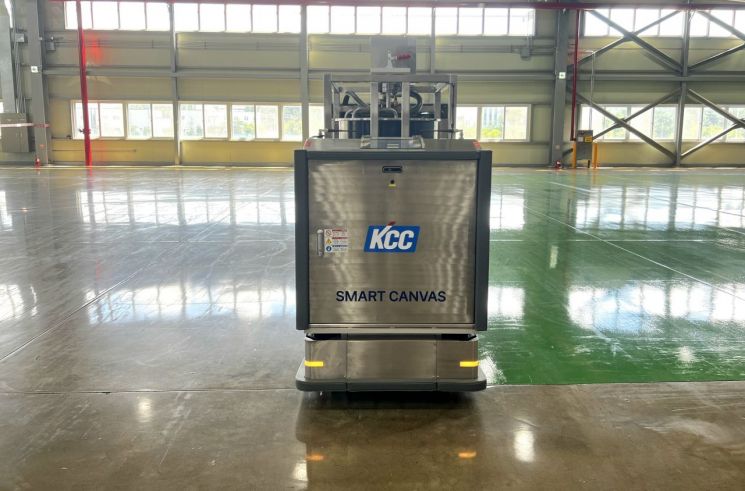
Investment results related to AI research are also beginning to emerge. KCC recently developed ‘SMART CANVAS,’ an autonomous painting robot that automates horizontal surface painting operations, the first of its kind in the domestic paint industry. This robot combines AI and autonomous mobile robot (AMR) technology to realize automated painting. After AI recognizes the painting space, it performs painting tasks autonomously according to user-set work conditions.
KCC has been steadily continuing AI-related R&D. In July, they developed and patented the industry’s first AI-based ‘paintless color mixing system’ and applied it to mass production. Thanks to this AI-based production and color mixing process platform, which can predict the colors needed for mixing without actual color mixing and painting, the time required has been reduced by approximately 72% compared to the previous process.
An industry insider explained, “The paint business is unstable because profits sharply decline whenever international oil prices fluctuate, so related companies are actively exploring new businesses. When developing new products, they also extensively research other chemicals that can be combined with paints, so the accumulated technological capabilities have become a foundation for expanding into chemical businesses beyond paints.”
© The Asia Business Daily(www.asiae.co.kr). All rights reserved.
![Clutching a Stolen Dior Bag, Saying "I Hate Being Poor but Real"... The Grotesque Con of a "Human Knockoff" [Slate]](https://cwcontent.asiae.co.kr/asiaresize/183/2026021902243444107_1771435474.jpg)

















