Japanese Prime Minister Kishida's Visit to Korea... Twelfth Summit
Securing 'Improvement Momentum' in Korea-Japan Relations, Ensuring Continuity
Historical Issues Remain Unchanged... Expecting Progressive Messages
Japanese Prime Minister Fumio Kishida is set to visit South Korea ahead of his retirement. It appears he aims to lay the groundwork for the momentum of improving Korea-Japan relations, which he built together with President Yoon Suk-yeol, to continue into the next cabinet. However, since the historical issues, considered the biggest challenges between the two countries, have repeatedly stalled, there are concerns that Prime Minister Kishida's visit to Korea could become a subject of political conflict amid opposition parties' anti-Japan campaigns.
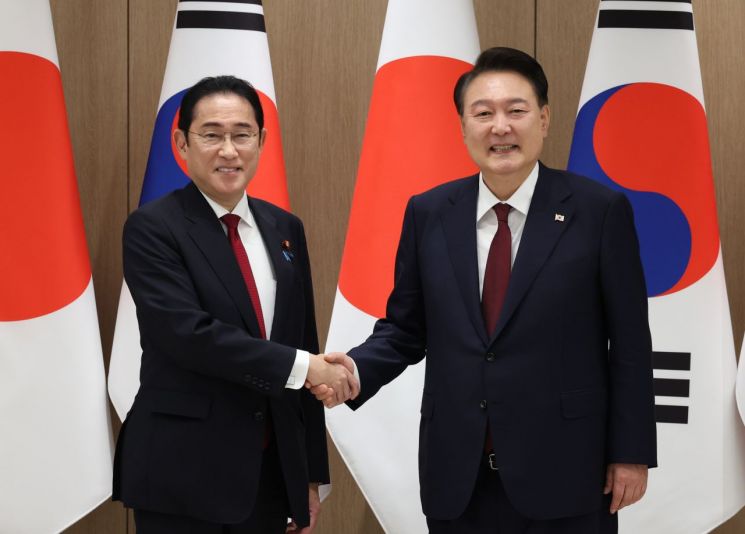 President Yoon Suk-yeol is shaking hands with Japanese Prime Minister Fumio Kishida at the Korea-Japan summit held at the Yongsan Presidential Office in Seoul in May last year. [Image source=Yonhap News]
According to the Presidential Office on the 6th, Prime Minister Kishida will visit South Korea that day and hold the twelfth summit meeting with President Yoon. There is interest in whether they will discuss topics recently reported by Japanese media as expected agenda items, such as "mutual cooperation in evacuating nationals in third countries during emergencies" or "the introduction of a pre-entry screening system."
In diplomatic circles, this visit is seen as carrying multiple meanings. Although the "bromance" between President Yoon and Prime Minister Kishida has been exceptionally close, it is rare to hold a "farewell" summit just before stepping down. Some interpret that Kishida, who is leaving office with the worst approval ratings, is trying to highlight diplomatic achievements such as improving Korea-Japan relations and strengthening the Korea-U.S.-Japan trilateral cooperation as his greatest accomplishments during his term.
Korea-Japan relations gained momentum last March when the South Korean government announced a solution to forced labor during the Japanese colonial period called "third-party subrogation payment." Shuttle diplomacy between the two countries was restored, and tangible achievements such as the full normalization of the Korea-Japan General Security of Military Information Agreement (GSOMIA) and the lifting of Japan's export restrictions on South Korea appeared. The Korea-U.S.-Japan trilateral cooperation peaked at the "Camp David" summit meeting in August last year.
Prime Minister Kishida is known to hope that the momentum for improving Korea-Japan relations, which will mark the 60th anniversary of diplomatic normalization next year, will continue into the next cabinet. Even when he announced last month on the 14th that he would not run in the Liberal Democratic Party leadership election, he specifically mentioned that "Korea-Japan relations must be further normalized." At the twelfth summit scheduled for that day, it is expected that achievements in improving Korea-Japan relations and additional cooperation measures will be discussed.
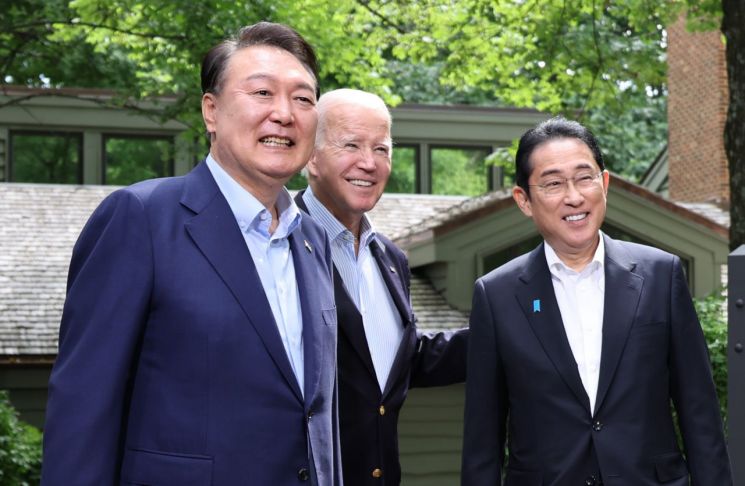 In August last year, President Yoon Suk-yeol, U.S. President Joe Biden, and Japanese Prime Minister Fumio Kishida held a summit at Camp David in the United States.
 [Image source=Yonhap News]
However, the "bromance" between the two leaders is not universally applauded. On the contrary, there are criticisms that while reconciliation and cooperation are being promoted, the resolution of the biggest issue?the historical problem?has been postponed. Although they have strongly united on security and economic fronts, there has been little progress on historical issues.
When the government announced the "third-party subrogation" solution, it said the glass was half full and that the remaining half would be filled depending on Japan's "sincere response." However, Japan's "sincere response" has yet to materialize. The funds for the third-party subrogation solution were depleted in a year and a half without contributions from Japan.
The domestic political situation also makes it difficult to fully welcome Prime Minister Kishida's "farewell visit." This is due to the recent strong anti-Japan campaigns by opposition parties. The Democratic Party of Korea has even announced plans to form a "Special Committee for Investigating the Erasure of Dokdo." The controversy over historical views, which began with the appointment of Kim Hyung-seok as director of the Independence Hall, has expanded into a political faction conflict.
Amid these bright and dark aspects, attention is focused on what messages will emerge from the final summit between President Yoon and Prime Minister Kishida. There is some expectation that Kishida, who has relieved political burdens by deciding not to seek re-election, might deliver a more progressive message regarding historical issues. During his visit to Korea in May last year, he expressed personal feelings and said that the historical issues "pain his heart."
© The Asia Business Daily(www.asiae.co.kr). All rights reserved.
![Clutching a Stolen Dior Bag, Saying "I Hate Being Poor but Real"... The Grotesque Con of a "Human Knockoff" [Slate]](https://cwcontent.asiae.co.kr/asiaresize/183/2026021902243444107_1771435474.jpg)

















