Policy for Establishing Volcanic Ash Forecast System
Mount Fuji Inactive for 3 Centuries
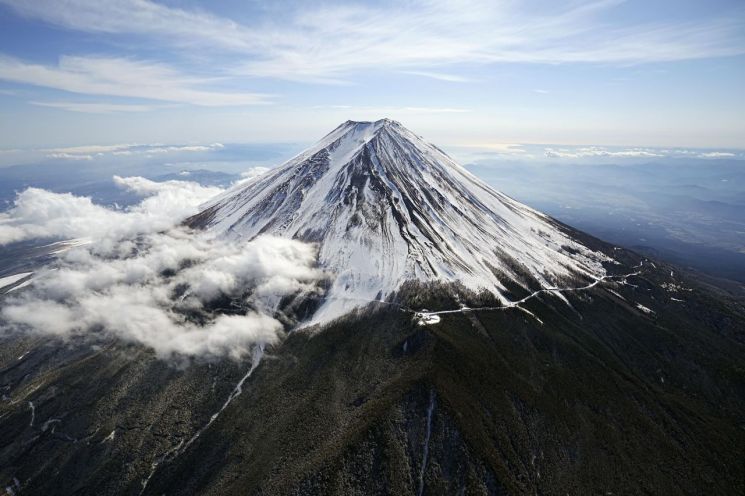
Japan's highest peak and dormant volcano, 'Fujisan,' could paralyze Tokyo and the entire surrounding metropolitan area if it were to erupt on a large scale, according to simulation results. Although Fujisan has shown no volcanic activity for the past three centuries, Japanese meteorological authorities plan to prepare for such an event.
On the 5th (local time), the Japanese daily newspaper Yomiuri Shimbun reported that the Japan Meteorological Agency plans to develop a volcanic ash forecast system starting next year. The agency currently has a 'volcanic ash fallout forecast' system to prepare for volcanic eruptions. This system predicts the amount of volcanic ash falling and the affected area, issuing warnings in advance to regions within the impact zone.
However, this system can only classify small amounts of volcanic ash and limits the forecast period to six hours, making it inadequate for large-scale events like a Fujisan eruption, according to ongoing criticisms.
The Japanese government released simulation results of a Fujisan eruption in 2020. If Fujisan erupts again, volcanic ash is expected to reach the metropolitan area within about three hours, causing railway operations to halt and triggering large-scale power outages.
Furthermore, if volcanic ash continues to fall over two weeks, it is predicted that Kanagawa Prefecture and Yamanashi Prefecture near Tokyo in the metropolitan area will accumulate more than 30 cm of ash, with over 10 cm accumulating in the city center.
Japan has not yet established measures to handle volcanic ash that falls to the ground. Instead, it has designated roads connecting essential infrastructure such as administrative and medical institutions as priority ash removal areas, with guidelines to secure one lane in both directions on these roads.
According to the media, the Japanese government is currently considering dumping volcanic ash from a Fujisan eruption into the sea. However, some experts have expressed concerns that the 'marine disposal plan' could disrupt marine ecosystems. Additionally, Japan's Marine Pollution Prevention Act generally prohibits dumping waste into the ocean and only allows it if the government deems it necessary in an emergency.
Regarding this, a Japanese government official told the media, "We must carefully consider the environmental impact while reviewing the plan."
However, there are currently no signs that Fujisan is about to erupt actively. The last activity was the Hoei eruption in December 1707 during the mid-Edo period, and it has been inactive for over 300 years since. However, if the timeframe is extended to 5,600 years ago, it is analyzed that Fujisan has erupted about 180 times. This makes it difficult to conclude that Fujisan has completely ceased activity.
© The Asia Business Daily(www.asiae.co.kr). All rights reserved.
![Clutching a Stolen Dior Bag, Saying "I Hate Being Poor but Real"... The Grotesque Con of a "Human Knockoff" [Slate]](https://cwcontent.asiae.co.kr/asiaresize/183/2026021902243444107_1771435474.jpg)
















