"Woori Financial, Exempt from Eligibility Review Despite Institutional Sanctions?"
Expected to Use Special Exception System Under Current Law
Criticism Over Lack of Transparency in Eligibility Review Criteria
Concerns have been raised that the major shareholder eligibility screening system, introduced to operate financial companies in a stable and transparent manner, has become ineffective. There is an analysis that it is necessary to fill the loopholes in the screening system and establish clear judgment criteria to revive the original purpose of the system.
On the 5th, Kim Hyun-jung, a member of the Democratic Party of Korea, pointed out at the forum titled “Is the Major Shareholder Eligibility Screening of Financial Institutions Good as It Is?” held at the National Assembly in Yeouido, Seoul, that “Woori Financial Group’s board of directors resolved to acquire Dongyang and ABL Life while undergoing inspections by the Financial Supervisory Service and prosecution investigations due to illegal preferential loans involving former Chairman Sohn Tae-seung’s relatives,” and “Meritz Fire & Marine Insurance is proceeding with the acquisition of MG Insurance despite the Financial Supervisory Service conducting frequent and special supervision and the possibility of sanctions.”
The background behind these financial companies challenging mergers and acquisitions (M&A) lies in Article 42-2 of the Financial Holding Companies Act. Kim said, “Normally, if an institution receives a warning from the financial authorities, it loses major shareholder eligibility,” but “due to a special exemption system introduced by the 2009 amendment to the Financial Holding Companies Act, major shareholder eligibility screening can be waived.” She added, “There are loopholes in the special exemption system. It is very concerning that this system was abused to decide on acquisitions.”
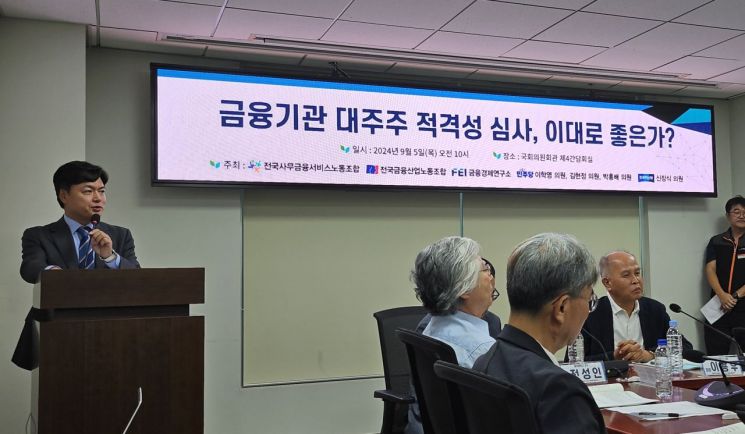 Kim Hyun-jung, a member of the Democratic Party of Korea, delivers a greeting at the discussion forum titled "Is the Current Financial Institution Major Shareholder Eligibility Review Adequate?" held the previous day at the National Assembly in Yeouido, Seoul.
 [Photo by Jeon Young-joo ange@]
Kim Deuk-ui, executive director of the Financial Justice Solidarity, also pointed out that the major shareholder eligibility screening has become nominal due to the amended Financial Holding Companies Act. He explained, “Under the current law, for a financial holding company to incorporate a subsidiary, it only needs to satisfy four approval requirements: whether the business plan is reasonable, whether the financial and management conditions are sound, whether the funding is appropriate, and whether it restricts competition in the relevant market,” adding, “Even if the financial holding company receives disciplinary actions such as institutional warnings, as long as these conditions are met, incorporation of subsidiaries is possible.”
In fact, many financial companies that faced major shareholder qualification issues succeeded in incorporating subsidiaries. Kim said, “In 2014, when KB Financial Group attempted to acquire LIG Insurance, conflicts arose between former Chairman Lim Young-rok and former Kookmin Bank President Lee Geon-ho, and sanctions from the financial authorities were anticipated. Many expected the acquisition to fail,” but “since the four conditions were met, the major shareholder eligibility screening was skipped, and the incorporation of the subsidiary was approved.” He added, “Shinhan Financial Group incorporated Orange Life in 2018 using the same method, even though then-Chairman Cho Yong-byeong was indicted over hiring irregularities.”
There are cases where major shareholder eligibility screening is avoided without using these special exemption conditions. Kakao requested approval from financial authorities in April 2019 to exceed the holding limit to become the largest shareholder of Kakao Bank. The issue was that at the time, Kakao Chairman Kim Beom-su was involved in ongoing legal disputes over violations of the Fair Trade Act. The Special Act on Internet Specialized Banks stipulates that industrial capital (non-financial major shareholders) must not have been fined or punished for violations such as the Fair Trade Act to hold more than 10% of an internet specialized bank’s shares.
Jo Hye-kyung, director of the Financial Economy Research Institute, said, “The Ministry of Government Legislation issued an official interpretation in June of that year stating that even if Chairman Kim violated the major shareholder conditions, if the corporation (Kakao) has no disqualifications, it can indirectly control the bank.” She added, “Even if Chairman Kim recently received a guilty verdict in the SM Entertainment stock manipulation case, it will not affect maintaining major shareholder eligibility,” expressing concern that “the Ministry’s interpretation opened the possibility for a criminal major shareholder to control through a clean company.”
At the forum, there was also a claim that OK Financial Group avoided major shareholder eligibility screening during the approval process for converting iM Bank (formerly Daegu Bank) into a commercial bank in May. Jo said, “According to Article 2, Paragraph 10, Subparagraph Na of the Banking Act, the largest shareholder holding more than 4% of shares is subject to major shareholder eligibility screening regardless of whether they are financial or non-financial major shareholders,” and “the Financial Services Commission’s press release at the time mentioned that there were no non-financial major shareholders holding more than 4%, raising suspicion about whether major shareholder eligibility screening was conducted for OK Financial Group.”

There are also criticisms about the lack of consistency in major shareholder eligibility screening. Professor Jeon Seong-in of Hongik University cited K Bank as a case where the major shareholder had disqualifications but still received approval. According to the Enforcement Decree of the Banking Act at the time, Woori Bank, the largest shareholder of K Bank, had to have management stability above the industry average. However, Woori Bank’s BIS (Bank for International Settlements) capital adequacy ratio at the end of the quarter (June 2015) was 14%, below the domestic banks’ average of 14.09%.
Professor Jeon explained, “The Financial Services Commission issued an official interpretation that Woori Bank met the requirement because its BIS ratio over the past three years was above the three-year average of domestic banks and gave preliminary approval,” adding, “At the time of final approval, the requirement that it must be above the industry average was deleted from the Enforcement Decree of the Banking Act.” He continued, “The logic was that there are no such requirements for non-bank industries and that regulatory fairness should be maintained, but shouldn’t the screening intensity differ between banks and non-banks?”
There were also criticisms that the basis for judging major shareholder eligibility was unclear during the approval process of Toss Bank. Jo said, “Toss Bank failed the preliminary banking license screening in May 2019 due to insufficient suitability of the controlling shareholder in terms of funding,” but “it passed three months later. The reason was the strong will for financial innovation, and there was no mention of whether the qualification deficiency due to lack of funding was resolved.”
Experts suggested that legislative efforts should be made to improve the major shareholder eligibility screening in a way that preserves its original purpose. Kim said, “I believe that the loopholes in the current law allowing abuse of the special exemption system should be eliminated, and blind spots in the screening system should be removed.”
Jo added, “The purpose of the major shareholder eligibility screening is to verify the social credibility of the largest shareholders of financial companies,” and “it is necessary to judge that social credibility is insufficient if the financial authorities have imposed disciplinary actions or if the major shareholder has been convicted due to disqualifications.”
© The Asia Business Daily(www.asiae.co.kr). All rights reserved.
![Clutching a Stolen Dior Bag, Saying "I Hate Being Poor but Real"... The Grotesque Con of a "Human Knockoff" [Slate]](https://cwcontent.asiae.co.kr/asiaresize/183/2026021902243444107_1771435474.jpg)

















