Current Account Surplus of $9.13 Billion in July
Largest Surplus for July in 9 Years
Semiconductor Exports Drive Expansion of Current Account Surplus
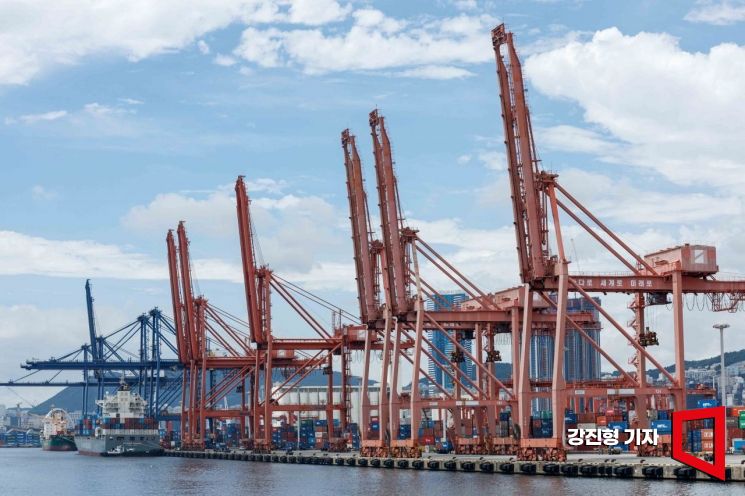
With continued strong semiconductor exports, South Korea's current account balance has achieved a surplus for three consecutive months.
According to the "July Balance of Payments (provisional)" released by the Bank of Korea on the 6th, the current account surplus in July reached $9.13 billion (12.188 trillion KRW). This marks a surplus for three consecutive months since May.
Although the surplus amount decreased compared to last month's $12.56 billion, it is the largest for July in nine years since July 2015. Last July, the surplus was around $4.11 billion, meaning the surplus has more than doubled in one year.
Breaking down the current account by category, exports increased by 16.7% year-on-year to $58.63 billion, while imports rose by 9.4% to $50.14 billion, resulting in a goods trade surplus of $8.49 billion. The increase in exports over imports indicates an improvement in the goods trade surplus compared to last year.
Semiconductors led the export improvement. Customs-based semiconductor exports in July increased by 50.1% compared to the previous year. This was followed by information and communication devices at 29.8%, petroleum products at 16.8%, machinery and precision instruments at 14.3%, chemical products at 2.6%, and steel products at 1.5%. On the other hand, passenger car exports decreased by 8.9%.
By region, exports to Southeast Asia increased by 27.4%, China by 14.9%, Japan by 10%, and the United States by 9.3%.
The services account recorded a deficit of $2.38 billion, mainly due to travel and other business services. The deficit widened compared to the previous month as more South Koreans traveled abroad.
The primary income account showed a surplus of $3.15 billion, mainly from dividend income, while the secondary income account recorded a deficit of $130 million.
The financial account, which reflects capital inflows and outflows, saw a net asset increase of $11.03 billion in July. Direct investment showed an increase of $4.33 billion in outbound investment by domestic investors and a $2.99 billion increase in inbound investment by foreigners.
In securities investment, domestic investors' overseas investment increased by $10.1 billion, mainly in stocks, while foreign investors' domestic investment increased by $3.92 billion, with similar amounts in stocks and bonds.
© The Asia Business Daily(www.asiae.co.kr). All rights reserved.

















