Retirement Pension Reserves Reach 400 Trillion Won... TDF at 10.5 Trillion Won
National Pension Faces Depletion Crisis... Government Launches Pension Reform
Retirement Pension In-Kind Transfer System to Be Implemented on Next Month 15
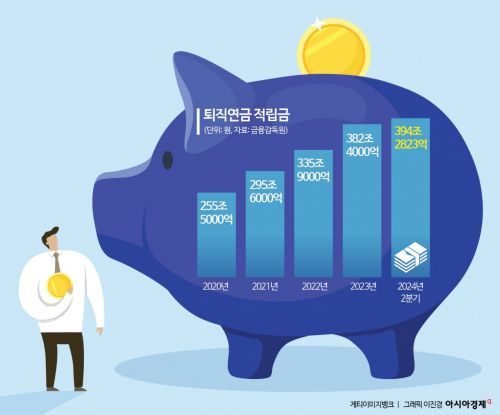
As domestic retirement pension reserves approach 400 trillion won this year, the assets under management for target date funds (TDFs), investment products designed for retirement preparation, have also surpassed 10 trillion won. With a growing consensus on the need for effective individual retirement pension products amid the looming depletion of the National Pension Service, the TDF market is expected to continue its growth. The 'retirement pension in-kind transfer' system scheduled for the 15th of next month is anticipated to serve as a catalyst that will transform the retirement pension market, which has been centered on principal-guaranteed products.
According to FnGuide, a fund evaluation company, as of the 4th, the total assets under management for 196 lifecycle-type funds in Korea amounted to 10.5126 trillion won. This increase is thanks to nearly 1.4 trillion won inflows since the beginning of the year. The net assets reached an impressive 15.1499 trillion won, exceeding the assets under management by 1.4 times. This is attributed to the compound interest effect being positively reflected, given the stock price rise and the long-term investment characteristics of TDF products.
Lifecycle funds automatically construct portfolios tailored to the investor's age and retirement timing throughout their lifetime. They consist of TDFs and target income funds (TIFs). While TDFs adjust the proportion of risky assets such as stocks and safe assets like bonds according to the life cycle, TIFs maintain a balanced fund with a constant ratio of risky and safe assets during the investment period. The 'Didim Fund,' which the Korea Financial Investment Association is preparing to launch this month, belongs to the balanced fund category.
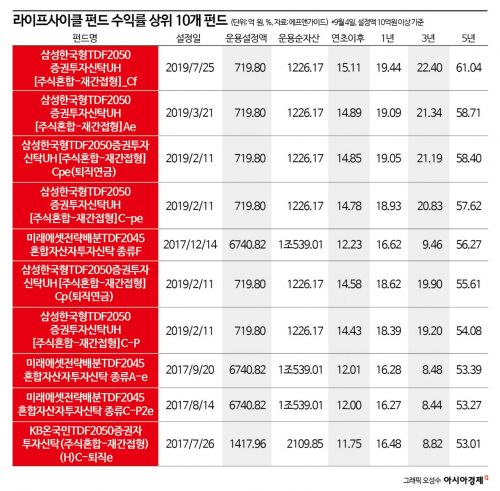
Among these, 88% (174 funds) are TDFs. The single fund with the largest assets under management in the TDF market is Mirae Asset Global Investments' 'Mirae Asset Strategic Allocation TDF 2025 Mixed Asset Self-Investment Trust Type C-P2,' with assets totaling 931.3 billion won (class combined basis). The fund with the highest 5-year return is Samsung Asset Management's 'Samsung Korea-style TDF 2050 Securities Investment Trust UH [Equity Mixed - Fund of Funds]_Cf,' which achieved 61.04%. As of the 1st of this month, the KOSPI index rose 24.8% compared to five years ago.
As the domestic retirement pension market expands, investors seeking asset allocation products have increased, leading to growth in the TDF market as well. As of the second quarter of this year, the size of domestic retirement pension reserves was 394.2832 trillion won, up 8.5311 trillion won (2.2%) from the previous quarter (385.7521 trillion won). However, the proportion of principal-guaranteed products remains high, mainly in banks and insurance sectors. As of the end of last year, the share of principal-guaranteed products was 87%, which has been a concern for the government. The proportion of performance-based products in the total reserves has also remained around 10% annually.
The recent social attention on TDFs is closely related to the crisis of the National Pension Service depletion due to aging. The government announced a National Pension reform plan on the 4th, which includes gradually increasing the National Pension contribution rate, currently 9% of income, by 0.25 to 1 percentage point annually by age group, ultimately raising it to 13%. This is the first pension reform in 21 years. The government plans to mandate retirement pensions and increase tax benefits for personal pensions. The 'three-tier pension' system of National Pension, retirement pension, and personal pension will also strengthen the retirement safety net.
Kim Byung-hwan, Chairman of the Financial Services Commission, also met with CEOs of domestic asset management companies on the 5th and urged them to "strive to develop stable long-term investment pension products," adding, "There is a need for serious discussion on how the asset management industry can enhance competitiveness and further develop to meet the asset management demands of the public and prepare for the future amid aging." He particularly emphasized that compared to overseas private pension markets where fund investments are mainly TDF-focused, the development of Korea's private pension market requires further progress.
The retirement pension in-kind transfer system, which will be implemented on the 15th of next month, is also one of the reasons for the increased interest in TDFs. The in-kind transfer system allows retirement pension subscribers to transfer their currently invested financial products to another financial institution's account without liquidating them. Previously, changing retirement pension accounts required liquidating all financial products into cash, but now the portfolio can be transferred as is.
It is expected that some accounts will move from the banking and insurance sectors, which have dominated the retirement pension market, to the securities sector centered on TDFs. Choi Jae-won, a researcher at Kiwoom Securities, recently stated in a report, "Active product selection and movement by consumers will promote competition among asset allocation products," and predicted, "Efforts to improve pension product returns will intensify."
A securities industry insider said, "Securities companies are expected to fiercely compete in marketing to attract accounts concentrated in banks and insurance sectors," adding, "Since being included in the options considered by companies is important, sales will appear in a mixed form of B2B (business-to-business) and B2C (business-to-consumer)." Another insider hinted, "Since customers who chose non-principal-guaranteed products tend to be conservative, targeting them well will enable effective sales," and added, "In this process, some companies with a good external image are expected to benefit."
© The Asia Business Daily(www.asiae.co.kr). All rights reserved.


















