National Assembly Science and ICT Committee 'Deepfake Sexual Crime Solutions' Forum
Broadcasting Commission "Cooperation Letters Also Included in Correction Measures"
At a National Assembly forum seeking alternatives to deepfake sexual crime videos, the Korea Communications Standards Commission (KCSC) announced that it will meet with global platform operators next month to discuss cooperation measures related to deepfake sexual crime videos. Experts proposed alternatives such as increasing punishment severity and proactive measures by platform operators.
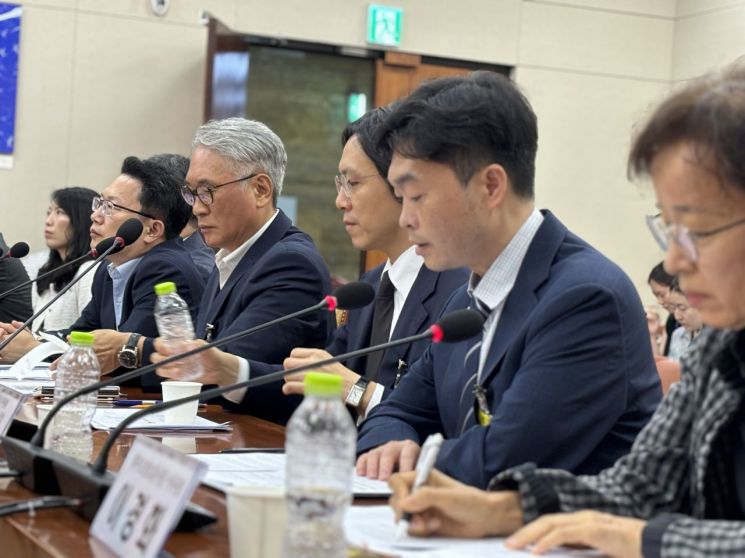 Lee Dongsu, Director of the Digital Crime Deliberation Bureau at the Korea Communications Standards Commission (second from the right), is speaking at the Deepfake Sexual Crime Video Alternatives Forum held by the National Assembly's Science, ICT, Broadcasting and Communications Committee on the 5th. Photo by Hwang Seoyul chestnut@
At the forum titled "How to Eradicate Deepfake Sexual Crime Videos" held on the 5th in the plenary meeting room of the National Assembly Science, Technology, Information and Broadcasting and Communications Committee, Lee Dong-su, Director of the Digital Sexual Crime Deliberation Bureau at KCSC, said, "We are preparing a meeting with global platform operators next month," adding, "We are also preparing to send cooperation letters to 11 global operators subject to KCSC corrective actions."
Lee also stated, "We are promoting on-site education and will continue international collaboration through cooperation with domestic related agencies, the global online safety network involving overseas organizations such as the UK and Australia, and international internet hotlines in the Netherlands and France." The KCSC is receiving reports of deepfake sexual crime videos and conducting related monitoring.
Professor Lee Hae-won of Kangwon National University Law School emphasized the need to increase punishment severity and appropriately reflect sentencing guidelines. Professor Lee said, "The current law has a relatively low level of sentencing," and added, "However, simply increasing sentences will not solve the problem; for heavy punishments to be applied, the Supreme Court's sentencing guidelines must also properly reflect this."
Furthermore, Professor Lee stated, "Platforms should adopt a 'Detect and take' approach rather than the 'Notice and take' method, which deletes content only after the victim's report." He also stressed the necessity of establishing special laws on civil compensation to ensure reasonable damages are paid to victims.
Heo Wook, Vice President of Meta Korea, said that platforms recognize their social responsibility and are taking appropriate measures accordingly. Heo stated, "We are sufficiently deleting sexual crime videos and images," and added, "Even if there are no related laws or sanctions in certain countries, we are applying watermarking to images created by generative AI."
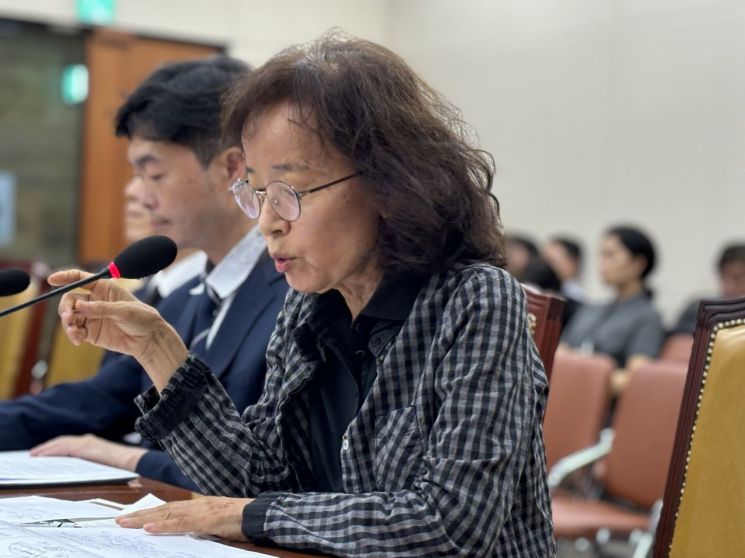 Chairman Lee Kyunghwa of the Parent Information Monitoring Group is speaking at the National Assembly forum / Photo by Hwang Seoyul chestnut@
The Korea Communications Commission (KCC) stated that due to the urgency of the situation, it will first review what can be done within the current legal framework. Shin Young-gyu, Director of the Broadcasting and Communications Use Policy Bureau at KCC, said, "The KCSC operates monitoring to request deletion and blocking, but the manpower is insufficient," adding, "If the workforce is doubled for monitoring, prompt processing will be possible." He also said, "The KCC has established the Online Damage 365 Center, which can provide in-depth counseling to victims of AI-based video damage within the current legal system."
There were also calls to reduce the gap between the field and policy. Lee Kyung-hwa, Director of the Parents' Information Monitoring Group who has conducted internet dysfunction monitoring for over 20 years, said, "It is necessary to see to what extent the KCSC is utilizing temporary measures for sexual crime videos," and added, "We need to consider whether the rapid processing and resolution are producing satisfactory results from the users' perspective."
Lee also said, "I am not sure if the alternative of linking (generative AI ethics education) with school education can reach users who are each fending for themselves," adding, "Although information communication and AI ethics education are already being conducted, when asked, adolescents understand copyright issues well but find ethics difficult." He emphasized, "When teaching extracurricular content at schools, it is necessary to consider when and how to conduct it."
The chair of the forum was Professor Kim Min-ho of Sungkyunkwan University Law School. Professor Kim Myung-joo of Seoul Women's University Department of Information Security gave a presentation on "The Dual Nature of Generative AI and the Need for Safety Regulation," and Professor Lee So-eun of National Pukyong University Media Communication presented on "The Current Status and Response Strategies for Deepfake Sexual Crime Videos."
© The Asia Business Daily(www.asiae.co.kr). All rights reserved.


















