Live Broadcast on the 23rd of Next Month Afternoon
National Compensation Liability Not Recognized in 1st and 2nd Trials
The Supreme Court has decided to hold a public hearing next month to determine whether the state should be held liable for damages related to the enforcement decree that designates facilities obligated to provide convenience services such as access ramps for people with disabilities, which has not been amended for 24 years. This is the first public hearing since Chief Justice Cho Hee-dae took office.
The Supreme Court en banc (presiding Justice Lee Sook-yeon) announced on the 5th that it will conduct a public hearing on April 23 at 2 p.m. in the grand courtroom regarding the state compensation claim filed by Kim and two others against the state. The hearing will be broadcast live on YouTube and other platforms on the day.
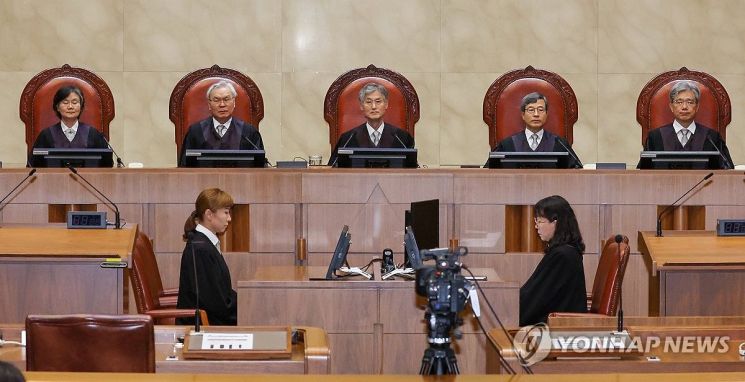
This lawsuit originally involved four plaintiffs, including Kim, who filed claims for discrimination relief and damages against Twosome Place Co., Ltd., J’s Retail Co., Ltd. operating convenience stores, Hotel Shilla Co., Ltd., and the Republic of Korea.
The plaintiffs demanded that the defendant companies install convenience facilities for people with disabilities and pregnant women, present installation standards, and bear part of the installation costs. They also claimed damages against the state for legislative inaction in failing to amend the enforcement decree for a long period.
The Act on the Promotion of Convenience for Persons with Disabilities, the Elderly, and Pregnant Women (Disability Convenience Act) and the Act on Prohibition of Discrimination against Persons with Disabilities and Remedy for Rights Violation (Disability Discrimination Act) do not directly specify the scope of small retail stores obligated to provide convenience for persons with physical disabilities in the law itself but delegate this to the enforcement decree of the Disability Convenience Act, a presidential decree. This is because it is practically impossible to regulate all types of facilities in the law.
Article 7 (Target Facilities) of the Disability Discrimination Act states that the facilities required to install convenience facilities are those specified by presidential decree, listing ▲parks ▲public buildings and public use facilities ▲multi-family housing ▲communication facilities ▲and other buildings, facilities, and their ancillary facilities where convenience facilities need to be installed for persons with disabilities.
At the time this lawsuit was first filed on April 11, 2018, Article 3 (Target Facilities) of the enforcement decree of the Disability Convenience Act stipulated, "The target facilities required to install convenience facilities under Article 7 of the Act are as listed in Appendix 1," and detailed criteria were set out in Appendix 1.
Appendix 1 defined "supermarkets and retail stores for daily necessities with a total floor area of 300 square meters or more but less than 1,000 square meters within the same building" as facilities obligated to install convenience facilities, meaning only retail stores with a total floor area of 300 square meters or more were required to provide convenience facilities for persons with disabilities.
The problem was that this regulation had never been amended since its establishment in 1998. The related regulation was revised in April 2022, during the ongoing trial, to require facilities with a total floor area of 50 square meters or more. This was after a long 24 years.
According to the Supreme Court, as of 2019, more than 97% of convenience stores nationwide were exempt from the obligation to provide convenience for persons with disabilities, reflecting how the outdated standard failed to reflect reality.
Among the four original plaintiffs, three are persons with physical disabilities. They argued that "the state’s failure to amend the enforcement decree for over 20 years has rendered the access rights guaranteed by the Disability Convenience Act and the Disability Discrimination Act ineffective," and claimed state compensation on the grounds that such administrative legislative inaction by the government was unlawful.
On February 10, 2022, the Seoul Central District Court, which handled the first trial, partially ruled in favor of the plaintiffs. However, all claims for state compensation against the state were dismissed.
The court found that the enforcement decree exceeded the scope of legal delegation, violating the right to pursue happiness and general freedom of action of persons with disabilities and the principle of equality, and thus invalid. It ordered the defendant GS Retail to install accessible exits with ramps for persons with disabilities in directly managed convenience stores newly built, expanded, or remodeled after April 11, 2009. Just before the first trial verdict, compulsory mediation was reached with defendants Twosome Place and Hotel Shilla.
However, the court did not recognize the state’s liability for damages. It judged that it was difficult to establish intent or illegality, which are requirements for unlawful acts, regarding the state’s long-term neglect of the enforcement decree.
Ultimately, the appeal trial focused only on the state compensation claims against the state. One of the plaintiffs did not appeal, and the Seoul High Court, which reviewed the first trial court’s dismissal of the damages claims by three plaintiffs against the state, also dismissed the plaintiffs’ claims.
The public hearing will proceed with the court’s organization of the issues, followed by arguments from the plaintiffs and defendants on each issue, and then a Q&A session with the court. The Supreme Court announced that the final ruling will be made within 2 to 4 months after the conclusion of the hearing, following a final discussion (en banc session) by the Chief Justice and Justices.
Chief Justice Cho Hee-dae sent requests for submission of opinion letters on the issues to various institutions and organizations, including the Korea Institute for Health and Social Affairs, in accordance with relevant rules to gather broad opinions on this case.
At the public hearing, Bae Yoong-ho, head of the Korea Environmental Architecture Research Institute, and Kim Joong-kwon, professor at Chung-Ang University Law School, will appear as plaintiff-side witnesses, while Ahn Sung-joon, head of the Environmental Policy Planning Team at the Korea Disabled Development Institute, and Ahn Byung-ha, professor at Kangwon National University Law School, will appear as defendant-side witnesses to present their opinions.
The Supreme Court stated, "This case not only concerns the substantive guarantee of access rights for persons with disabilities but may also have a significant impact on other areas where state compensation liability for administrative legislative inaction is at issue."
© The Asia Business Daily(www.asiae.co.kr). All rights reserved.
!["The Woman Who Threw Herself into the Water Clutching a Stolen Dior Bag"...A Grotesque Success Story That Shakes the Korean Psyche [Slate]](https://cwcontent.asiae.co.kr/asiaresize/183/2026021902243444107_1771435474.jpg)
















