"Even After Calling Nationwide for Several Hours, No Acceptance in the End"
"Explaining to Patients That It May Not Be Appropriate Treatment as It Is Not a Specialized Subject"
"If the Government's Medical Reform Plan Is Promoted, the Public Will Have to Rely on Private Healthcare"
A regional emergency medicine resident who resigned raised his voice, saying, "The claim that emergency rooms are in chaos is an absurd lie."
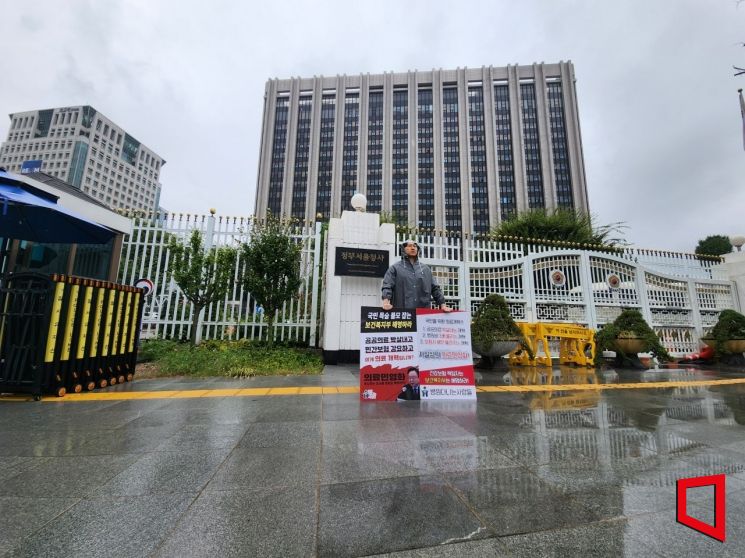 Kim Chan-gyu, a resident in emergency medicine at Wonkwang University Hospital and representative of Hospital Workers, is holding a solo protest around 1 p.m. on the 5th in front of the Government Seoul Office in Jongno-gu, Seoul. Photo by Choi Tae-won peaceful1@
Kim Chan-gyu, a resident in emergency medicine at Wonkwang University Hospital (representative of Hospital Workers), held a solo protest on the morning of the 5th in front of the Government Seoul Office in Jongno-gu, Seoul, where the Central Disaster and Safety Countermeasures Headquarters meeting on doctors' collective action was held. He stated, "As a doctor in a regional emergency room, I felt I had to speak up, so I came all the way to Seoul."
Currently working in the emergency room of a regional general hospital after his resignation, he said, "Even after making transfer inquiries nationwide for three to four hours, acceptance is often not possible, so we are forced to provide only the best possible care in the emergency room." He emphasized, "In such cases, we explain the situation to patients and their guardians and have no choice but to write in the chart, 'This is not a specialized medical field, so the treatment may not be appropriate; both the patient and guardian understand this, and we plan to inquire about transfer again tomorrow.'"
He continued, "The professors at university hospitals are struggling because the number of patients far exceeds the appropriate number that the remaining medical staff can handle due to a shortage of backend medical personnel." He added, "It is very regrettable that explanations and treatments inevitably get delayed when there are too many patients to see."
Earlier, President Yoon Suk-yeol responded to reporters' questions about the crisis in the medical field during a national briefing and press conference held at the Yongsan Presidential Office on the 29th of last month, saying, "If you visit regional general hospitals, there are problems, but the emergency medical system is still operating smoothly, and the government is working hard."
He also raised concerns that the government's medical reform efforts would force medical consumers to rely on private healthcare. Kim Chan-gyu, in a statement titled "The New Flag Planted on the Ruins of Collapsed Emergency Rooms is Medical Privatization," argued, "Medical reform, under the pretext of revitalizing essential and regional healthcare, is essentially no different from promoting privatization." He claimed, "'Value-based healthcare' mentioned in the medical reform plan will limit total medical expenditure, cause under-treatment, and increase patients' out-of-pocket expenses."
He explained, "Citizens accustomed to the existing hexagonal healthcare system will seek alternatives by turning to private insurance and commercial insurance, and all the benefits will go to large insurance companies." He added, "Although not openly stated, ultimately, people will be made to depend on private and commercial insurance, inevitably leading to de facto privatization."
© The Asia Business Daily(www.asiae.co.kr). All rights reserved.
![Clutching a Stolen Dior Bag, Saying "I Hate Being Poor but Real"... The Grotesque Con of a "Human Knockoff" [Slate]](https://cwcontent.asiae.co.kr/asiaresize/183/2026021902243444107_1771435474.jpg)











