The government will designate a 'dedicated person in charge' for each emergency medical institution to prevent 'emergency room refusal' and manage them intensively on a one-to-one basis.
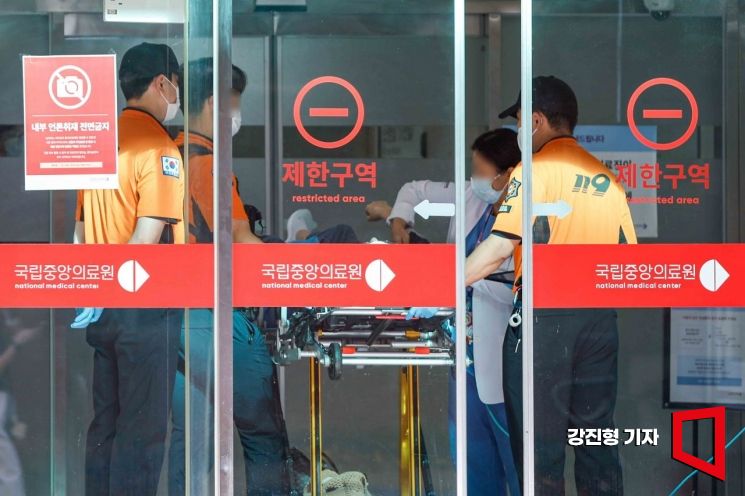 Medical staff are checking the condition of patients in the emergency room at the National Medical Center in Jung-gu, Seoul, on the 28th, as the National Health and Medical Industry Labor Union has announced a strike starting on the 29th. Photo by Jinhyung Kang aymsdream@
On the 5th, Jeong Yoon-soon, Director of Health and Medical Policy at the Ministry of Health and Welfare, held a briefing at the Central Disaster and Safety Countermeasures Headquarters on emergency medical care and doctors' collective action, stating, "Among the 409 emergency rooms nationwide, the Ministry of Health and Welfare has assigned one-to-one dedicated officers to 25 locations where there is a possibility of medical disruption, and will respond immediately with personnel support if problems arise."
For the remaining 384 emergency rooms, the Ministry of the Interior and Safety and local governments will appoint one-to-one dedicated persons in charge to monitor the on-site situation daily, collect individual suggestions, and report immediately if any unusual matters occur. A cooperation system within the region will also be established so that fire services and medical institutions can collaborate to distribute patients appropriately according to severity to suitable medical institutions.
From this day until the 25th, three weeks covering the Chuseok holiday period, each local government will establish and operate an 'Emergency Medical Management Situation Room' led by the head of the local government to actively operate the emergency medical system.
During the holiday, more than 4,000 duty hospitals and clinics will operate nationwide, and the number of pharmacies open will also be expanded.
Director Jeong said, "The government is taking the current emergency medical situation very seriously and is responding with full force not only from related ministries but also from local governments," adding, "We will continue to build a close cooperation system to ensure that there are no disruptions in emergency medical care."
As of today, among the 409 emergency rooms nationwide, 405 operate 24 hours a day, and 27 locations, accounting for 6.6% of the total, are operating with reduced beds. The standard number of beds in emergency medical institutions is 5,925, which is 97.3% of the normal period (6,069 beds in the first week of February).
As of the 4th, the average number of medical institutions capable of treating 27 different diseases was 102, which decreased by one compared to the previous day.
The number of mild and non-emergency patients corresponding to levels 4-5 of the Korean Triage and Acuity Scale (KTAS) increased to an average of 8,541 in the third week of August but has been steadily decreasing to 6,258 as of the 3rd of this month. This is about 75% compared to the normal period (8,285 patients).
The total number of patients visiting emergency rooms increased to an average of 19,783 in the third week of August but decreased to 15,104 as of the 3rd, which is 84% compared to the normal period (17,892 patients), along with the decrease in mild patients.
Director Jeong emphasized, "The government acknowledges that the current situation is difficult, but it is necessary to be cautious about exaggerating the situation or causing excessive anxiety," adding, "If the spark of reform is extinguished because of current difficulties, it will be very difficult to improve the problem of emergency room refusal."
© The Asia Business Daily(www.asiae.co.kr). All rights reserved.

















