Jeonse Market Also Shows Rising Trend Mainly in the Seoul Metropolitan Area
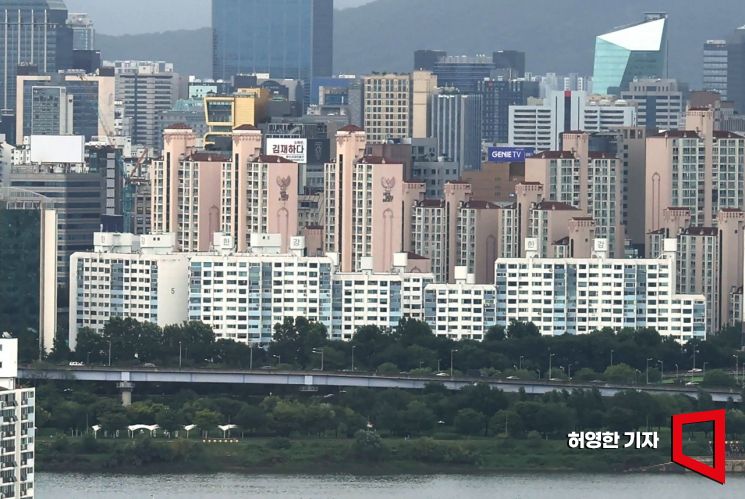
Apartment prices in Seoul have continued to rise for 24 consecutive weeks, but the rate of increase has slowed. This appears to be influenced by reduced loan limits and concerns over prices that surged rapidly in a short period.
According to the "Weekly Apartment Price Trends for the First Week of September (as of the 2nd)" released by the Korea Real Estate Board on the 5th, the apartment sales price index in Seoul rose by 0.21% this week compared to last week. Although it showed an upward trend for 24 consecutive weeks, the rate of increase narrowed compared to last week's 0.26%.
Seoul apartment prices turned to an upward trend in the fourth week of March (0.01%) and steadily increased, showing the highest rate of increase in 5 years and 11 months at 0.32% in the second week of August. However, the rate of increase has decreased for three consecutive weeks recently, with 0.28% in the third week of August and 0.26% in the fourth week.
The loan regulations that started this month seem to have had a significant impact. From the 1st of this month, the second stage of the stress DSR (Debt Service Ratio) regulation was implemented, reducing the limit on mortgage loans. Under pressure from financial authorities, commercial banks have also raised interest rates, making it harder to obtain loans.
The Real Estate Board explained, "Localized rising transactions in preferred areas and complexes continue to be detected, but due to cautious loan conditions and fatigue over short-term rapid price increases, the speed of inventory depletion has relatively slowed, resulting in a reduced rate of increase."
Nevertheless, Seoul's "Gangnam 3 districts" (Gangnam, Seocho, Songpa) and "Mayongseong" (Mapo, Yongsan, Seongdong districts) are still experiencing significant price increases.
This week's rate of increase was highest in Seongdong-gu (0.43%), Seocho-gu (0.41%), Gwangjin-gu (0.32%), Songpa-gu (0.31%), Gangnam-gu (0.30%), Mapo-gu (0.30%), and Yongsan-gu (0.26%).
Incheon (0.14% → 0.13%) and Gyeonggi (0.12% → 0.10%) also saw a decrease in the rate of increase. The overall rate of increase in the metropolitan area dropped from 0.17% last week to 0.14% this week.
In the provinces (-0.01% → -0.02%), the rate of decline slightly increased, causing the national average rate of increase to narrow from 0.08% to 0.06%.
The jeonse (long-term lease) market is also maintaining an upward trend mainly in the metropolitan area. Seoul's jeonse prices continued to rise for 68 consecutive weeks, increasing by 0.15% compared to the previous week. However, the rate of increase decreased compared to last week's 0.17%.
The Real Estate Board stated, "The shortage of listings continues mainly in preferred complexes, and with steady tenant demand, rising transactions are ongoing. However, due to concerns over continuous price increases, the rate of increase has narrowed."
Similar to the sales market, Seongdong-gu (0.38%) recorded the highest rate of increase, followed by Seocho-gu (0.24%), Yeongdeungpo-gu (0.22%), Gwangjin-gu (0.21%), Nowon-gu (0.19%), Yongsan-gu (0.18%), Gangseo-gu (0.18%), and Jungnang-gu (0.18%).
Like Seoul, the rate of increase in jeonse prices in Gyeonggi (0.12% → 0.09%) also narrowed. However, Incheon saw an expansion in the rate of increase, rising to 0.30% compared to 0.21% last week. Jeonse prices in the provinces, which stopped declining last week, remained flat (0.00%) this week as well.
© The Asia Business Daily(www.asiae.co.kr). All rights reserved.

















