As September arrives, the call to read books can be heard everywhere without fail. It marks the arrival of autumn, the so-called 'season of reading.' Most people believe that the most books are sold in autumn because they have grown up hearing that autumn is the season for reading. However, autumn is actually the season when the fewest books are sold annually.
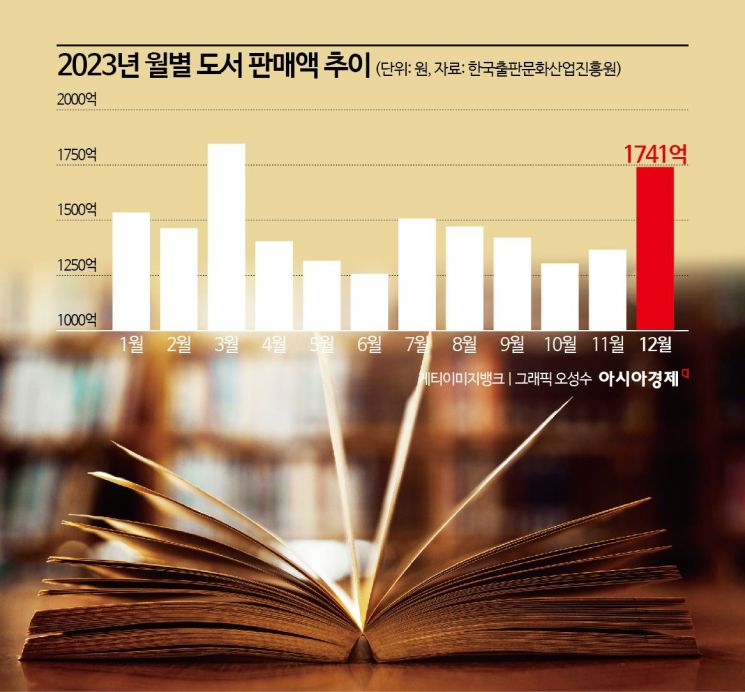
According to the Integrated Publishing Distribution Network operated by the Korea Publication Industry Promotion Agency, the month with the lowest book sales last year was June (125.7 billion KRW), followed by October (130.5 billion KRW), May (131.6 billion KRW), and November (137.9 billion KRW). Two of these four months with sales below 140 billion KRW, the lowest in the year, fall in autumn. The sales in September, the beginning of autumn, were also unimpressive at 142.1 billion KRW.
The month with the highest book sales was March, when the new school term begins, with sales amounting to 184.6 billion KRW. This was followed by December (174.1 billion KRW), January (153.5 billion KRW), and July (150.8 billion KRW). The situation was the same in 2022, with June sales at 99.4 billion KRW being the lowest, and October sales, representing the peak of autumn, at 116.8 billion KRW, the second lowest.
Considering this reality, the phrase 'autumn is the season of reading' is merely a facade. Despite low book sales in autumn, publishers emphasize it as the season of reading as a marketing tactic to boost sales during a slow season. Of course, the claim that autumn is a good season for reading has some merit. The weather is pleasant, neither too hot nor too cold, allowing for a comfortable atmosphere. The problem is that when the weather is nice, people prefer to go out rather than stay home and read.
The government also makes various efforts to encourage people to read in autumn. The 'Reading Culture Promotion Act' designates September as the 'Month of Reading' to promote book reading. To mark the Month of Reading, the Ministry of Culture, Sports and Tourism announced plans to hold about 10,000 reading culture events nationwide over the course of a month, focusing on libraries, 17 local governments, and education offices, each highlighting regional characteristics. Pohang City in Gyeongbuk, selected as the 'City of Books in Korea' this year, will host the 'Korea Reading Festival' from September 27 to 29, while the Daehak-ro area in Jongno-gu, Seoul, will hold a Literature Week event from September 27 to October 1. Kyobo Bookstore, the largest bookstore in Korea, has also launched autumn reading season marketing, including the '2024 All-Star Game: Discovery of Good Books,' where 20 books published from late last year to the first half of this year are selected and readers vote for the best among them.
Adults have long told children not to play but to read books in autumn. In the past agrarian society, autumn was a time to finish the year's farming and find peace of mind, so reading was encouraged. The association of autumn with reading actually originates from a poem called 'Fu Dushu Chengnan Shi (符讀書城南詩)' written by Han Yu during the Tang Dynasty in China to encourage his son to read. The poem includes the four-character idiom 'deunghwaga-chin (燈火可親),' meaning 'the lamp light is close and friendly,' interpreted as autumn being a season with cool, refreshing winds, making it ideal to sit close to a lamp and read.

Our body's hormones also change in autumn, making it easier to fall into contemplation. As daylight decreases in autumn, the production of vitamin D, synthesized through sunlight and ultraviolet rays, decreases. The serotonin hormone, related to vitamin D and associated with happiness, also naturally decreases, causing people to feel loneliness and calmness, increasing the desire to be close to books. However, is autumn only good for reading? It is also a season of abundant harvest, making it ideal for food trips, and a season to enjoy autumn foliage.
There is also an analysis that the reason autumn became known as the season of reading is due to Japanese colonial rule. During the 1920s, Japan emphasized the season of reading as part of its cultural rule to assimilate Koreans into Japanese culture by encouraging them to read books in Japanese. History lecturer Seol Min-seok said on tvN's 'These Days Bookstore: Reading for You' in 2019, "In 1925, Japan built libraries and forced our people to read Japanese books," adding, "The slogan used then was 'autumn is the season of reading.'"
Japan holds a campaign to promote reading centered around its public holiday, Culture Day (November 3), designating the two weeks from October 27 to November 9 as 'Reading Week' in late autumn. The origin of Reading Week is the United States, which has held 'Children's Book Week' during one week in November since 1919. Japan is said to have referenced this when establishing its own Reading Week.
© The Asia Business Daily(www.asiae.co.kr). All rights reserved.


















